

Testing
Industry Insight
Food and Agricultural Export Testing in Pakistan: The Certification Route
Food export testing in Pakistan: pesticide residues, aflatoxin, heavy metals and microbial limits, and the certification route buyers ask exporters to hold.

A food or agricultural consignment is judged at the destination border. The importing market's contaminant limits apply, not Pakistan's. That single fact explains most of the rejections recorded against rice, spices, nuts and processed foods leaving Pakistan.
It also explains why a test report on its own so rarely settles a buyer's question. The buyer should name the method, the limit and its legal basis before the order.
EU law names the hazards that stop food at the border, and the findings go public
Pesticide residues, mycotoxins, heavy metals, microbes and adulteration drive most food rejections. Regulation (EU) 2019/1793 names mycotoxins including aflatoxins, pesticide residues, pentachlorophenol and dioxins, and microbiological contamination. Annex I lists third-country products under a temporary increase of official controls. Annex II lists products under emergency measures, which carry stricter entry conditions.
The annexes show which combinations recur. Aflatoxin appears against groundnuts from listed countries, ochratoxin A against dried grapes from Turkey, and salmonella against sesame seeds from Ethiopia, Nigeria, Sudan and Uganda. Sudan dyes and Rhodamine B, colourants added to disguise poor quality, appear against palm oil and turnips.
Findings enter the public record through the Rapid Alert System for Food and Feed, which member states use under Article 50 of the General Food Law, and the public RASFF Window lets a buyer search them by product and country of origin. Deliberate adulteration runs through the separate EU Agri-Food Fraud Network.
Each contaminant class has its own test and its own limit basis
The limit basis is more important than the number, because the number depends on the product, the destination and the intended use.
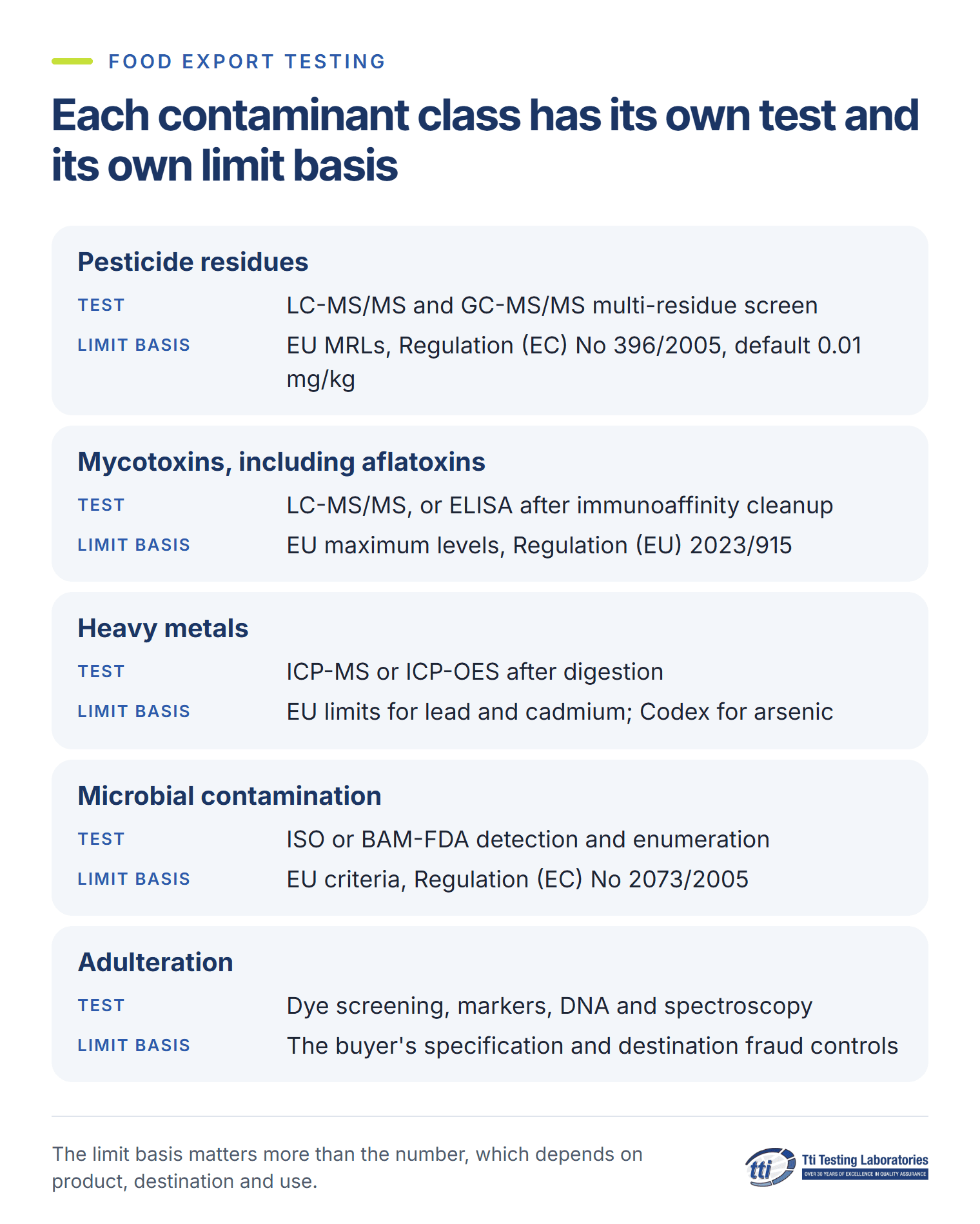
Contaminant class | Test | Limit basis |
|---|---|---|
Pesticide residues | LC-MS/MS and GC-MS/MS multi-residue screen | EU MRLs under Regulation (EC) No 396/2005, with a default of 0.01 mg/kg |
Mycotoxins, including aflatoxins | LC-MS/MS or ELISA after immunoaffinity cleanup | EU maximum levels under Regulation (EU) 2023/915 |
Heavy metals | ICP-MS or ICP-OES after digestion | EU limits for lead and cadmium, and Codex codes of practice for arsenic |
Microbial contamination | ISO or BAM-FDA detection and enumeration | EU criteria under Regulation (EC) No 2073/2005 |
Adulteration | Dye screening, markers, DNA and spectroscopy | The buyer's specification and destination fraud controls |
There is no single mycotoxin limit. Regulation (EU) 2023/915 sets aflatoxin limits for cereals, with higher limits for maize and rice that will be sorted before sale. It restricts aflatoxin B1 and the sum of B1, B2, G1 and G2 separately, covers ochratoxin A and fumonisins, and sets lead and cadmium limits by food category.
Microbiological criteria come in two kinds. Regulation (EC) No 2073/2005 defines food safety criteria, which decide whether a batch may be placed on the market, and process hygiene criteria, which show whether a line is under control. Salmonella, Listeria monocytogenes and E. coli appear in its annexes, and a failed food safety result requires withdrawal or recall.
EU pesticide limits follow European authorised uses, so a lawful Pakistani use can exceed them
EU maximum residue levels (MRLs) sit in Regulation (EC) No 396/2005, which the European Commission applies to all food and animal feed. The searchable set is in the EU pesticides database.
An MRL is not a safety threshold drawn from toxicology alone. The Commission's guidance on how MRLs are set explains that each level comes from Good Agricultural Practice, meaning an authorised safe use of a plant protection product, and that a member state and the European Food Safety Authority then assess the risk.
Where no MRL is listed for an active substance on a product, a default of 0.01 mg/kg applies, near the analytical floor for many older actives. An active that a Pakistani grower uses lawfully may have no EU MRL, so its residue is measured against that default. The same guidance states that identical MRLs apply to imported and domestically produced food, with no difference in enforcement.
A formal route exists for a different use pattern: Regulation 396/2005 defines an import tolerance as an MRL set for imported products to meet international trade needs.
Codex limits are not a substitute. The Codex pesticides database records 6,522 maximum residue limits adopted up to November 2025, and they apply at the point of entry in countries that adopt them, not automatically in the EU.
A test report covers one sample, and a certificate covers a site
A test report names the sample, the method, the parameter, the result, the limit and the date. It applies to the sample submitted and to nothing else.
A certificate comes from a certification body that has audited a producer against a scheme. It carries a scope and an expiry date, and it covers the site, not a specific lot.
Standards bodies don't certify. The ISO 22000:2018 page states that ISO does not perform certification, and that a certified organisation must find a third-party certifying body.
HACCP is a system. The FDA's HACCP guidelines describe a systematic approach with seven principles, covering biological, chemical and physical hazards from raw material to finished product. It is a way of working, not a document a body issues.
The buyer decides which certification scheme an exporter needs
A European retailer, an industrial processor and a Gulf importer ask for different evidence.
Scheme or system | What it is | Who issues it |
|---|---|---|
ISO 22000:2018 | Food safety management system standard integrating the Codex HACCP principles | A third-party certification body; ISO does not certify |
FSSC 22000 | Scheme built on ISO 22000, recognised through GFSI benchmarking | A licensed certification body |
BRCGS Food Safety | Certification programme for food safety supply chain assurance | A certification body under the BRCGS scheme |
HACCP | Seven principles applied inside a management system | No certificate; audited within a scheme |
Foundation FSSC states that ISO 22000 covers the HACCP principles according to the Codex Alimentarius, and that GFSI recognised the FSSC 22000 scheme through benchmarking. A retailer checks GFSI recognition by name. BRCGS publishes its food safety standard as one of a family of certification programmes.
Codex sits underneath. The Codex codes of practice index lists the General Principles of Food Hygiene, CXC 1-1969, revised in 2022, and texts on mycotoxins in cereals and spices.
A specification starts with the destination market, which sets the limit basis
Name each contaminant class, the method family that detects it, and the limit with the legal instrument behind it.
Name the sampling procedure. Without one, a result cannot be applied to a lot.
Require accreditation for the specific method, as a scope reference.
State the acceptance criteria and the action required on a failed result.
Place the specification before production, not after the container is booked.
Each shipment needs documents that prove the specification was met
Document | What it establishes | Source |
|---|---|---|
Test report or certificate of analysis | Result per parameter against a stated limit | An accredited laboratory |
Sampling and chain-of-custody record | That the sample represents the lot | Sampling party or laboratory |
Food safety management certificate | The site, scope and expiry of the scheme certificate | Licensed certification body |
Phytosanitary certificate | Plant health requirements | National plant protection organisation |
Official certificate and sampling results, where required | Entry conditions for goods under emergency measures | Exporting country's competent authority |
Container hygiene and cold-chain record | Condition and temperature history | Inspection body |
For goods under emergency measures, Regulation (EU) 2019/1793 also requires an official certificate, an identification code, and sampling results from the exporting country's competent authority. Customs releases the consignment only against a finalised Common Health Entry Document.
Tti Labs tests and inspects food exports, and a licensed certification body issues the certificate
Tti Labs' food and agriculture testing page lists:
Rice testing packages, with pesticide residue testing aligned to EU, UK, US, SFDA, Codex and Gulf MRL standards.
Plant-based goods such as cereals, legumes, spices and oils, and animal-based goods such as seafood, dairy and meat.
Six test families, from pathogen testing to nutritional analysis, shelf-life, contaminants and packaging safety.
Method standards from ASTM, AOAC, ISO and BAM-FDA.
Instruments including LC-MS/MS, GC/MS, ICP-OES, ICP-MS, HPLC and ELISA platforms.
A GC-MS/MS platform was added in 2025. The laboratory is a US IAC certified microbiology laboratory with ISO Class 5 and Class 7 environments, approved by the Punjab, KPK and Balochistan food authorities. Its reports are carried by ISO/IEC 17025 accreditation through PNAC, LAB-022, with food and agriculture inside the accredited scope. The wider service range is on the testing page.
Food inspection is separate. Tti Labs is an ISO/IEC 17020 accredited inspection body with PSQCA approval as an inspection agency. It runs pre-production, during-production and final random inspection, plus loading supervision, which covers container hygiene and cold-chain integrity.
Tti Labs does not certify a product or a management system, and it is not a food safety certification body.
Arrange food and agriculture testing and pre-shipment inspection through Tti Labs.
Related guides: Pharmaceutical Testing in Pakistan: What Manufacturers Outsource.
FAQ
Are EU pesticide limits stricter than Pakistan's?
Often, for structural reasons rather than intent. An EU maximum residue level comes from a European authorised use. Where none is listed, the 0.01 mg/kg default applies, and a lawful use in Pakistan can exceed it.
Which food safety certification does a Pakistani exporter need?
The buyer's market decides. FSSC 22000 and BRCGS are recognised through GFSI benchmarking and are commonly required by European retailers. ISO 22000:2018 is the standard underneath FSSC 22000.
How does a buyer verify a Pakistani food test report?
Check that the method and the parameter sit inside the laboratory's accreditation scope. Then confirm that the sample identification matches the goods and that each result carries a stated limit.
References
Accreditation scope LAB-022, Pakistan National Accreditation Council, https://pnac.gov.pk/pdfFiles/LAB-022
Food and agriculture testing, Tti Labs, https://ttilabs.net/food-agri
Analytical testing services, Tti Labs, https://ttilabs.net/testing
Accreditation and approvals, Tti Labs, https://ttilabs.net/accreditations/
Regulation (EC) No 396/2005 on maximum residue levels of pesticides in or on food and feed of plant and animal origin, EUR-Lex, https://eur-lex.europa.eu/eli/reg/2005/396/oj
Regulation of pesticide residues in the EU: questions and answers, European Commission, https://food.ec.europa.eu/plants/pesticides/maximum-residue-levels/qas-pesticides_en
EU pesticides database: maximum residue levels, European Commission, https://ec.europa.eu/food/plant/pesticides/eu-pesticides-database/start/screen/mrls
Commission Regulation (EU) 2023/915 on maximum levels for certain contaminants in food, EUR-Lex, https://eur-lex.europa.eu/eli/reg/2023/915/oj
Commission Regulation (EC) No 2073/2005 on microbiological criteria for foodstuffs, EUR-Lex, https://eur-lex.europa.eu/eli/reg/2005/2073/oj/eng
Commission Implementing Regulation (EU) 2019/1793 on the temporary increase of official controls and emergency measures, EUR-Lex, https://eur-lex.europa.eu/eli/reg/2019/1793/oj
Rapid Alert System for Food and Feed (RASFF), European Commission, https://food.ec.europa.eu/food-safety/rasff_en
RASFF Window public notification search, European Commission, https://webgate.ec.europa.eu/rasff-window/screen/search
The EU Agri-Food Fraud Network, European Commission, https://food.ec.europa.eu/food-safety/eu-agri-food-fraud-network_en
Codex Pesticides Residues in Food Online Database, FAO and WHO, https://www.fao.org/fao-who-codexalimentarius/codex-texts/dbs/pestres/en/
Codex Alimentarius codes of practice, FAO and WHO, https://www.fao.org/fao-who-codexalimentarius/codex-texts/codes-of-practice/en/
ISO 22000:2018 Food safety management systems: requirements for any organization in the food chain, International Organization for Standardization, https://www.iso.org/standard/65464.html
Foundation FSSC and the FSSC 22000 certification scheme, Foundation FSSC, https://www.fssc.com/
BRCGS Food Safety standard, BRCGS, https://www.brcgs.com/our-standards/food-safety/
HACCP principles and application guidelines, U.S. Food and Drug Administration, https://www.fda.gov/food/hazard-analysis-critical-control-point-haccp/haccp-principles-application-guidelines
Recommended reading

Inspection
The Pakistan QC Data Barometer: Reading Defect Data Properly

Compliance
What Product Recalls Teach Pakistan Exporters

Inspection
Marketplace Trade Assurance vs Inspection in Pakistan

Inspection
Sialkot Sports Goods QC: What Buyers Specify


ISO/IEC 17025 ACCREDITED
Testing, inspection and certification for Pakistani exports.

Textiles & Apparel
Denim quality control in Pakistan: shade banding, wash variation, leg twist and shrinkage, stage by stage, and the test methods that prove each result.

Pharmaceutical
Which pharmaceutical and nutraceutical tests Pakistani manufacturers outsource, why, and what a buyer or auditor should verify in a contract laboratory.

General
Lab testing for Pakistan exports: ISO/IEC 17025 scope, CPSC accepted status, REACH and PFAS methods, and how buyers verify a Pakistani lab test report.