

Inspection
Blog
Production Monitoring in Pakistan: Prevent Late Shipments
How production monitoring in Pakistan catches schedule slippage before a shipment misses its vessel, and the reporting discipline that makes it all work.

Goods that pass every inspection can still miss the vessel. Inspection asks whether the product conforms. Production monitoring asks whether the order will finish on time, and answers it by checking output, capacity and materials against a written plan on a fixed cadence.
In Pakistan the causes of slippage repeat: peak-season capacity, power interruptions, material lead times, subcontractor queues, single-line dependency and late buyer approvals. Each one shows a signal weeks before the vessel sails.
Inspection checks the product at milestones, and monitoring follows the schedule
Buyers often book one expecting the other. An inspection is a spot check against a specification, taken at a point in the run. A production monitoring programme is a recurring check against a plan: it verifies production status and raw material inventory, and follows the schedule across the whole order.
Tti Labs' softlines cycle places inspection stages at fixed milestones (inspection services): sample picking, pre-production, during-production inspection at 30 to 60 percent, pre-final, pre-shipment, full check and loading supervision. Each stage ends in a conformance verdict. A during-production inspection also reports production status, with quantities of semi-finished and packed goods and a predicted completion date (QIMA's DUPRO checks). Monitoring repeats that status line on every visit, which turns one reading into a trend.
Production monitoring | Quality inspection | |
|---|---|---|
Question answered | Will the order finish on time? | Does the product meet specification? |
What it watches | Schedule, output, capacity and materials | Conformance, workmanship and measurements |
Cadence | Recurring through the run | Fixed production milestones |
Decision it supports | Resequence, split, substitute, rebook | Accept, rework or reject the lot |
Failure it catches | A late shipment | Non-conforming goods |
A late shipment is a schedule failure that quality control cannot see
A shipment can be flawless and still arrive after the selling season. Quality control cannot see that outcome, because the goods never failed a test. The schedule did.
The cost sits with the buyer. Late shipments carry possible rework costs and a loss of sales, and a missed season turns directly into lost revenue (Grosskord's buyer problem list). A missed vessel is rarely the first warning. It is the last event in a sequence that started weeks earlier on the factory floor.
Structured inspection does improve delivery. One apparel exporter cut product rejections by 38 percent over six months after inline checks and final random inspection, and reported better delivery timelines alongside the quality gain. That gain came through quality. Inspection still says nothing about when a given order will sail.
Six causes of slippage recur in Pakistan, and each gives an early signal
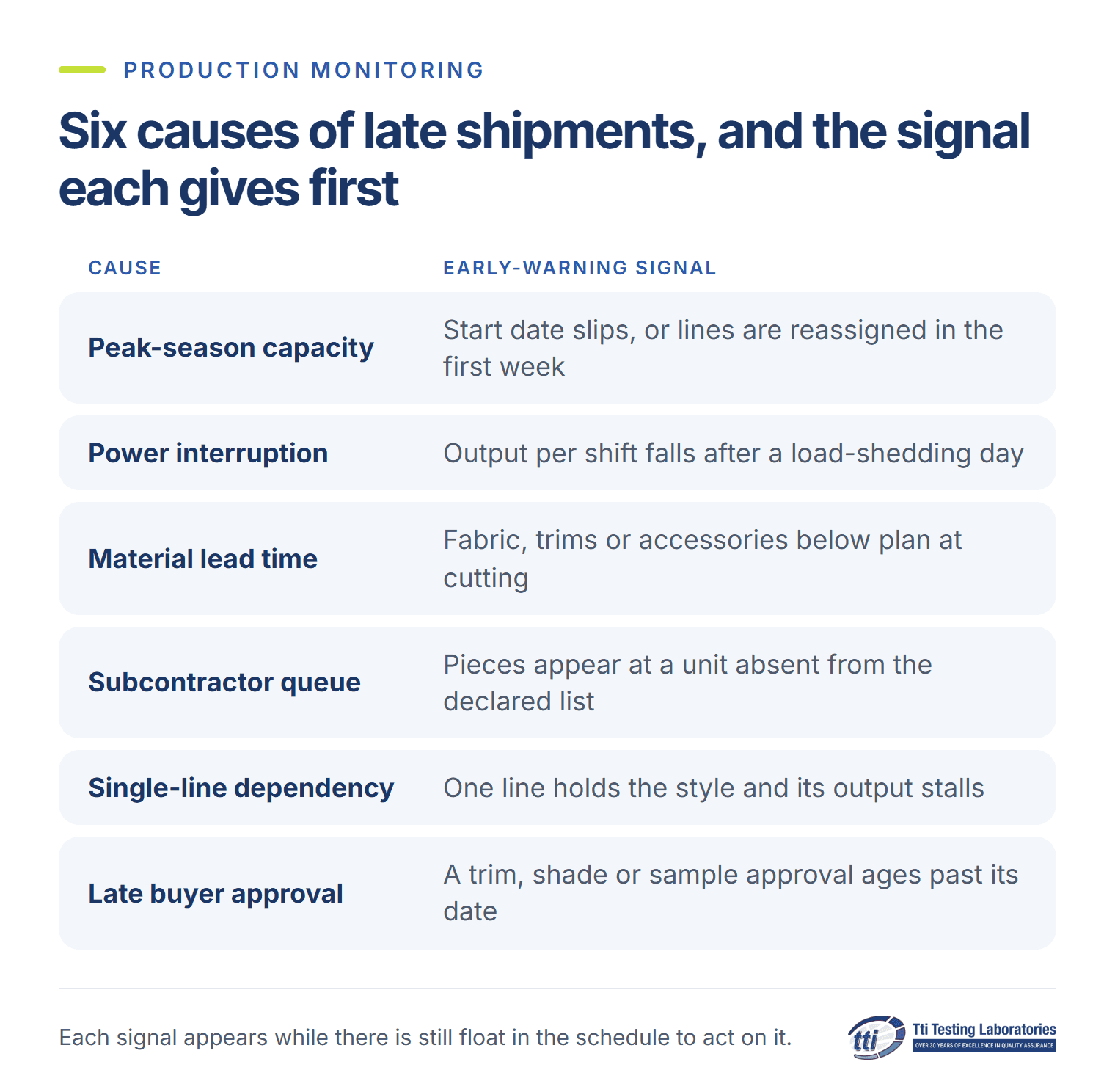
In peak season, order calendars cluster and several buyers book the same factory for the same window. The plan then assumes more line capacity than the factory holds, and the first sign is a start date that slips in week one.
Inspectors report power supply inconsistencies affecting output across workshops of different maturity.
Material lead times run through other units. Many garment factories don't weave: they buy fabric and subcontract dyeing and finishing to separate units, so the processing chain decides timing as much as the sewing floor does. A dye house queue is a hidden lead time.
When volume exceeds capacity, work moves to stitching units the buyer did not approve, and the practice is more common than buyers assume. The second unit is not on the plan, so its queue adds days silently.
If one line carries an entire style, any stoppage is total. A capacity check against remaining volume tests whether the plan is deliverable at all.
Trims, shades and size-set samples need a buyer decision before the run can proceed, and a monitoring programme follows those approvals as closely as output. A communication gap on production details becomes a shipment delay (Grosskord).
Early gaps are cheap to close, so monitoring runs on a fixed cadence
The factory holds a plan of record, and each visit measures actual output against it. A small gap found early is cheap to close. The same gap at packing is a missed vessel.
Cadence is what separates monitoring from a one-off check. Consistent monitoring over a period, such as weekly, produces a more precise timeline. The cadence matches the risk, and a complex order needs more visits than a simple one.
Port conditions add a second source of delay. Even a factory that finishes on time must still catch the vessel, and Karachi congestion brings its own delays from import surges, limited terminal capacity, documentation and customs processing, and inland bottlenecks (Globalia Logistics Network). The capacity base is strained too: 187 of 568 textile mills were reported shut during the energy crisis (Pakistan Today). Monitoring saves days at the factory, and those days offset delays at the port and from the grid.
A written baseline and one report format make the visits comparable
Monitoring fails when it is improvised. Booking fixes the plan of record before production starts: the buyer and factory agree the ship date, the cargo cut-off, the lines and shifts assigned, the declared unit list and the escalation contact. Without a written baseline, a later visit has nothing to measure against.
Reporting runs to one fixed format, so two visits can be compared. Each report carries the same fields, in writing, with photographs.
Field | What it records | Why it matters |
|---|---|---|
Output to date | Units complete against plan, by line and process | Turns a claim of progress into a number |
Materials on hand | Fabric, trims and accessories against the bill of materials | Shows lead-time risk before a line stops |
Capacity check | Declared lines and shifts against remaining volume | Tests whether the plan is deliverable |
Slippage flag | Gap between plan and actual, with the cause | Creates the early warning |
The report is a record both sides acknowledge. A flagged gap with a named cause gives the buyer a decision while float remains.
Monitoring reports progress and cannot make a factory run faster
Monitoring does not create capacity, and it does not fix quality. QIMA states that production monitoring does not control product quality or corrective action plans, and recommends pairing it with a during-production inspection for that reason.
What monitoring gives the buyer is time and information: the days to resequence an order, split a style, approve a substitute, rebook a vessel or accept a partial shipment. The buyer makes that decision. Monitoring's job is to raise the warning while those options are still open.
What Tti Labs offers for production monitoring in Pakistan
Tti Labs runs inspection through Tti Inspections Pvt Ltd, an ISO/IEC 17020-accredited body listed on the PNAC active inspection bodies register. The eight-stage softlines cycle covers the run from sample picking to loading supervision, inside a wider textiles and apparel programme.
During-production inspection at 30 to 60 percent completion, reporting production status, quantities and process condition alongside conformance.
Pre-shipment inspection at the packed stage, to confirm the lot before the vessel.
Monitoring visits that can follow a fixed cadence through the run, with the same report fields each time.
Laboratory backup under ISO/IEC 17025 testing where a mid-run material question needs evidence. The laboratory holds PNAC accreditation under LAB-022.
Booking and coordination through Tti Labs contact points, UAN 111 786 001.
Tti Labs observes and reports. It does not rework goods, coach a line to a pass, or push a factory to run faster.
Book production monitoring and inspection with Tti Inspections Pvt Ltd. UAN 111 786 001. See the slip before the vessel sails.
FAQ
Can a shipment pass every inspection and still be late?
Yes. Quality and schedule are separate facts. A lot can meet its standard and still leave after the cargo cut-off, because the delay came from capacity, materials or power.
How often should production be monitored?
As often as the risk calls for. A simple order may need a mid-run visit. A complex order benefits from recurring checks, such as weekly visits, because a single check is only a snapshot.
Does production monitoring improve product quality?
Not directly. Monitoring reports status and schedule, and it does not control quality or corrective action. Quality belongs to inspection and laboratory testing, so pair them: monitoring for the schedule, inspection for conformance.
References
Production monitoring (delivery schedule control, weekly cadence, capacity feasibility, raw-material lead times), QIMA, https://www.qima.com/consumer-products/production-monitoring
During production inspection (DUPRO) and in-line inspection (production status, quantities, estimated capacity, predicted completion date), QIMA, https://www.qima.com/consumer-products/during-production-inspection
Apparel production monitoring program (progress follow-up, approvals, on-site visits, regular reporting), Sofeast, https://www.sofeast.com/quality-assurance/apparel-production-monitoring-program/
Buyer problem list (late shipments, loss of sales, communication gap on production details), Grosskord, https://www.grosskord.com/
Sourcing agent Pakistan (subcontracting prevalence, irregular supplier updates, shipment delays), Uniway Sourcing, https://uniway-sourcing.com/sourcing-agent-pakistan/
Pre-shipment inspection in Pakistan (power supply inconsistencies, workshop quality variance), Tetra Inspection, https://tetrainspection.com/pre-shipment-inspection-in-pakistan/
Container congestion challenges at Port of Karachi and what forwarders should know, Globalia Logistics Network, 16 Mar 2026, https://blog.globalialogisticsnetwork.com/2026/03/16/container-congestion-challenges-at-port-of-karachi-and-what-forwarders-should-know
High electricity costs push 187 textile mills to shut down, Profit by Pakistan Today, 24 Jan 2025, https://profit.pakistantoday.com.pk/2025/01/24/187-mills-stop-operation-across-country-textile-sector-in-crisis
Inspection services (eight-stage softlines cycle, during-production inspection at 30 to 60 percent, loading supervision), Tti Labs, https://ttilabs.net/inspection
Analytical testing services (ISO/IEC 17025 accredited testing), Tti Labs, https://ttilabs.net/testing
Textiles and apparel testing programme, Tti Labs, https://ttilabs.net/textiles-apparel
Contact and booking, Tti Labs, https://ttilabs.net/contact
Active inspection bodies register (certificate IB-006, Tti Inspections Pvt Ltd), Pakistan National Accreditation Council, https://www.pnac.gov.pk/index.php/Accredited-Cabs-serve/Inspection-Bodies/Active
Accreditation scope LAB-022 (ISO/IEC 17025:2017, valid to 8 Aug 2027), Pakistan National Accreditation Council, https://pnac.gov.pk/pdfFiles/LAB-022
Recommended reading

Inspection
The Pakistan QC Data Barometer: Reading Defect Data Properly

Compliance
What Product Recalls Teach Pakistan Exporters

Inspection
Marketplace Trade Assurance vs Inspection in Pakistan

Inspection
Sialkot Sports Goods QC: What Buyers Specify


ISO/IEC 17025 ACCREDITED
Testing, inspection and certification for Pakistani exports.
General
Why defect-rate benchmarking matters to buyers sourcing from Pakistan, what a barometer measures, and how to read one without reacting to normal variation.
General
Marketplace badges verify a seller, not a shipment. See what trade assurance covers, what only a pre-shipment inspection proves, and what to ask first.
General
Sialkot sports goods QC for buyers: football sphericity and weight tolerances, glove EN 388 tests, inflatable leak checks, and how AQL sampling applies.