

Sustainability
Blog
CSRD and VSME Questionnaires for Pakistani Suppliers
European buyers push CSRD and VSME questionnaires to Pakistani suppliers. Which module applies, what each pillar asks, and how to answer a data gap honestly.

CSRD binds the European buyer, not its Pakistani supplier. The buyer's report still needs value-chain data, so the request reaches your factory as a questionnaire that can ask for data you have never been asked to record.
VSME, a voluntary EFRAG standard, exists to keep that request proportionate. Which of its two modules applies depends on the supplier's size and the buyer's reporting duty. Where a figure is missing, a stated gap with an owner and a closure date survives an audit better than an invented one.
A buyer's CSRD report needs supplier data, so the request trickles down the value chain
The Corporate Sustainability Reporting Directive obliges large and listed companies to publish reports on their environmental and social impacts. The European Commission describes those reports as covering the risks a company faces and the effects of its activities on people and the environment.
A report of that kind needs value-chain data, and the Commission Recommendation on the VSME names the mechanism, a trickle-down effect in which in-scope companies request sustainability information from undertakings in their value chain. A Pakistani supplier with no European listing sits at the receiving end.
The buyer must disclose supply chain emissions and social risk, and its auditor will test the data behind those disclosures. Procurement needs a record before the next order. All three reach you as the same questionnaire.
The legal duty stops with the buyer, and a value-chain cap limits what it can ask for
CSRD applies to large and listed companies, which report under the European Sustainability Reporting Standards that EFRAG develops.
To protect smaller firms, the Directive set a value-chain cap. The reporting standards may not require a buyer to obtain more information from an SME than the proportionate standard for listed SMEs would disclose. The Recommendation restates the cap and asks in-scope companies to keep supplier requests within the VSME.
What arrives at your gate is a data request, a code annex and a deadline.
VSME is voluntary, and suppliers outside the EU may use it
VSME stands for the Voluntary Sustainability Reporting Standard for non-listed SMEs. EFRAG developed it under a mandate from the European Commission, as part of the 2023 SME Relief Package, and delivered it in December 2024. On 30 July 2025 the Commission endorsed it by adopting Recommendation (EU) 2025/1710.
The VSME standard is voluntary and carries no legal authority. It is written for non-listed micro, small and medium undertakings outside CSRD scope, though it stays aligned with the European Sustainability Reporting Standards and covers the same environmental, social and governance topics.
It is built to answer the data requests that banks, investors and corporate clients send. The Commission's announcement states that SMEs and micro-undertakings in third countries may use it on a voluntary basis, so a Pakistani supplier can answer a European form in the disclosure terms the buyer already recognises.
The Basic Module is the minimum, and the Comprehensive Module builds on it
The Basic Module holds disclosures B1 and B2 plus metrics B3 to B11. The Comprehensive Module adds datapoints C1 to C9. It can't stand alone: applying the Basic Module is a prerequisite.
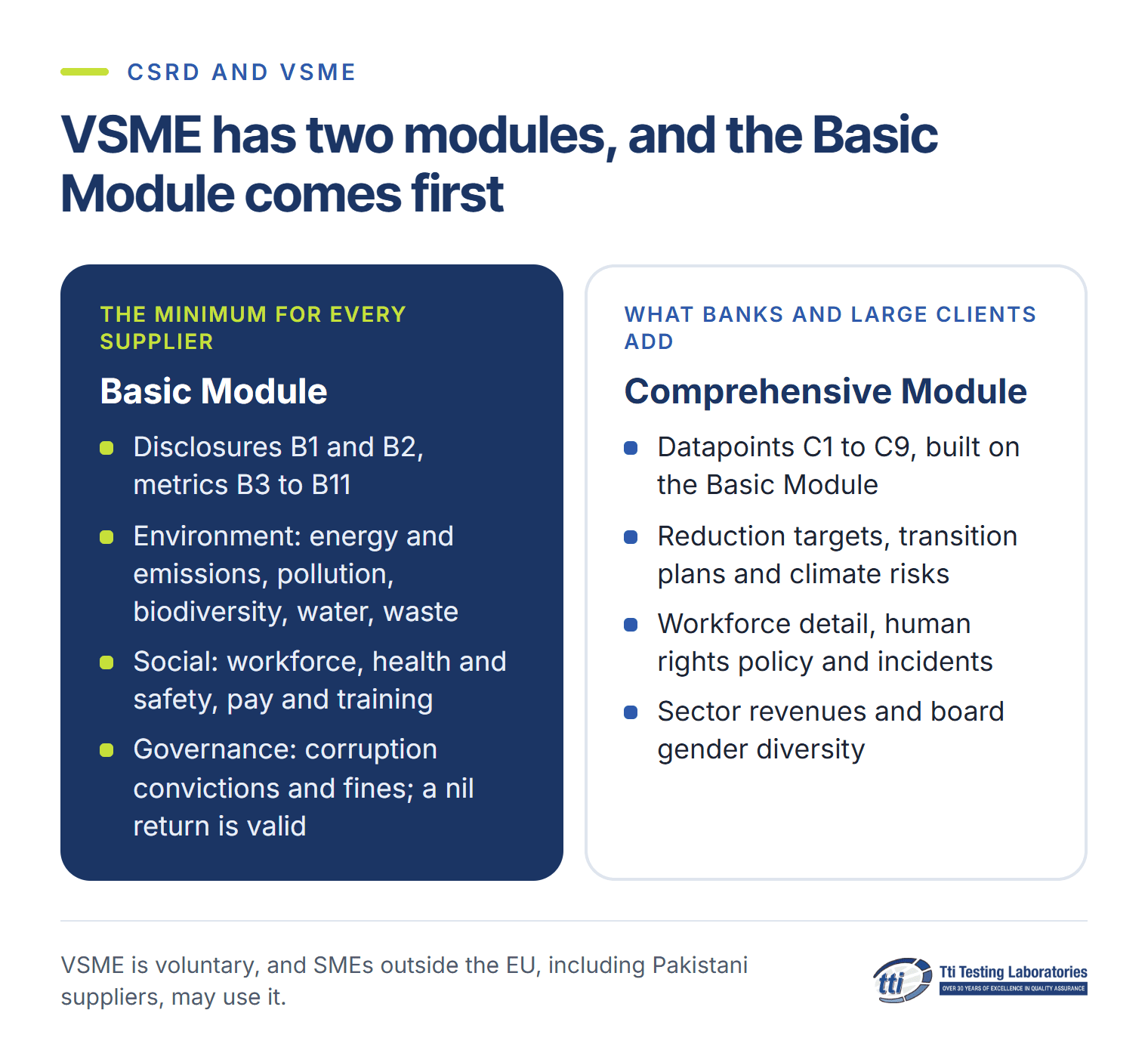
The Basic Module is the target approach for micro-undertakings and the minimum for everyone else, while the Comprehensive Module holds the datapoints that banks, investors and corporate clients tend to request beyond it. A supplier declares which option it follows: Basic only, or Basic plus Comprehensive.
Typical supplier profile | What the buyer usually requests | Module that fits | What it means in practice |
|---|---|---|---|
Micro unit, under 10 staff | A short form from one buyer | Basic Module only | B1 to B11, the target approach for micro-undertakings |
Small supplier, 10 to 49 staff | A core-metric questionnaire | Basic Module as the minimum | B1 to B11, with the Comprehensive Module optional |
Medium supplier, 50 to 249 staff | A bank or large corporate client request | Basic plus Comprehensive | Adds targets, climate risk and management ratios |
Non-EU supplier to a CSRD reporter | A request aligned to VSME | Basic plus Comprehensive where sought | Third-country SMEs may use the standard voluntarily |
Supplier with a verified baseline | Fewer repeat requests | Publish once, reuse | One report answers several buyers |
The environmental metrics ask for energy by source and emissions by scope
The Basic Module's environmental metrics are B3 to B7. They cover energy and greenhouse gas emissions; pollution of air, water and soil; biodiversity; water; and resource use, circular economy and waste.
Energy is reported in megawatt hours, split between renewable and non-renewable sources. Emissions are reported as Scope 1 and location-based Scope 2, in tonnes of carbon dioxide equivalent, with a greenhouse gas intensity figure per unit of turnover. A buyer that consolidates your number into a Scope 3 Category 1 line needs the method behind it as well as the total.
The Comprehensive Module adds C3 on reduction targets and climate transition and C4 on climate risks. Both ask for forward-looking content: a target year, a base year and a plan.
The social metrics cover workforce, safety and pay, and a nil corruption return is a valid answer
The Basic Module's social metrics are B8 to B10: workforce characteristics, health and safety, and remuneration, collective bargaining and training. A supplier with 50 or more employees also reports staff turnover for the period.
The governance metric is B11, the number of convictions and the total fines for corruption and bribery. If there are none, a nil return is a complete and valid answer.
The Comprehensive Module goes further. C5 adds workforce detail and a management gender ratio for larger employers. C6 asks whether you hold a code of conduct or human rights policy and a complaints mechanism. C7 covers severe negative human rights incidents in your own workforce, and awareness of such incidents in the value chain. C8 and C9 cover sector revenues and gender diversity in the governance body.
Factories hold the source records and usually lack the calculated metric
Most factories already keep payroll, permits and utility bills as ordinary business records. What they usually lack is a calculated metric with a stated method and a named boundary.
VSME area | Common question | Evidence a Pakistani supplier can usually produce |
|---|---|---|
Energy (B3) | Total energy use by source | Utility bills, fuel purchase records and captive generation logs |
Emissions (B3) | Scope 1 and location-based Scope 2 | Calculated only if asked before; needs emission factors and a method |
Water (B6) | Withdrawal and consumption, high-stress sites | Permit records, meter readings and borehole logs |
Waste (B7) | Waste by type, hazardous and non-hazardous | Internal logs; hazardous manifests are often incomplete |
Workforce (B8) | Headcount by contract type and gender | Payroll and HR records |
Health and safety (B9) | Recordable accidents and fatalities | First-aid and incident registers, often under-reported |
Remuneration (B10) | Minimum wage, pay gap and bargaining coverage | Wage registers; bargaining coverage is usually low |
Anti-corruption (B11) | Convictions and fines | A nil return is normal and acceptable |
Human rights (C6, C7) | Policy and incidents | A code of conduct; incident data rarely tracked by theme |
Targets (C3) | Absolute reduction target and base year | Rare without a prior, verified inventory |
When a figure doesn't exist, state the gap with an owner and a closure date
Not applicable, not measured and not yet available are different answers. Not applicable means the disclosure does not fit your operations, and the standard treats it as absent. Not measured means you have the activity but no figure. Not yet available means the figure exists and needs work.
A stated gap is a strong answer when it carries three parts: the missing data, a named owner and a closure date. A buyer reads that as a working system, and a reviewer testing a self-declared report treats an open finding with a plan differently from a blank field.
Don't substitute an estimate for a measurement. An unsupported number behaves like a warranty. If a later audit, a worker interview or a laboratory result contradicts it, you have breached a representation rather than missed a target. The exposure from unverified supplier data sits with the buyer's auditor first, and comes back to the supplier as a commercial consequence.
So report what you measured, name the method and the boundary, flag what you did not measure, and date the plan to close it.
Tti Labs produces the audit, testing and monitoring records behind an answer
Factory and supplier assessments through Tti Inspections Pvt Ltd, an ISO/IEC 17020 accredited inspection body.
Wastewater and effluent testing under ISO/IEC 17025 accreditation, held under PNAC LAB-022, which can back an environmental answer.
Supplier mapping, due diligence, supplier ESG audits and corrective action plans through the Sustainability Center.
Chemical management work and certification support covering ZDHC MRSL v3.1 conformance at Level 1 and 2, alongside CE and UKCA facilitation.
Where an answer needs analytical backing, accredited testing produces the record that supports it. Tti Labs does not decide whether a buyer has met its reporting duty.
Ask the Tti Sustainability Center for supplier ESG audit and GHG inventory support. Mapping, corrective action plans and verified data in one evidence trail for buyer questionnaires.
FAQ
Do Pakistani suppliers have to follow CSRD?
No. The Directive binds large and listed companies, not a Pakistani supplier directly. A supplier meets it as a buyer questionnaire, a code annex and a corrective action deadline.
Is VSME mandatory for a Pakistani exporter?
No. It is voluntary, and its value is practical. The Commission asks in-scope companies to keep supplier requests within the VSME, so a VSME-shaped answer is easier to accept and to reuse.
Which module applies to a small Pakistani supplier?
The Basic Module, which is the minimum for a small undertaking and the target approach for a micro one. A buyer usually requests the Comprehensive Module only when its own reporting or its bank needs the extra datapoints.
References
Directive (EU) 2022/2464 as regards corporate sustainability reporting, EUR-Lex, https://eur-lex.europa.eu/eli/dir/2022/2464/oj/eng
Corporate sustainability reporting, European Commission, https://finance.ec.europa.eu/financial-markets/company-reporting-and-auditing/company-reporting/corporate-sustainability-reporting_en
Commission Recommendation (EU) 2025/1710 on a voluntary sustainability reporting standard for small and medium-sized undertakings, EUR-Lex, https://eur-lex.europa.eu/eli/reco/2025/1710/oj/eng
SMEs and sustainability reporting, EFRAG, https://www.efrag.org/en/smes-and-sustainability-reporting
EFRAG Voluntary Sustainability Reporting Standard for non-listed SMEs (VSME), EFRAG, https://xbrl.efrag.org/e-esrs/2024-12-17-efrag-vsme.xhtml
Commission presents voluntary sustainability reporting standard to ease burden on SMEs, European Commission, https://finance.ec.europa.eu/publications/commission-presents-voluntary-sustainability-reporting-standard-ease-burden-smes_en
Sustainability services, Tti Labs, https://ttilabs.net/sustainability/
Testing services, Tti Labs, https://ttilabs.net/testing
Inspection services, Tti Labs, https://ttilabs.net/inspection
Certification services, Tti Labs, https://ttilabs.net/certification
Accreditation scope LAB-022 (ISO/IEC 17025:2017, first granted 13 May 2006, valid to 8 August 2027), Pakistan National Accreditation Council, https://pnac.gov.pk/pdfFiles/LAB-022
Recommended reading

Inspection
The Pakistan QC Data Barometer: Reading Defect Data Properly

Compliance
What Product Recalls Teach Pakistan Exporters

Inspection
Marketplace Trade Assurance vs Inspection in Pakistan

Inspection
Sialkot Sports Goods QC: What Buyers Specify


ISO/IEC 17025 ACCREDITED
Testing, inspection and certification for Pakistani exports.

Textiles & Apparel
How a product carbon footprint is built for Pakistani textiles: the life cycle stages, the activity data a mill must record and the data quality buyers test.

Textiles & Apparel
ZDHC wastewater testing for Pakistan denim mills and laundries: MRSL conformance levels, effluent parameters, discharge categories and the buyer evidence route.

Textiles & Apparel
Cotton and wet processing both draw on basins already under structural water pressure. Here is what buyers should actually ask about it.