
Certification
Industry Insight
Sialkot Surgical Instruments QC: Defects and the 13485 Route
Sialkot surgical instrument QC for buyers: the jaw-alignment and material-substitution defects, batch certificate checks, and the ISO 13485 certification route.

An 8 percent saving on Sialkot forceps ended in a 22 percent rejection rate. The 3,000 hemostatic forceps reached the importer's French warehouse with inconsistent jaw alignment, a fault caught only after the goods had shipped.
Most Sialkot surgical instrument failures are procedural, and so are the fixes. Jaw misalignment and substituted steel account for the shipments buyers reject. A material certificate for every batch before production, plus inspection at the factory, catches both. The ISO 13485 certificate is a separate route, and it comes from an accredited certification body.
A French importer found the misaligned jaws six months after switching to a cheaper supplier
A European importer moved a hemostatic forceps order to a new Sialkot supplier at 8 percent below its long-term partner. Six months later, 3,000 pieces arrived at the French warehouse with inconsistent jaw alignment. The rejection rate was 22 percent, and the saving went on rework, delayed deliveries and damage to the buyer's own customer relationships.
Sarfraz Ali of SA Audit tells the story in "Lessons from representing a European importer in Pakistan for over a decade". It is one auditor's account of one order. He spent more than a decade as the on-ground agent for a French surgical instruments importer, and he is blunt about distance: "If you are a European buyer sourcing from Pakistan without local representation, you are flying blind." Sialkot makes the instruments. Quality is lost or won between the cluster and the buyer's warehouse, and inspection closes that distance.
Misaligned jaws and substituted steel sink most shipments, and both can be caught at the factory
These two failures account for most Sialkot shipments that reach a buyer in poor condition, and both can be stopped before the goods leave Pakistan.
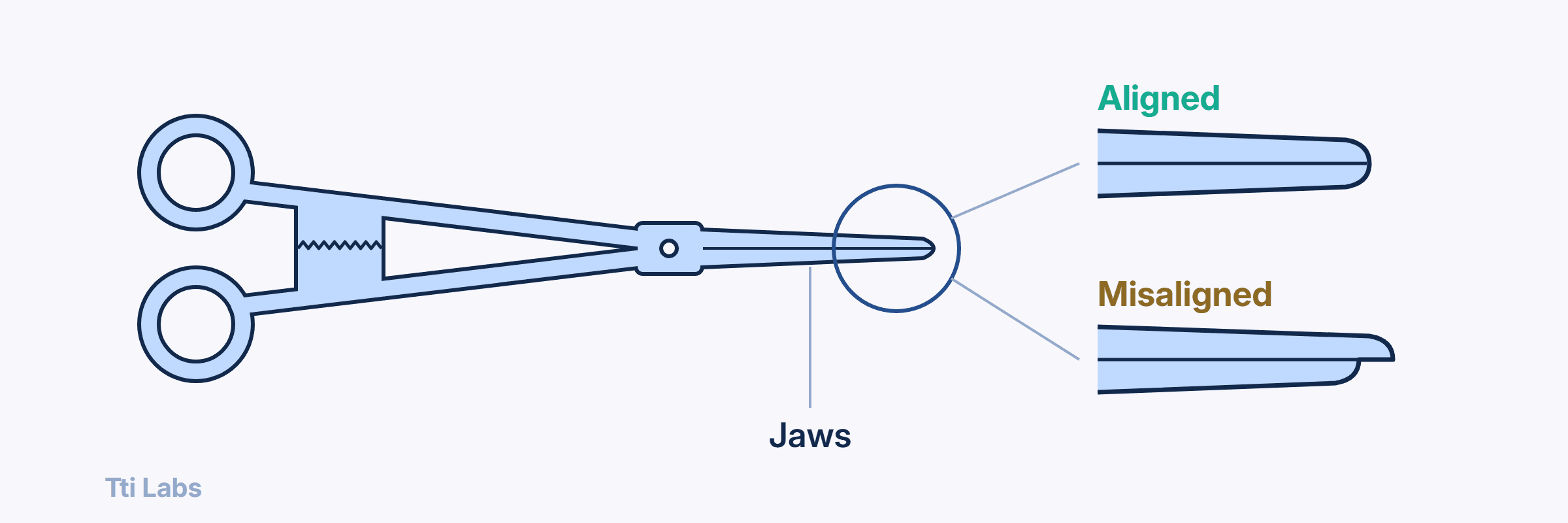
Forceps, needle holders and scissors depend on how their working ends meet. An inspector at the factory catches the fault the French importer found too late, with a closing test on sampled pieces. It's a standard final random inspection check.
Material substitution shows up later. Sarfraz Ali reports seeing workshops mix low-grade local material with surgical stainless steel to cut costs ("Five red flags when selecting a new surgical instruments supplier in Pakistan"), and those instruments corrode after three autoclave cycles. Because the corrosion appears after sterilization, the buyer finds it once the goods are in stock or in use, and no visual check at packing catches it. Two things do: batch material certificates before production, and corrosion-resistance testing of samples.
Defect | When it is found | What stops it |
|---|---|---|
Jaw misalignment | Final inspection, closing test on samples | AQL sampling at the factory before dispatch |
Material substitution | After autoclaving, at the buyer's site | Batch material certificates plus sample testing |
A material certificate for every batch is the strongest check a buyer has before production
Sarfraz Ali's rule is "Request material certificates for every batch before production starts. No certificate, no order." A certificate binds the workshop to a stated material before cutting starts. Without one, the buyer is left negotiating chemistry after the instruments already exist, and that negotiation always favours whoever holds the goods.
Certificates direct testing; they don't replace it. A certificate states what the batch should be, and testing confirms whether the delivered pieces match. Mechanical strength and dimensional verification check the certificate's promise on the finished instrument.
Four parties share the ISO 13485 route, and none of them delivers all of it
ISO 13485 is the quality management standard buyers ask Sialkot vendors about. The International Organization for Standardization publishes it, but ISO certifies no one itself, as its certification explainer states. The certificate belongs to the vendor.
What the buyer needs | Who provides it |
|---|---|
A vendor quality system certified to ISO 13485 | An accredited certification body |
Instruments tested to the applicable product standards | Tti Labs laboratory under ISO/IEC 17025 |
Inspected lots with recorded results | Tti Labs inspection under ISO/IEC 17020 |
CE marking for the EU market | The manufacturer, with a Notified Body for the reuse aspects of reusable instruments (EU MDR) |
Suppliers often struggle to move from ISO 9001 to ISO 13485, because the rigour differs (SGS North America).
Five steps qualify a Sialkot vendor, and inspection and testing are steps 2 and 3
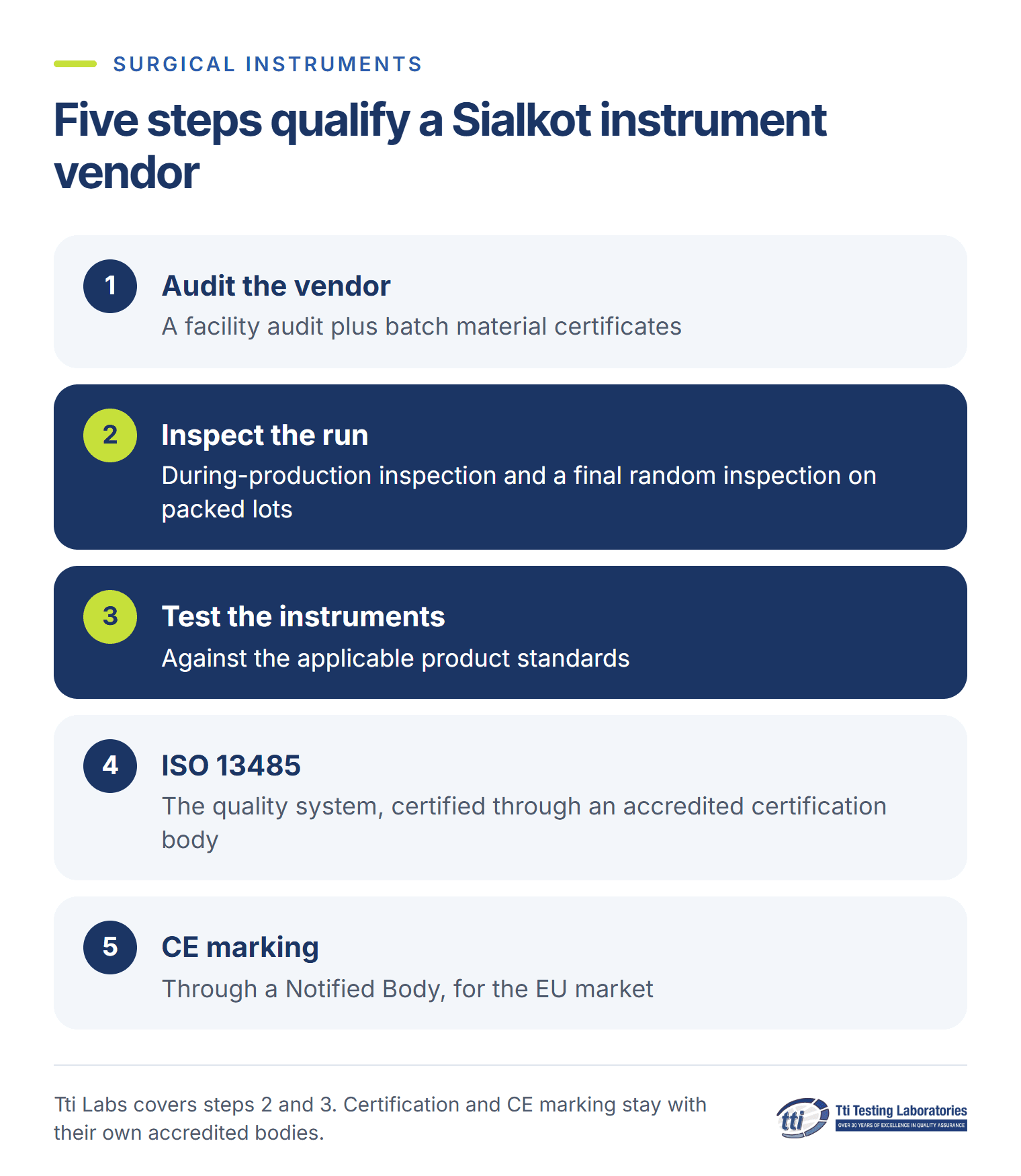
Tti Labs covers steps 2 and 3. Certification stays with an accredited certification body, and CE marking with the manufacturer and its Notified Body. For the French importer, step 2 is where the misaligned jaws would have turned up: at the factory, before dispatch.
What Tti Labs inspects and tests for surgical instrument buyers
Tti Labs' surgical devices work runs in its Medical Testing and Biocompatibility Laboratory, set up in 2020, with its test scope published on the surgical devices page. The instrument scope covers curettes, ear cannula, forceps, needle holders, probes and directors, retractors, scalpels and scissors. Surgical PPE covers masks, gowns, drapes, gloves and coveralls.
Final random inspection of surgical lots at AQL C:0, Mj:2.5, Mi:4.0, Level II, from the Sialkot office, which puts inspectors near the cluster.
A 100 percent full check for high-risk consignments where sampling is not enough.
During-production inspection to catch drift before packing.
Surgical devices testing: sterility, bacterial endotoxin, bioburden, extractables and leachables, residual analysis, elemental impurities, container closure integrity, mechanical strength and dimensional verification.
Test reports for the manufacturer's technical documentation on the CE route. The Tti Labs Notified Body partnerships under Module B cover PPE under Regulation (EU) 2016/425, not the EU MDR route for instruments.
Supplier audits that verify the vendor behind the instruments.
Tti Labs does not issue ISO 13485 certification or CE marking. Its sterility, bioburden and endotoxin testing, together with the buyer's own autoclave history, is evidence of sterilization compatibility. Sterilization validation is a separate exercise that the manufacturer performs against ISO 11135 or ISO 17665.
Structural-steel testing scopes held by other Pakistani laboratories cover construction and industrial steel, not surgical stainless, so they say nothing about surgical capability.
Contact Tti Labs through the contact page, UAN 111-786-001. The Sialkot office is at Kashmir Road, (052) 3573367.
Book surgical instrument inspection and testing with Tti Labs. UAN 111-786-001. Batch certificates, lot inspection, and laboratory evidence in one programme.
FAQ
What is ISO 13485 and who needs it?
It's the medical-device quality management standard. Vendors supplying regulated buyers need certification from an accredited certification body. Testing laboratories support that route, but they don't certify it.
Which materials checks apply?
Batch material certificates before production, backed by mechanical and dimensional verification of the finished pieces. Steel-grade composition sits with the mill certificate and the supplier's declared grade.
How do buyers qualify a Sialkot vendor?
Audit the facility, demand batch material certificates, inspect before the bulk purchase, and confirm CE or ISO certification on record. Then verify every production lot with sampling inspection.
References
"Lessons from representing a European importer in Pakistan for over a decade," Sarfraz Ali, SA Audit, Inspection & Vetting, https://www.saauditpk.com/ (French importer case: 3,000 hemostatic forceps, inconsistent jaw alignment, 22 percent rejection at the French warehouse, 8 percent saving lost to rework; on-ground representation and distance). An auditor's field account about one order, not an independent market statistic.
"Five red flags when selecting a new surgical instruments supplier in Pakistan," Sarfraz Ali, SA Audit, Inspection & Vetting, https://www.saauditpk.com/ (material mixing and autoclave corrosion; "No certificate, no order")
Surgical Devices, Tti Labs, https://ttilabs.net/surgical-devices (Medical Testing and Biocompatibility Laboratory, set up in 2020; eight instrument types and four test families; surgical PPE; results under ISO/IEC 17025)
ISO 13485:2016, Medical devices and quality management systems, International Organization for Standardization, https://www.iso.org/standard/59752.html
Certification and conformity, International Organization for Standardization, https://www.iso.org/certification.html
Inspection services, Tti Labs, https://ttilabs.net/inspection (eight-stage cycle; full check; ISO/IEC 17020 accredited body)
Certification services, Tti Labs, https://ttilabs.net/certification (CE and UKCA facilitation with Notified Bodies for PPE under Regulation (EU) 2016/425; EU Type Examination, Module B)
"ISO 9001 vs. ISO 13485: Why Do Companies Struggle When Transitioning to ISO 13485?," 24 Aug 2026, SGS North America, https://www.sgs.com/en-us/news/2026/08/iso-9001-vs-iso-13485
Contact, Tti Labs, https://ttilabs.net/contact (UAN 111-786-001; Sialkot office, Kashmir Road, +92 52 3573367)
"Reusable surgical instrument, a MDR legacy device?," Obelis Group, 18 Aug 2023, https://www.obelis.net/news/reusable-surgical-instrument-a-mdr-legacy-device/ (EU MDR Article 52(7): Notified Body involvement for class I reusable surgical instruments)
Recommended reading

Testing
Fabric Shrinkage Testing: Methods, Calculation and Limits

Testing
GPSR for Pakistani Exporters: What the EU Product Safety Rules Require

Testing
Thread Count and Towel GSM: How Each Is Tested and Labelled

Testing
OEKO-TEX STANDARD 100 in Pakistan: The Route to Certification


ISO/IEC 17025 ACCREDITED
Testing, inspection and certification for Pakistani exports.
General
Fabric shrinkage testing explained: ISO 5077, ISO 6330 and AATCC 135 and 150, how the percentage is calculated, spirality, and how to set the limit.
General
What the EU GPSR asks of Pakistani exporters: the EU responsible person, labels, technical documentation, online listings, and the tests that back them.
General
How thread count and towel GSM are tested: ASTM D3775 and ISO 7211-2 counts, why plied yarns count once, GSM by ASTM D3776, and the clause to write.