

Inspection
Blog
Marketplace Trade Assurance vs Inspection in Pakistan
Marketplace badges verify a seller, not a shipment. See what trade assurance covers, what only a pre-shipment inspection proves, and what to ask first.

A marketplace badge verifies the seller, not the shipment. Trade Assurance protects the payment, and Verified Supplier status rests on an on-site check of the company. Neither examines the goods in one production lot.
A buyer's exposure is lot-specific: does this shipment match this purchase order? Only an independent pre-shipment inspection answers that before the goods leave, and it has to be booked separately.
Trade Assurance protects the payment, and Verified Supplier status checks the seller
Two different products sit behind a marketplace badge, and buyers often read them as one.
The first is transaction protection. The Trade Assurance programme publishes order protection from payment to delivery, covering secure payment, a money-back policy, logistics support and after-sales help. Payment is held in escrow and released to the supplier after the product is received and confirmed. It is a payment and dispute mechanism.
The second is seller verification. Verified Supplier status is a membership tier built on on-site verification by a third-party inspection company, which produces an assessment report buyers can read. That report covers the business licence and ownership status, contact information, company and factory location, company overview, business type, export markets, production capacity, production machinery and departments.
Both solve real problems. Payment risk, seller fraud and supplier opacity are genuine exposures, and escrow, refund mediation and on-site verification address them. Identity checks make fraud harder, and escrow removes the risk of paying a stranger with no recourse. But neither programme is pointed at a production lot, so neither can examine one.
The money-back window opens at delivery, after the goods have moved
The published money-back policy covers orders that are not shipped, go missing, or arrive with product issues such as defective, incorrect or damaged goods. A buyer can apply for a refund within 30 or 60 days from the delivery date, and a successful claim may require returning the item.
The remedy is real. By the time a buyer can claim it, the goods have been produced, packed, shipped and delivered. A refund is a good remedy for a bad outcome, and it is no check on the goods before they leave the factory.
Neither a badge nor a certificate answers a question about the lot
A badge answers a question about a seller. The buyer's risk is a question about a lot. They are different objects, measured at different times, and the lot is where the buyer loses money.
Lot questions are concrete. Do the measurements in these 4,000 pieces fall inside tolerance? Is the shade consistent across cartons? Does the packing and marking match the order? A supplier assessment report answers none of them.
A certificate doesn't answer them either. A management system certificate covers a scope, a standard and a named site over a validity period, and the IAF CertSearch register confirms its scope, locations and status. That says nothing about the condition of a shipment, and the certificate never claimed to.
Platforms verify sellers at scale, and a lot check is priced to one order
The platform's relationship is with the seller, across thousands of transactions and years. The buyer's risk runs across the events of one production lot and one purchase order. Those time horizons don't meet.
Platform verification is built to scale, covering millions of product listings and hundreds of thousands of suppliers at a cost the membership fee can carry. A lot check examines one packing line against one order, at a cost that attaches to that order alone. Neither model can produce the other's output.
The error is a buyer reading a seller-level guarantee as a lot-level verification. That is a mistake about what the document measures, and no fault of the platform.
Only pre-shipment inspection examines the packed lot
Each layer examines a different object. Buying one and expecting the output of another is the recurring programme error.
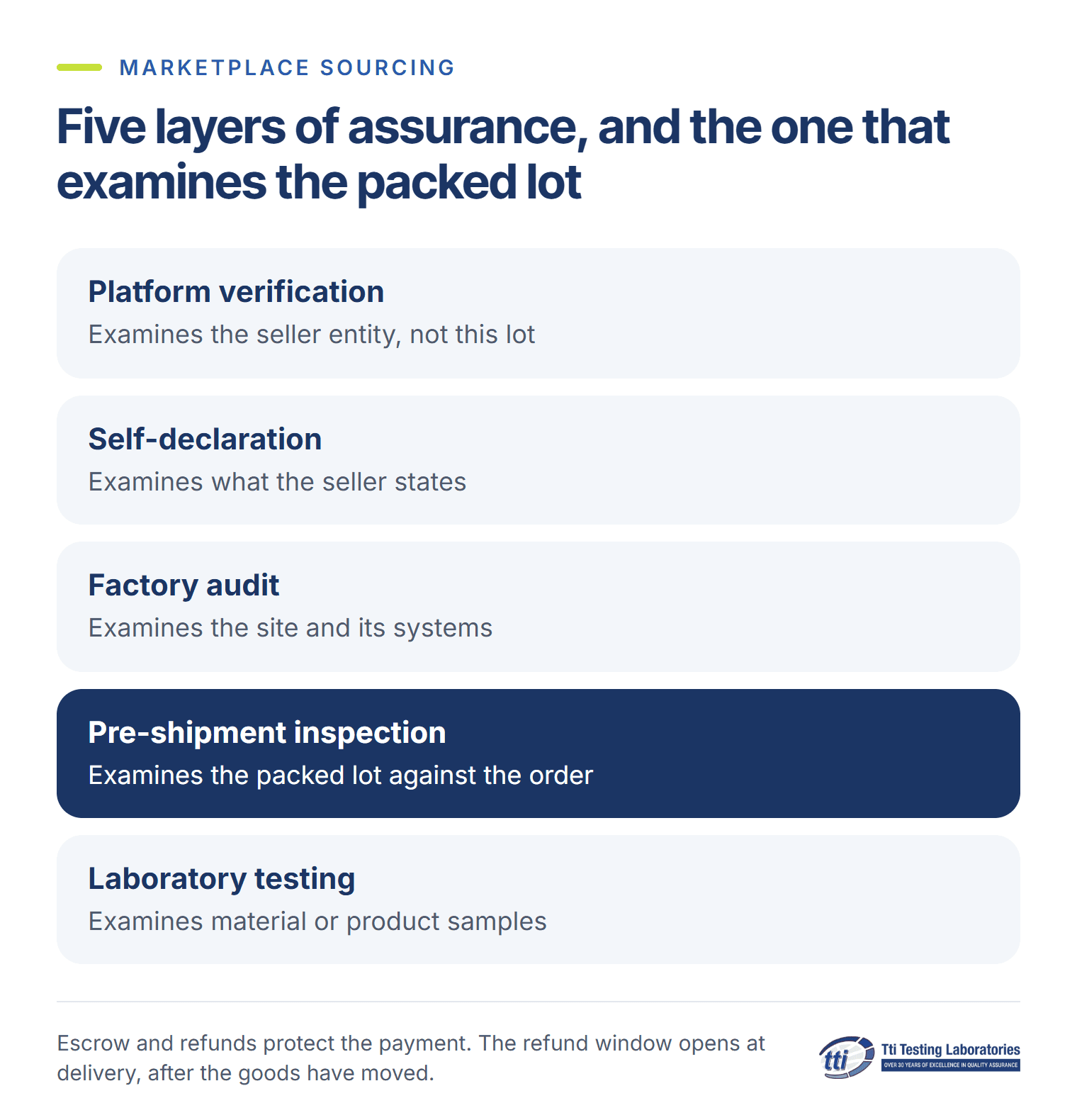
Layer | What it examines | Evidence it produces | What it leaves unanswered |
|---|---|---|---|
Platform verification | The seller entity | Assessment report, badge, escrow and refund terms | Whether this lot matches this order |
Supplier self-declaration | What the seller states | Quotation, specification sheet, capability claims | Whether any stated claim is true |
Factory audit | The site and its systems | Audit report on capacity, machinery, QC and records | Whether a given lot conforms |
Pre-shipment inspection | The packed lot against the order | Inspection report under a stated sampling basis, defect log, photographs | Composition and performance beyond the visual check |
Laboratory testing | Material or product samples | Test report for named methods and parameters | Whether workmanship across the whole lot is consistent |
Pre-shipment inspection and laboratory testing are the layers that touch the goods. A factory audit examines capability before production, and a laboratory test examines a parameter in a sample. Only inspection examines the packed lot that is about to ship.
Get the supplier's answers in writing before the first order
The badge removes the first of these questions and leaves the rest untouched.
Question | Why it changes the risk |
|---|---|
Who manufactures the goods, and at which address? | A trader adds a supply tier the buyer cannot see |
Is the production site the address on the assessment report? | Verification attaches to a site, not to a trading name |
Which processes run in-house and which are subcontracted? | Undisclosed outsourcing moves production outside the verified scope |
Is the company record current? | The SECP company search shows legal identity and status |
Is the tax registration valid? | The FBR verification service confirms the tax identity |
Which certificate covers this product, and at which site? | A scoped certificate proves a system, not a shipment |
Will the order state tolerances and defect definitions? | An inspector has nothing to measure without them |
Which AQL standard, level and defect limits will apply? | Sampling is arithmetic, and the numbers must be agreed first |
Who appoints and pays the inspector? | Independence depends on who holds the contract |
What must the inspection report contain? | Sampling basis, defect log and photographs are the evidence |
Will loading be supervised at stuffing? | Inspection ends before the container does |
Four items in the purchase order and inspection brief close the gap
A badge can replace none of them.
Start with a pre-shipment inspection against the purchase order. The order is the measuring instrument. If it does not state tolerances, defect definitions and packing requirements, the inspector has nothing to measure against.
The report must state its sampling basis: the standard behind the sample, such as ISO 2859-1 or its United States form, plus the inspection level. QIMA's AQL guidance explains how the tables work. At AQL 2.5 on a 4,000 unit lot, code letter L draws 200 units, and 10 or fewer failures pass the batch.
Defects go into a classified log, with critical, major and minor defects counted separately against separate limits.
And the report needs photographs of carton markings, packing, defect evidence and shade checks, so the buyer can see the evidence behind the verdict. A report that arrives on time without them costs as much as a late one.
QIMA's pre-shipment inspection runs at the fully packed stage, the last moment when a lot can still be held. SGS publishes the same family of stages, and the Intertek inspection hub covers the sequence from initial production through to the final random check. Book yours for that stage, before the container is loaded, while a failing lot can still be reworked or renegotiated.
Tti Labs checks the packed lot against the order
Independent inspection through Tti Inspections Pvt Ltd under ISO/IEC 17020 accreditation, PNAC certificate IB-006, listed on the PNAC active inspection bodies register.
Pre-shipment inspection against the purchase order, with AQL C:0 for critical defects, Mj:2.5 for major and Mi:4.0 for minor at general inspection level II, through inspection services.
A report built for decisions: stated sampling basis, classified defect log, photographs and a pass, fail or hold outcome.
Laboratory evidence where a defect raises a material question, under ISO/IEC 17025 accreditation through PNAC LAB-022 and analytical testing services.
Certification support where a programme needs it, including certification services and ZDHC MRSL v3.1 conformance at Level 1 and Level 2.
Recognised approvals and accreditation scope on Tti Labs' accreditations page, with offices reachable through contact.
Tti Labs inspects and reports against the order. It does not certify a supplier, and it does not replace the platform protections that cover payment and delivery.
Book an independent pre-shipment inspection with Tti Inspections Pvt Ltd. UAN 111 786 001. ISO/IEC 17020 accredited, PNAC certificate IB-006.
FAQ
Does trade assurance guarantee product quality?
Not before shipment. It provides a refund or compensation route where an order is not shipped, goes missing, or arrives defective, incorrect or damaged. The claim is assessed after delivery, within a time window that starts at the delivery date.
Is a verified supplier badge the same as an inspection?
No. Verification examines the seller entity: registration, location, ownership, capacity and facilities. Inspection examines a specific packed lot against a specific purchase order.
Does independent inspection replace trade assurance?
No. The two cover different exposures. Trade assurance handles payment, delivery and dispute resolution, and independent inspection reduces the chance that a dispute is needed at all.
References
Trade Assurance: order protection for Alibaba.com orders, Alibaba.com, https://tradeassurance.alibaba.com/
Money-back policy, Alibaba.com Trade Assurance, https://tradeassurance.alibaba.com/ta/MoneyBackPolicy.htm
Alibaba.com Verified Suppliers make trust happen, Alibaba.com, https://seller.alibaba.com/verified-supplier
Introducing Verified Suppliers, Alibaba.com, https://activity.alibaba.com/page/verifiedsuppliers.html
Acceptable Quality Limit (AQL), sampling chart and calculator, QIMA, https://www.qima.com/aql-acceptable-quality-limit
Pre-shipment inspection (PSI), QIMA, https://www.qima.com/consumer-products/pre-shipment-inspection
Product inspection services, SGS, https://www.sgs.com/en/services/product-inspection
Inspection services, Intertek, https://www.intertek.com/inspection/
ISO 2859-1, Sampling procedures for inspection by attributes: sampling schemes indexed by acceptance quality limit for lot-by-lot inspection, International Organization for Standardization, https://www.iso.org/standard/2859-1
Verify certificates, IAF CertSearch, https://iafcertsearch.org/verify-certificates
Company search, Securities and Exchange Commission of Pakistan, https://eservices.secp.gov.pk/eServices/CompanySearch.jsp
Online verification services, Federal Board of Revenue, https://e.fbr.gov.pk/esbn/Verification
Active inspection bodies register, Pakistan National Accreditation Council, https://www.pnac.gov.pk/index.php/Accredited-Cabs-serve/Inspection-Bodies/Active
Accreditation scope LAB-022 (ISO/IEC 17025:2017, first granted 13 May 2006, valid to 8 August 2027), Pakistan National Accreditation Council, https://pnac.gov.pk/pdfFiles/LAB-022
Inspection and audit services, Tti Labs, https://ttilabs.net/inspection
Analytical testing services, Tti Labs, https://ttilabs.net/testing
Certification services, Tti Labs, https://ttilabs.net/certification
Contact, Tti Labs, https://ttilabs.net/contact
Accreditations, Tti Labs, https://ttilabs.net/accreditations/
Recommended reading

Inspection
The Pakistan QC Data Barometer: Reading Defect Data Properly

Compliance
What Product Recalls Teach Pakistan Exporters

Inspection
Sialkot Sports Goods QC: What Buyers Specify

Compliance
Audit Duplication: How Small Exporters Stop Paying Twice for the Same Audit


ISO/IEC 17025 ACCREDITED
Testing, inspection and certification for Pakistani exports.
General
Why defect-rate benchmarking matters to buyers sourcing from Pakistan, what a barometer measures, and how to read one without reacting to normal variation.
General
Sialkot sports goods QC for buyers: football sphericity and weight tolerances, glove EN 388 tests, inflatable leak checks, and how AQL sampling applies.

General
How production monitoring in Pakistan catches schedule slippage before a shipment misses its vessel, and the reporting discipline that makes it all work.