

Compliance
Blog
PPWR Packaging Rules for Pakistan Exporters
PPWR packaging rules for Pakistan exporters: recyclable design, recycled content targets, empty space limits and why the EPR fee falls on the EU importer.

Every EU shipment arrives in packaging. From 12 August 2026, Regulation (EU) 2025/40 governs that packaging whatever the goods inside, whether a garment, a surgical instrument or a bag of rice.
The legal duty, and the fee that funds recycling, fall on the EU importer or brand. A Pakistani exporter meets the rules through the buyer's purchase order. The design rules that change a packing line, on recyclability, recycled content and empty space, apply from 1 January 2030.
The regulation covers the polybag, the carton, the tape and the air pillows
Regulation (EU) 2025/40 is the Packaging and Packaging Waste Regulation, or PPWR. It was adopted on 19 December 2024, published on 22 January 2025 and entered into force on 11 February 2025. It applies from 12 August 2026 and repeals Directive 94/62/EC.
It governs packaging placed on the EU market, whatever the origin of the goods inside. The European Commission's packaging waste hub sets out the policy, and the PPWR page describes one rulebook replacing fragmented national schemes.
The definition of packaging is broad. It covers sales packaging, grouped packaging that bundles items, transport packaging such as the shipping carton, and e-commerce packaging. The polybag protecting a garment, the carton holding ten of them, the tape sealing the box and the air pillows inside it are all in scope.
Seven obligations reach an export order, and five of them start on 1 January 2030
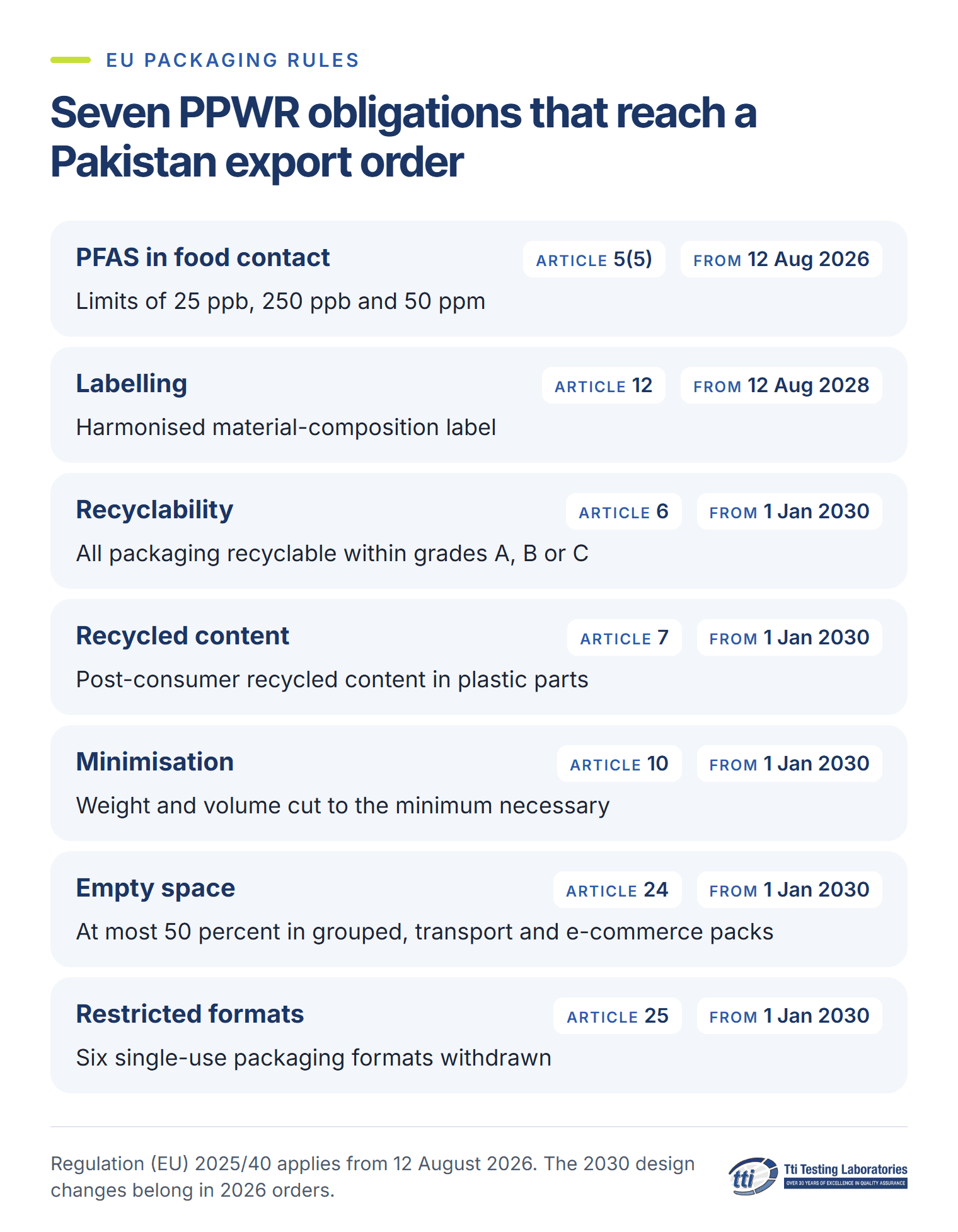
Under Article 6, all packaging placed on the market must be recyclable, and performance is graded A, B or C. Packaging below grade C can't be placed on the market from 1 January 2030. From 1 January 2038, only grades A and B are accepted. The design-for-recycling criteria arrive through delegated acts by 1 January 2028.
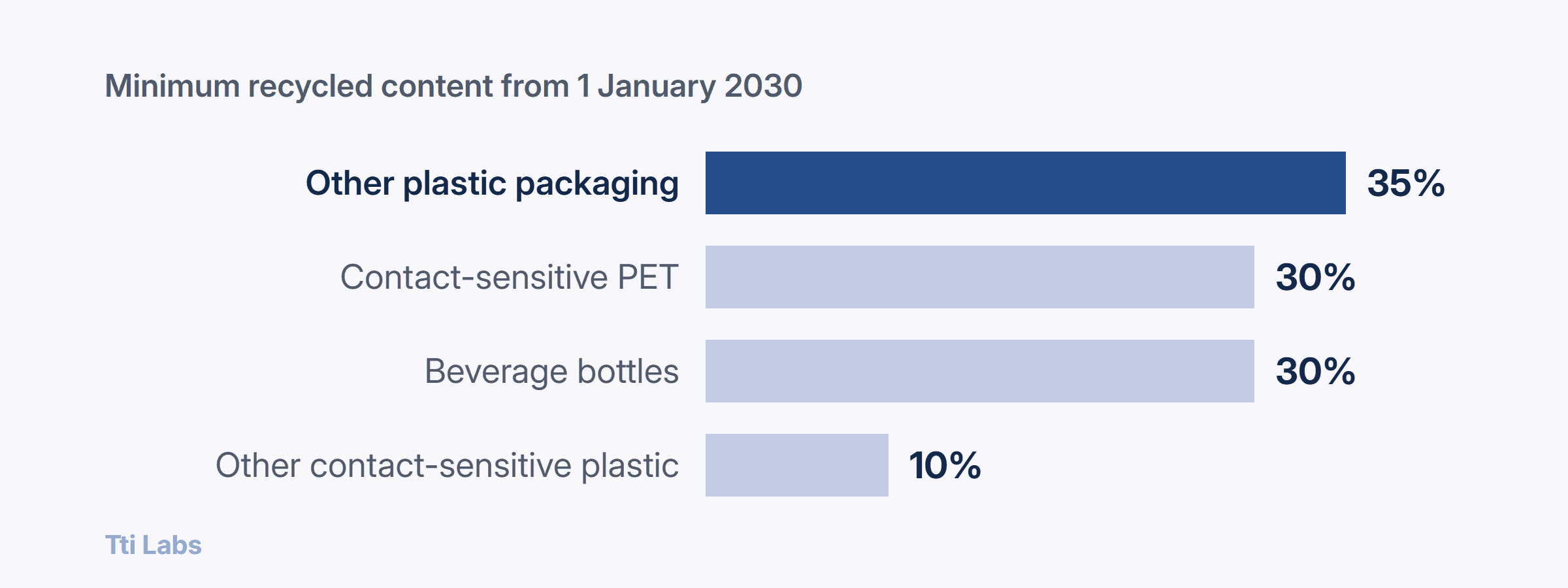
Article 7 sets minimum recycled content for the plastic parts of packaging, recovered from post-consumer waste and averaged per plant and year. From 1 January 2030 the floors are 30 percent for contact-sensitive PET and 10 percent for other contact-sensitive plastic, while beverage bottles face 30 percent and other plastic packaging 35 percent. Stricter floors apply from 1 January 2040.
By 1 January 2030, Article 10 requires the manufacturer or importer to cut packaging weight and volume to the minimum needed for function, and Article 24 caps the empty space ratio at 50 percent for grouped, transport and e-commerce packaging.
Article 25 withdraws the formats listed in Annex V from 1 January 2030. They include single-use plastic grouped packaging such as shrink wrap collation films, single-use formats for fresh produce, on-premises food, condiment sachets and hotel toiletries, and very lightweight plastic carrier bags. Most entries target consumer and hospitality formats, alongside the earlier single-use plastics rules. The collation-film entry is the one that reaches retail-ready export packaging.
From 12 August 2028, Article 12 requires a harmonised label showing material composition, built on pictograms, not words, and the Commission Decision 97/129/EC marking scheme it replaces is repealed. Voluntary recycled or biobased claims are permitted, but only in the harmonised format. An invented logo is a risk.
From 12 August 2026, Article 5(5) bars food-contact packaging containing per- and polyfluoroalkyl substances, or PFAS, at limits of 25 ppb for any single PFAS, 250 ppb for the sum and 50 ppm including polymeric PFAS. Food exporters using greaseproof wrappers or moulded fibre trays sit closest to this rule.
The EU importer or brand pays the EPR fee, unless the exporter sells direct to consumers
Extended producer responsibility (EPR) is the fee that funds collection and recycling. Article 45 places it on the producer, and the Waste Framework Directive supplies the scheme.
Article 3(1)(15) defines the producer as the manufacturer, importer or distributor that makes packaging available for the first time on a Member State's territory. On a normal business-to-business export, that is the EU importer or the brand that owns the order, not the factory in Karachi or Sialkot. That party registers under Article 44 in each Member State where it places packaging, and pays the fee.
The fee is modulated by recyclability grade and recycled content share. A hard-to-recycle format costs the producer more, and the signal travels back down the supply chain.
There is one exception. A Pakistani exporter that sells directly to EU consumers, for example through an online store, can itself become the producer. Article 45(3) then requires a written mandate appointing an authorised representative in each Member State where the packaging is first made available.
Most packing-line fixes swap plastic extras for paper or a single material
Packaging component | Likely change | Why the buyer asks |
|---|---|---|
Polybag | Mono-material polyethylene, declared recycled content, no PVC or laminate | Recyclability grade and the 2030 recycled content target attach to the plastic part |
Carton | Uncoated or water-based coated corrugated board, no plastic windows | Coatings and windows lower the recyclability grade and material quality |
Tape and strapping | Paper or water-activated tape in place of plastic tape, no PVC strapping | Plastic tape and strapping contaminate the paper stream and depress the grade |
Void fill | Paper-based fill instead of air pillows or expanded polystyrene | Plastic fill is plastic packaging and carries the same duties |
Pack size | Right-sized cartons without excess volume | Article 24 caps empty space at 50 percent |
The polybag's plastic carries the recycled content target, so a buyer will ask for the percentage and the traceable source of the recycled resin. Multi-material laminates and PVC are the fastest way to fall below a passing grade.
Corrugated board is one of the most recyclable packaging materials, which puts the shipping carton on the good side of Article 6. The risk sits in the extras: plastic windows, heavy laminates and solvent-based coatings. Removing them raises the grade and lowers the buyer's EPR fee.
Plastic tape is a small share of the box by weight and a large problem for the paper stream, so paper tape keeps the carton mono-material. For strapping, polypropylene is common and PVC is worse, so buyers increasingly ask for paper strapping.
The buyer can't comply without the exporter's packaging data
The exporter doesn't file with an EU regulator. The buyer will ask for:
A packing specification by component, naming material, format and weight.
The recycled content share for each plastic part, with the supplier's evidence.
Converter declarations for cartons, tape, strapping and void fill.
A recyclability statement from the converter.
The harmonised label artwork, once Article 12 applies.
For direct sellers to consumers, the authorised representative mandate.
Keep the figures consistent across these documents, because the grade and the EPR fee both rest on composition data.
Fix one representative order, then make its specification the template
Recyclability, recycled content, empty space and format rules apply from 1 January 2030, so the design changes belong in 2026 orders.
Map every packaging component in one representative order.
Ask the converter for material composition, format weight and recycled content evidence.
Remove multi-material elements that block recycling, starting with plastic windows and laminates.
Right-size the carton so empty space stays below the 50 percent ratio.
Replace plastic tape, strapping and void fill with paper alternatives. Then write the specification into the purchase-order template, so new orders inherit it.
Circular economy reporting and the EU Digital Product Passport run on the same material data, so one record set can serve both.
What Tti Labs offers for packaging evidence
ISO/IEC 17025 accreditation through the Pakistan National Accreditation Council, published as LAB-022.
The Sustainability Center, which runs multi-tier supplier mapping and traceability, material compliance and RSL screening, circular economy work and readiness for the EU Digital Product Passport. Its division list also carries a Paper & Packaging division covering cartons, polybags and corrugated board.
The testing division, which publishes 544 accredited methods and 378 accredited parameters, covering composition and identification testing and RSL analysis.
Textiles and apparel testing for product-side fibre and material work.
Tti Labs reports results for the samples submitted and the methods performed. It does not certify a product.
Talk to Tti Labs about packaging evidence for EU orders. UAN 111 786 001. ISO/IEC 17025 accredited, PNAC LAB-022.
FAQ
Does PPWR apply to Pakistani exporters?
Indirectly, yes. The regulation binds the party placing packaging on the EU market, normally the importer or brand. The exporter meets it because the buyer writes packaging requirements into the purchase order and requests the data behind them.
Do polybags have to be recyclable under PPWR?
Yes. A polybag is packaging, so it falls under the Article 6 recyclability requirement and the Article 7 recycled content target for its plastic part. Mono-material polyethylene grades better than a laminate.
What is the 50 percent empty space rule?
From 1 January 2030, Article 24 caps the empty space ratio at 50 percent for grouped, transport and e-commerce packaging filled by economic operators. Reusable packaging is exempt.
References
Regulation (EU) 2025/40 on packaging and packaging waste, EUR-Lex, https://eur-lex.europa.eu/eli/reg/2025/40/oj/eng
Packaging and Packaging Waste Regulation, European Commission, https://environment.ec.europa.eu/topics/waste-and-recycling/packaging-waste/packaging-packaging-waste-regulation_en
Packaging waste, European Commission, https://environment.ec.europa.eu/topics/waste-and-recycling/packaging-waste_en
Directive 2008/98/EC on waste (Waste Framework Directive), EUR-Lex, https://eur-lex.europa.eu/eli/dir/2008/98/oj/eng
Regulation (EU) 2019/904 on the reduction of the impact of certain plastic products on the environment, EUR-Lex, https://eur-lex.europa.eu/eli/reg/2019/904/oj/eng
Commission Decision 97/129/EC establishing the identification system for packaging materials, EUR-Lex, https://eur-lex.europa.eu/eli/dec/1997/129/oj/eng
Accreditation scope LAB-022, Pakistan National Accreditation Council, https://pnac.gov.pk/pdfFiles/LAB-022
Sustainability and environmental compliance services, Tti Labs, https://ttilabs.net/sustainability/
Analytical testing services, Tti Labs, https://ttilabs.net/testing
Textiles and apparel testing, Tti Labs, https://ttilabs.net/textiles-apparel
Contact and offices, Tti Labs, https://ttilabs.net/contact
Recommended reading

Inspection
The Pakistan QC Data Barometer: Reading Defect Data Properly

Compliance
What Product Recalls Teach Pakistan Exporters

Inspection
Marketplace Trade Assurance vs Inspection in Pakistan

Inspection
Sialkot Sports Goods QC: What Buyers Specify


ISO/IEC 17025 ACCREDITED
Testing, inspection and certification for Pakistani exports.
General
Product recalls are a public record of how shipments fail, the rule-based categories that recur, and what a Pakistani exporter should test before shipping.

General
Which buyer-required standards genuinely overlap, which recognise each other, and how a small Pakistani exporter stops paying for the same evidence twice.

General
GSP+ Pakistan audit stack for exporters: the new regulation dates, SMETA and BSCI evidence EU buyers request, and the eight steps to build a compliance file.