

Compliance
Blog
GSP+ Pakistan: The Audit Stack Exporters Need, Whatever Happens Next
GSP+ Pakistan audit stack for exporters: the new regulation dates, SMETA and BSCI evidence EU buyers request, and the eight steps to build a compliance file.

Buyers and suppliers keep asking what changes if GSP+ lapses. It isn't lapsing. The European Parliament adopted a new regulation that applies from 1 January 2027, and Pakistan keeps its preferences until 31 December 2028, by which date it must reapply with an action plan.
The audits European buyers ask for don't depend on that answer anyway. They come from the buyers' own duties under the EU Forced Labour Regulation and the due diligence directive, which apply whatever Pakistan's preference status. Start with supply-chain mapping and labour records: every scheme needs them.
Pakistan has held GSP+ since 2014 and is the largest beneficiary of the arrangement
The legal basis is settled. The scheme runs under Regulation (EU) No 978/2012, which Regulation (EU) 2023/2663 extended in November 2023 to the end of 2027.
Under GSP+, which Pakistan has used since 1 January 2014, most tariffs on two thirds of EU tariff lines fall to zero (European Commission trade relations with Pakistan). To keep that access, Pakistan must ratify and effectively implement 27 core conventions covering human rights, labour rights, environmental protection and good governance.
The EU is Pakistan's second most important trading partner, with 14.1 percent of Pakistan's total trade in 2025 and €12.2bn in bilateral goods trade. Around 89 percent of textiles and clothing articles imported from Pakistan enter at a preferential tariff rate. More than 85 percent of Pakistan's exports enter the EU duty and quota free, close to 20 percent of its exports globally.
The new regulation applies from 1 January 2027, and current beneficiaries must reapply by 31 December 2028
Regulation (EU) 2026/1395 runs to the end of 2036 and replaces the 2012 Regulation (Commission factsheet on the new scheme). The European Parliament voted in favour on 28 April 2026 (text adopted by the European Parliament), so the scheme continues under new conditions instead of lapsing.
A provisional agreement on 1 December 2025 preceded that vote. The Parliament and Council signed the regulation on 18 June 2026, and it was published in the Official Journal on 22 June 2026 (GSP review timeline).
Date | Milestone |
|---|---|
1 January 2014 | Pakistan enters GSP+ |
November 2023 | Current regulation extended three years, to end of 2027 |
1 December 2025 | Provisional political agreement on the new scheme |
28 April 2026 | European Parliament votes in favour |
18 June 2026 | New GSP Regulation signed, published 22 June |
1 January 2027 | New scheme applies, running to the end of 2036 |
31 December 2028 | Deadline for current GSP+ beneficiaries to reapply, with an action plan |
The dates don't conflict. The 2012 scheme ran to the end of 2027, and the new regulation supersedes that extension from 1 January 2027.
The new scheme adds six instruments to the list of conventions beneficiary countries must respect:
Optional Protocol to the Convention on the Rights of the Child on the involvement of children in armed conflict
Convention on the Rights of Persons with Disabilities
ILO Convention No. 81 on labour inspection
ILO Convention No. 144 on tripartite consultations
Paris Agreement on climate change
United Nations Convention against Transnational Organised Crime
The Paris Agreement replaces the Kyoto Protocol, which brings climate reporting inside the conditionality frame.
Current GSP+ beneficiaries keep preferences during a two-year transition to 31 December 2028. They must then reapply under the new legal basis, with an action plan for effective implementation of the full convention list. A standing entitlement becomes a documented application.
The new scheme also introduces an urgent withdrawal procedure, which allows preferences to be suspended for serious and systemic violations. It extends negative conditionality across the full convention list, now 32 instruments, and lengthens the monitoring cycle from two years to three (European Commission GSP overview). The urgent procedure raises the cost of a documented compliance failure.
Buyers' audit demands run on their own legal clocks, whatever happens to GSP+
The audit requirements European buyers place on Pakistani suppliers come from the buyers' own legal exposure. Three obligations apply to buyers irrespective of tariffs.
The EU Forced Labour Regulation applies from 14 December 2027. It prohibits products made wholly or partly with forced labour at any stage of production, and the obligation is of result, not of documentation.
The Corporate Sustainability Due Diligence Directive applies to the largest EU companies from 26 July 2029. It reaches Pakistani suppliers through contractual clauses and questionnaire requirements, and the labour risk those clauses target is concentrated in specific tiers.
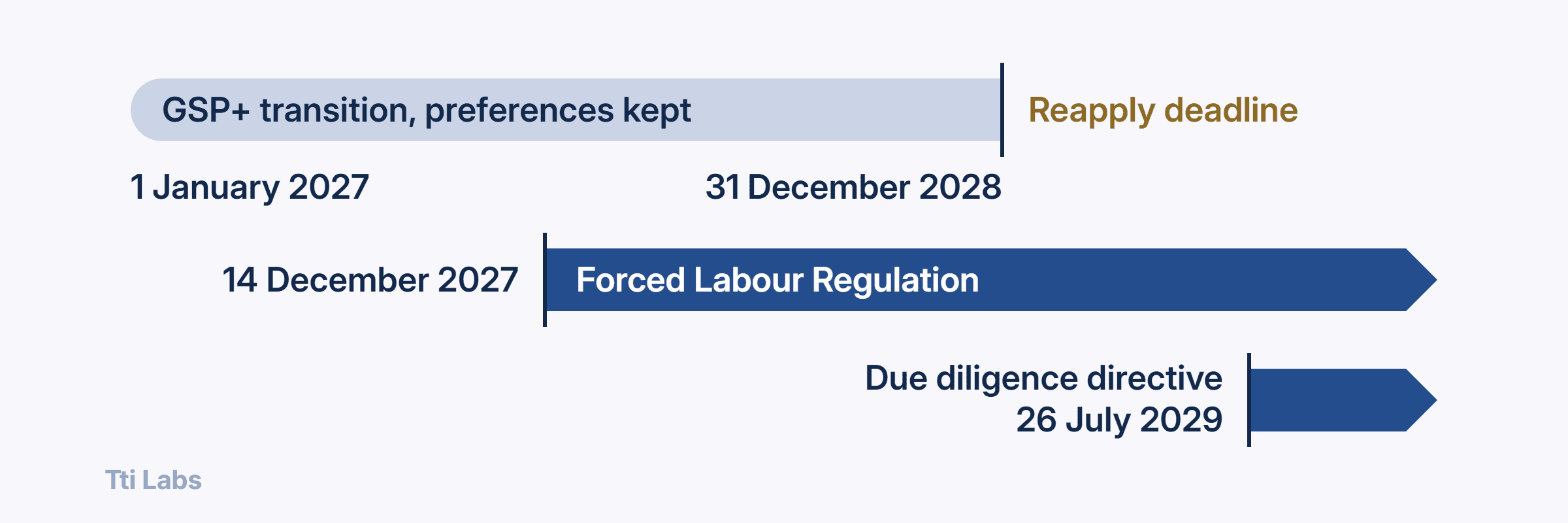
The directive applies to the largest EU companies.
Chemical and product regulations continue on their own clocks.
So one compliance file serves the buyer twice. It evidences the buyer's own due diligence, and it supports the preference claim Pakistan makes under GSP+. Its value doesn't depend on how a trade negotiation ends.
Buyers pick the audit scheme by the platform they already use
Buyer requests to Pakistani suppliers cluster around a small set of schemes.
Scheme | Typical requesting buyer | What the buyer receives |
|---|---|---|
SMETA audit through Sedex | UK and EU retailers | A shared report with findings and corrective actions |
amfori BSCI audit | EU retailers and brands | A graded report on amfori's platform |
WRAP certification | US and EU apparel buyers | A facility certification against WRAP principles |
Brand's own code of conduct audit | Large brands with proprietary programmes | Findings against the brand's own standard |
GOTS, OEKO-TEX, ISO 14064 | Category-specific buyers | Product, chemical or carbon claims tied to specific scope |
ISO 9001 and ISO 14001 | Industrial and institutional buyers | Management-system certification |
Because GSP+ duty-free access is conditional on human rights, labour and environmental conventions (European Commission GSP overview), buyers verify factory compliance with social standards such as BSCI, SMETA and WRAP.
A buyer that already runs Sedex reads a SMETA report in its workflow, and a buyer on amfori's platform reads BSCI. Suppliers selling into more than one European market commonly meet both, and the evidence base behind each is broadly the same.
Build the stack in order, starting with supply-chain mapping and labour records
Sequence determines cost. Done in the right order, each step produces evidence the next step reuses.
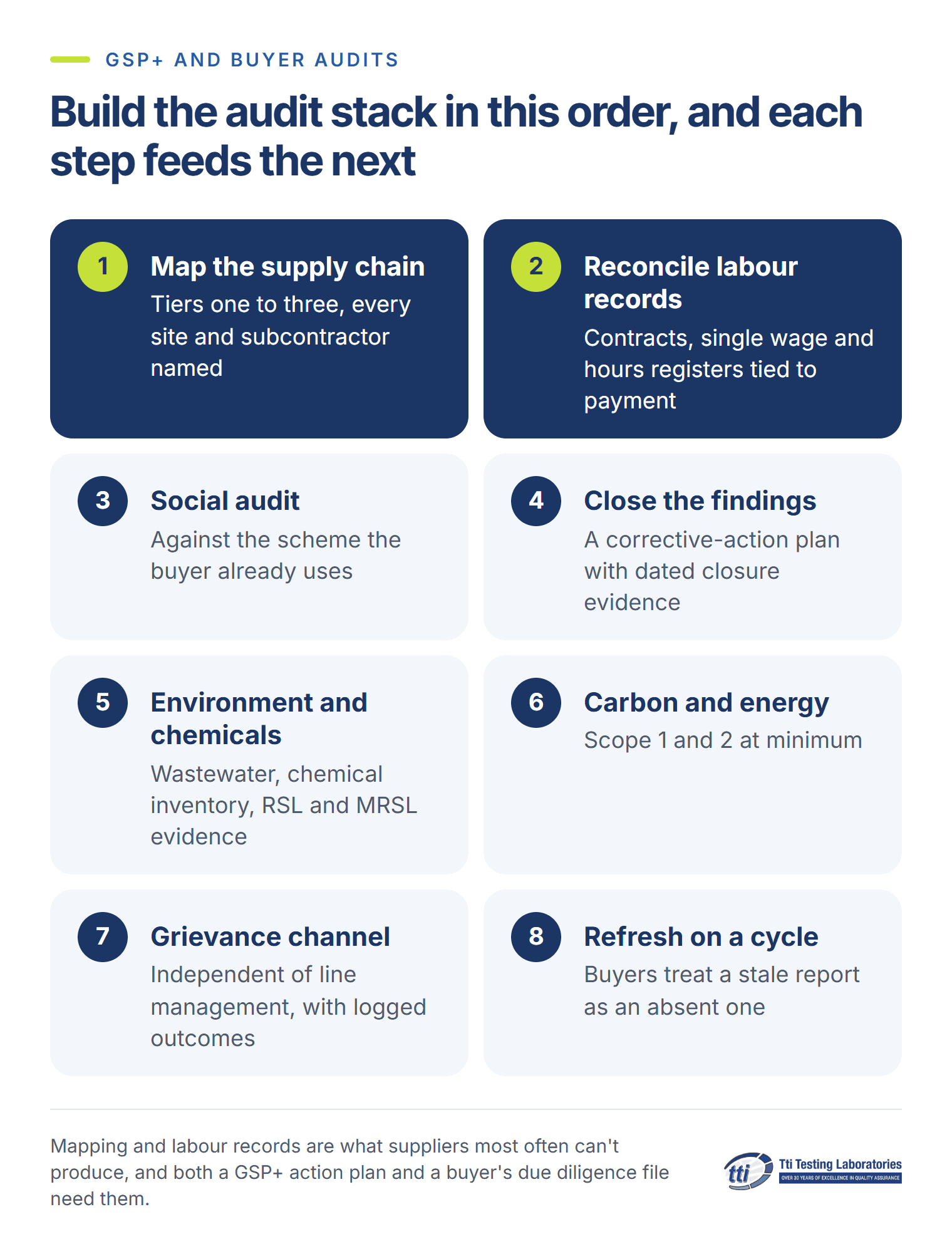
Map the supply chain, tiers one to three. Name and locate every production site, including subcontractors. This document is the precondition for nearly everything else.
Reconcile the labour records. Written contracts for every worker, and wage and hours registers tied to payment evidence. Keep single registers. Parallel registers are the first thing an auditor reconciles, and the cheapest gap to close before the visit.
Commission a social audit against a named scheme. Choose the scheme the buyer already uses, and file the report where the buyer can reach it.
Close the findings with dated evidence. A corrective-action plan with a closure record is worth more than a clean initial report, because it shows the mechanism works.
Add environmental and chemical evidence. Wastewater monitoring, chemical inventory, restricted substance declarations, and MRSL conformance where buyers run chemical programmes.
Add carbon and energy data. Scope 1 and 2 at minimum, with Scope 3 supplier mapping as buyer reporting requirements mature.
Prepare the grievance channel and its records. A functioning mechanism with a logged outcome, independent of line management, closes a finding that buyers increasingly check directly with workers.
Refresh on a fixed cycle. An audit report carries a date, and buyers treat a stale report as an absent one.
The first two steps carry disproportionate weight. Mapping and labour records are what Pakistani suppliers most often can't produce on request, and both a reapplication action plan and a buyer due-diligence file require them.
Where Tti Labs supports the audit stack
Factory and supplier audits through Tti Inspections Pvt Ltd, accredited to ISO/IEC 17020 under PNAC certificate IB-006 and listed on the PNAC active register.
A compliance portfolio spanning SA8000, SMETA, GOTS, OEKO-TEX, ISO 14064 and Higg FEM support, so a programme can follow the buyer's existing scheme.
Certification support for ZDHC and CE routes.
Laboratory testing under ISO/IEC 17025 accreditation, PNAC LAB-022, covering fibre, chemical, restricted substance and performance testing where a claim needs analytical evidence.
Chemical and MRSL conformance work, with ZDHC MRSL v3.1 approved certifier status at Level 1 and Level 2.
ZDHC wastewater approved laboratory status under the Wastewater Guidelines V1, covering all four discharge categories including zero liquid discharge. The V1 approval runs to 30 November 2026.
Sustainability Center support for carbon inventories, ESG reporting and supplier-capacity work where the buyer's own reporting obligations reach down the chain.
Coverage from Lahore headquarters, with offices in Karachi, Faisalabad and Sialkot and liaison points in Multan and Kasur.
Tti Labs does not issue GSP+ compliance findings, and no audit body does. The European Commission determines preference status. Tti Labs produces the evidence a buyer reads and a supplier can defend.
Book a supplier audit with Tti Inspections Pvt Ltd. UAN 111 786 001. Evidence your buyer can read and you can defend.
FAQ
What changes for exporters if GSP+ lapses?
Tariffs would change. Audit requirements largely would not, because the EU Forced Labour Regulation and the Corporate Sustainability Due Diligence Directive impose duties on buyers independently of Pakistan's preference status.
Which audits do EU buyers require from Pakistani suppliers?
Most often SMETA through Sedex or amfori BSCI, with WRAP for US-linked apparel programmes and brand-specific audits for large retailers.
Where should an unaudited exporter start?
With supply-chain mapping across tiers one to three, and reconciliation of labour records. Both are preconditions for every scheme, and both feed the action plan a reapplication needs by 31 December 2028.
References
Regulation (EU) No 978/2012 applying a scheme of generalised tariff preferences, EUR-Lex, https://eur-lex.europa.eu/eli/reg/2012/978/oj/eng
Regulation (EU) 2023/2663 amending Regulation (EU) No 978/2012, EUR-Lex, https://eur-lex.europa.eu/eli/reg/2023/2663/oj/eng
Regulation (EU) 2026/1395 of the European Parliament and of the Council of 17 June 2026 on applying a generalised scheme of tariff preferences and repealing Regulation (EU) No 978/2012, EUR-Lex, http://data.europa.eu/eli/reg/2026/1395/oj
GSP review: timeline and content of the new scheme, GSP Hub, https://gsphub.eu/about-gsp/gsp-review
EU trade relations with Pakistan, European Commission, https://policy.trade.ec.europa.eu/eu-trade-relationships-country-and-region/countries-and-regions/pakistan_en
Generalised Scheme of Preferences, European Commission, https://policy.trade.ec.europa.eu/development-and-sustainability/generalised-scheme-preferences_en
The new EU Generalised Scheme of Preferences (factsheet), European Commission, https://taxation-customs.ec.europa.eu/document/download/01150813-1418-4bea-8bf2-9110bddf8b02_en?filename=new-GSP-regulation-factsheet.pdf
Regulation (EU) 2024/3015 on prohibiting products made with forced labour, EUR-Lex, https://eur-lex.europa.eu/eli/reg/2024/3015/oj/eng
Corporate sustainability due diligence, European Commission, https://commission.europa.eu/topics/business-and-industry/company-law-and-corporate-governance/corporate-sustainability-due-diligence_en
Text adopted: new Generalised Scheme of Preferences regulation (vote of 28 April 2026), European Parliament, https://www.europarl.europa.eu/doceo/document/TA-10-2026-0114_EN.html
Inspection services, Tti Labs, https://ttilabs.net/inspection
Certification services, Tti Labs, https://ttilabs.net/certification
Sustainability services, Tti Labs, https://ttilabs.net/sustainability/
Active inspection bodies register, Pakistan National Accreditation Council, https://www.pnac.gov.pk/index.php/Accredited-Cabs-serve/Inspection-Bodies/Active
Accreditation scope LAB-022 (ISO/IEC 17025:2017, first granted 13 May 2006, valid to 8 August 2027), Pakistan National Accreditation Council, https://pnac.gov.pk/pdfFiles/LAB-022
Recommended reading

Inspection
The Pakistan QC Data Barometer: Reading Defect Data Properly

Compliance
What Product Recalls Teach Pakistan Exporters

Inspection
Marketplace Trade Assurance vs Inspection in Pakistan

Inspection
Sialkot Sports Goods QC: What Buyers Specify


ISO/IEC 17025 ACCREDITED
Testing, inspection and certification for Pakistani exports.
General
Product recalls are a public record of how shipments fail, the rule-based categories that recur, and what a Pakistani exporter should test before shipping.

General
Which buyer-required standards genuinely overlap, which recognise each other, and how a small Pakistani exporter stops paying for the same evidence twice.

General
PPWR packaging rules for Pakistan exporters: recyclable design, recycled content targets, empty space limits and why the EPR fee falls on the EU importer.