

Sustainability
Industry Insight
ZDHC Wastewater Testing in Pakistan: A Denim Mill and Laundry Guide
ZDHC wastewater testing for Pakistan denim mills and laundries: MRSL conformance levels, effluent parameters, discharge categories and the buyer evidence route.

A denim laundry loses an order for one reason more often than any other. It cannot show what left the pipe. In Pakistan, ZDHC wastewater testing answers that with laboratory evidence: treated effluent sampled at the point of discharge, tested against a fixed parameter set and filed against the facility's declared discharge category.
Buyers ask for that output record together with proof of the chemistry going in. Suppliers carry the input certificates. Only your laundry can produce the effluent record.
Buyers treat ZDHC's input and output rules as one evidence system
The programme behind the test is Zero Discharge of Hazardous Chemicals (ZDHC). Its Manufacturing Restricted Substances List (MRSL) sets what may enter a textile factory, and its wastewater guidelines set what may leave it.
The evidence exists per facility, not per brand. A laundry holding current, category-matched results clears a gate its neighbours may not clear, and buyers read those results alongside basin-level risk. The fabric carries a parallel discipline: denim quality control covers shade, weight and shrinkage across runs.
The conformance level decides how much of the supply chain a buyer accepts as evidenced
Level | What it requires | What it adds |
|---|---|---|
Level 1 | Analytical testing of the formulation plus safety-data-sheet review | The entry rung: a formulation proven and documented |
Level 2 | Level 1 plus an on-site management-systems assessment | Evidence that the system, not just the sample, is controlled |
MRSL conformance runs from Level 1 to Level 2, and each level builds on the one before, so the level tells a buyer what a certifier verified on site. A formulator listed at Level 1 meets the testing requirement but not the system requirement, so check which one your customer asks for, and check the exact level on the certificate.
A lapsed listing shows as expired for eight weeks before it reverts to private, so a document dated two seasons ago proves nothing. Certifier standing and formulation listings are published through the ZDHC MRSL conformance route and the Gateway Chemical Module. Mills that want their own level confirmed against the current standard can have their chemistry reviewed before submitting.
Each buyer decides how hard ZDHC is enforced
ZDHC's programme documentation sets what MRSL conformance means. The requirement itself reaches a laundry through buyer programmes. Four buyer types publish the clearest requirements:
A US big-box retailer binds suppliers to ZDHC MRSL and runs a water-quality programme aimed at denim laundries, with dated phase-out targets for long-chain PFAS finishes.
A UK high-street retailer equates its restricted-substance standard with the full ZDHC MRSL and pairs it with Tier-1 wet-processing audits.
A US denim brand runs ZDHC-screened chemistry through a published chemical playbook.
A German apparel group stacks ZDHC MRSL with AFIRM and other standards, and routes testing through named incumbent laboratories.
All four ask for input chemistry control and output wastewater evidence together, both current and documented.
An auditor reads the file from the chemistry going in to the effluent going out
Every dye, auxiliary, detergent and finishing chemical needs a current safety data sheet and, where the buyer programme requires it, a conformance record. Restricted dye classes, processing auxiliaries, plasticizers, organotin compounds, solvents and volatile organics, heavy metals and PFAS screening all belong to this input layer, with restricted-substance obligations behind it. Unlisted chemistry is the most common finding. The typical case is a drum of auxiliary bought outside the programme, used for one season and never screened.

Denim washing, stone-washing alternatives, bleaching, dyeing and finishing each produce effluent with its own profile. Suspended solids, colour, pH swings, oxygen demand, dissolved metals and surfactant load arrive in proportions set by whichever step dominates the line. The effluent treatment plant manages that profile, and its operating records are evidence.
Composite sampling across the production day captures variation that a single grab sample misses. Sampling point, timing and preservation belong in the record with the numbers, because a result traced to no defensible sample cannot be defended later.
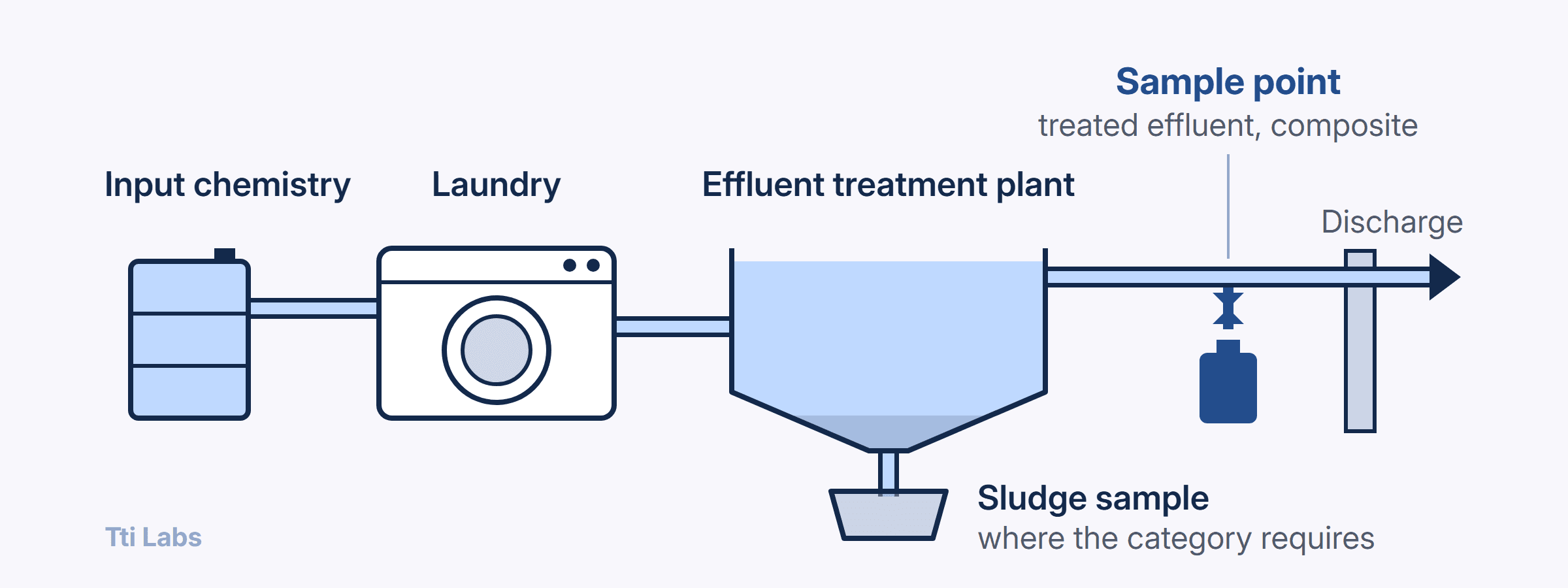
The ZDHC wastewater guidelines, supported by the programme's wastewater principles and procedures, divide the analysis into three groups:
Conventional pollutants: pH, chemical oxygen demand, biochemical oxygen demand and total suspended solids.
Heavy metals: lead, cadmium, chromium, hexavalent chromium, arsenic and mercury.
Priority organics: alkylphenols and their ethoxylates, phthalates, perfluorinated compounds and volatile organics.
Sludge sampling runs alongside effluent testing where the category requires it. A programme that stops at microbiological screening misses the heavy-metal and organic load this panel exists to catch.
Results must map to the discharge category the facility operates. Zero liquid discharge (ZLD) is its own case, and a ZLD claim needs closed-loop evidence before it counts as a finding. Published results travel to buyers through the ZDHC Gateway wastewater module.
Five failures recur at denim laundries, and none of them needs new machinery
They are unlisted chemistry in active use, expired evidence, a discharge category that doesn't match the pipe on the wall, treatment-plant records kept apart from the test reports, and PFAS left in water-repellent and stain-resistant finishes. Each is a documentation problem with a technical remedy, and each is cheaper to close before sampling than after a buyer asks.
For unlisted chemistry, check the chemical inventory line by line against conformance listings and current safety data sheets, and quarantine off-programme drums until they're screened. That work starts in the store room.
Evidence expires because effluent results and input certificates age out, and the eight-week private-listing window makes the lapse sudden. A laundry retests as often as the buyer programme and its discharge category require, so it needs a standing retest calendar, not an annual one, with a named owner and input chemistry treated as a live record. Two events force a retest whatever the calendar says: a change in the chemistry set, which alters the effluent profile, and a change in treatment configuration. Adding a finishing line without re-sampling invalidates the file.
Confirm the discharge category with the buyer programme before sampling. A mismatch means results tested against the wrong category, or a ZLD claim with no closed-loop records behind it.
Operating logs, sludge consignment notes and calibration certificates for on-site meters belong in the same file as the test reports, so an auditor reads one narrative.
Buyers have set dated phase-outs for long-chain PFAS and durable water repellent (DWR) finishes, so any remaining fluorinated chemistry needs screening and a reformulation plan. Total organic fluorine screening catches the substitution patterns that targeted lists miss, because it measures the class, not a single compound.
A compliant file is one folder an auditor can read without help
Evidence element | What it proves | Who holds it | Refresh trigger |
|---|---|---|---|
Safety data sheets | Every chemical in use is known | Laundry and suppliers | Formulation or supplier change |
Conformance listings | Chemistry meets MRSL at the stated level | Formulator and certifier | Listing lapse or expiry |
Effluent reports | Treated discharge meets the category limits | Analytical laboratory | Programme cycle and process change |
Sludge records | Solid-phase disposal is documented | Laundry and disposal contractor | Each consignment |
Plant logs and calibrations | Treatment performance is controlled | Laundry | Continuous, reviewed on cycle |
With that folder in place, two questions take minutes to answer: does every drum trace to a listing, and does every pipe leaving the building trace to a result?
Tti Labs is a ZDHC approved certifier and a ZDHC approved wastewater laboratory
Tti Labs is a ZDHC MRSL v3.1 approved certifier at Level 1 and Level 2, covering analytical testing, screening and safety-data-sheet review for chemical formulators. It also holds ZDHC wastewater approved laboratory status under the Wastewater Guidelines V1, covering all four discharge categories, zero liquid discharge included. The V1 approval runs to 30 November 2026.
Chemical input screening for restricted dyes and colourants, processing auxiliaries, plasticizers, organotin compounds, solvents, heavy metals, and PFAS screening including total organic fluorine.
Wastewater and sludge testing for conventional pollutants, heavy metals including hexavalent chromium, and priority organics, with sludge sampling where the category requires it.
Analysis across chemical and environmental matrices in one accredited house: textile, leather, synthetic and polymer chemistry alongside effluent, sludge and calibration work, through Tti Labs' testing services. Laundries unsure which parameters their category requires can have the scope confirmed before sampling day.
Factory and environmental audit capacity alongside the laboratory file, so the paper record and the floor agree.
Sustainability Center support: effluent treatment guidance, scrubbers, green chemical management, Higg FEM support and chemical management audits.
The certifier pathway runs through Tti Labs' certification services. Mills that need on-site chemical-hazard-assessment capability are routed through the applicable ZDHC pathway. Coverage runs from Lahore headquarters, with offices in Karachi, Faisalabad and Sialkot.
Book a wastewater test with Tti Labs. UAN 111 786 001. Category-matched results, filed where your buyer will look.
FAQ
What is ZDHC MRSL?
The Manufacturing Restricted Substances List of the Zero Discharge of Hazardous Chemicals programme. It limits hazardous chemicals in textile, leather and polymer production inputs. Conformance runs from Level 1 to Level 2.
What does wastewater testing involve at a denim laundry?
Composite sampling at the discharge point, analysed for conventional pollutants, heavy metals and priority organics, and mapped to the facility's discharge category, with sludge sampling where required.
How often should testing be repeated?
On the buyer programme's cycle for the applicable category, and again whenever formulations, suppliers or treatment configuration change. A lapsed listing shows as expired for eight weeks before it reverts to private, so the file needs a standing calendar.
References
ZDHC MRSL Conformance Guidance V2.1, ZDHC Roadmap to Zero, https://downloads.roadmaptozero.com/input/ZDHC-MRSL-Conformance-Guidance
ZDHC Manufacturing Restricted Substances List, Roadmap to Zero, https://www.roadmaptozero.com/mrsl
ZDHC Wastewater Guidelines Version 2.2, ZDHC Roadmap to Zero, https://downloads.roadmaptozero.com/output/ZDHC-Wastewater-Guidelines
ZDHC Gateway Chemical Module, ZDHC, https://www.zdhc-gateway.com/modules/chemical-module
ZDHC Gateway Wastewater Module, ZDHC, https://www.zdhc-gateway.com/modules/wastewater-module
ZDHC programme documentation library, ZDHC Roadmap to Zero, https://www.roadmaptozero.com/documents
ZDHC Wastewater Principles and Procedures, ZDHC Roadmap to Zero, https://downloads.roadmaptozero.com/output/ZDHC-WW-Principles-and-Procedures
AFIRM Restricted Substances List hub, AFIRM Group, https://afirm-group.com/afirm-rsl/
ZDHC MRSL certification services, Tti Labs, https://ttilabs.net/certification
Analytical and environmental testing services, Tti Labs, https://ttilabs.net/testing
Contact and offices, Tti Labs, https://ttilabs.net/contact
Recommended reading

Inspection
The Pakistan QC Data Barometer: Reading Defect Data Properly

Compliance
What Product Recalls Teach Pakistan Exporters

Inspection
Marketplace Trade Assurance vs Inspection in Pakistan

Inspection
Sialkot Sports Goods QC: What Buyers Specify


ISO/IEC 17025 ACCREDITED
Testing, inspection and certification for Pakistani exports.

General
European buyers push CSRD and VSME questionnaires to Pakistani suppliers. Which module applies, what each pillar asks, and how to answer a data gap honestly.

Textiles & Apparel
How a product carbon footprint is built for Pakistani textiles: the life cycle stages, the activity data a mill must record and the data quality buyers test.

Textiles & Apparel
Cotton and wet processing both draw on basins already under structural water pressure. Here is what buyers should actually ask about it.