

Certification
Blog
Which Certificates Win the Order, and What They Cost
What each buyer-required certificate actually costs a Pakistani exporter, which fees are published, and which order to buy them in on a limited budget.

Most certificate fees are not published. WRAP, amfori BSCI, SA8000 and GOTS publish scheme-side fees; most other schemes publish nothing at all. Even where a fee is published, the monitoring firm or certification body usually prices the audit separately. Travel, corrective action and re-audit after a failed attempt are rarely quoted upfront.
On a tight budget, ask each buyer first whether a certificate you already hold will do. Buyers frequently accept one if asked directly. Then buy for shared evidence: one social audit plus one management system covers more ground than three overlapping social audits.
Published fees rarely include the audit itself
Fees change annually, so confirm each figure with the scheme before you budget.
Scheme | Published fee | Covers | Audit fee included? |
|---|---|---|---|
WRAP | US$650 (to 100 workers), US$950 (101 to 200), US$1,350 (201 to 1,000), US$1,550 (1,001+) | Registration only | No. Set by the monitoring firm and paid to them |
amfori BSCI | Annual membership from €2,090 at the lowest turnover band to €39,150 at the highest (amfori fee table) | Membership, by buyer turnover | No. amfori states it does not prescribe audit pricing |
SA8000 | US$300 self-assessment to SAI, plus roughly US$400 to US$1,500 per audit day to the certification body | Self-assessment and audit days | Partly. The day rate is published as an approximate range |
GOTS | Entity annual fee €180; certification body annual fee €50 (GOTS fee revision) | Scheme registration | No. Certification body fees are separate |
Higg FEM | US$350 verification access fee; platform subscription from US$299 to US$1,499 per year | Verification methodology and platform | Verification is charged via the verifier |
GRS | No fee charged to the supplier directly by Textile Exchange | Scheme charges the certification body instead | No. Each certification body prices its own service |
OEKO-TEX STANDARD 100 and STeP | None published | n/a | Quote required |
ISO 9001, 14001, 45001 | None, and structurally none exists (ISO 9001) | ISO sells the standard, not certification | Certification bodies price audits independently |
ZDHC MRSL conformance | None published | n/a | Approved certifiers price their own service |
The WRAP FAQ says its registration fee "does not include the price of the audit." The individual monitoring firms set that price, and the supplier pays them directly.
SAI, which owns SA8000, says neither it nor its accreditation body "sets specific costs for the SA8000 certification process". The accredited certification bodies determine the prices.
Travel, corrective action and re-audit are the costs nobody quotes
For most exporters, the published scheme fee is the smallest part of the bill.
SAI itemises four cost layers, and three of them vary: pre-audit work to implement corrective actions, paid to internal staff or a consultant; administrative preparation; the mandatory self-assessment; and corrective actions after non-conformities are found. Most suppliers forget that last layer, and it can cost more than the audit itself.
A certification body's fee list shows the rest, and the ICEA fee list is unusually explicit. Auditor travel is billed by the kilometre, plus tolls, meals and accommodation. Laboratory tests are charged at cost, including sample shipping. And if the supplier cancels, ICEA still charges the travel already incurred. Those three lines explain why quotations for the same scope differ.
WRAP grants certification "only after all corrective actions have been implemented and verified", and a failed report triggers "an additional inspection from the monitoring firm" (WRAP certification explainer). A first audit that fails costs roughly the price of two.
Budget for these lines from the start.
Cost line | Typical treatment | Why it surprises |
|---|---|---|
Auditor travel, accommodation, meals | Billed at cost, often by distance | Varies with the auditor's location, not yours |
Corrective actions before the audit | Internal staff time or a consultant | Often the largest single line |
Corrective actions after the audit | Internal or consultant, scope unknown | Depends entirely on findings |
Re-audit after a failed attempt | Full audit fee again in most cases | Roughly doubles the cost |
Sampling and laboratory testing | Charged at cost plus shipping | Required by several schemes |
Staff time and record preparation | Never quoted, always real | Weeks of work at audit time |
Cancellation | Travel already incurred still charged | Costs money for nothing |
One benchmark puts an apparel audit at 2.7 days and around US$500 a day
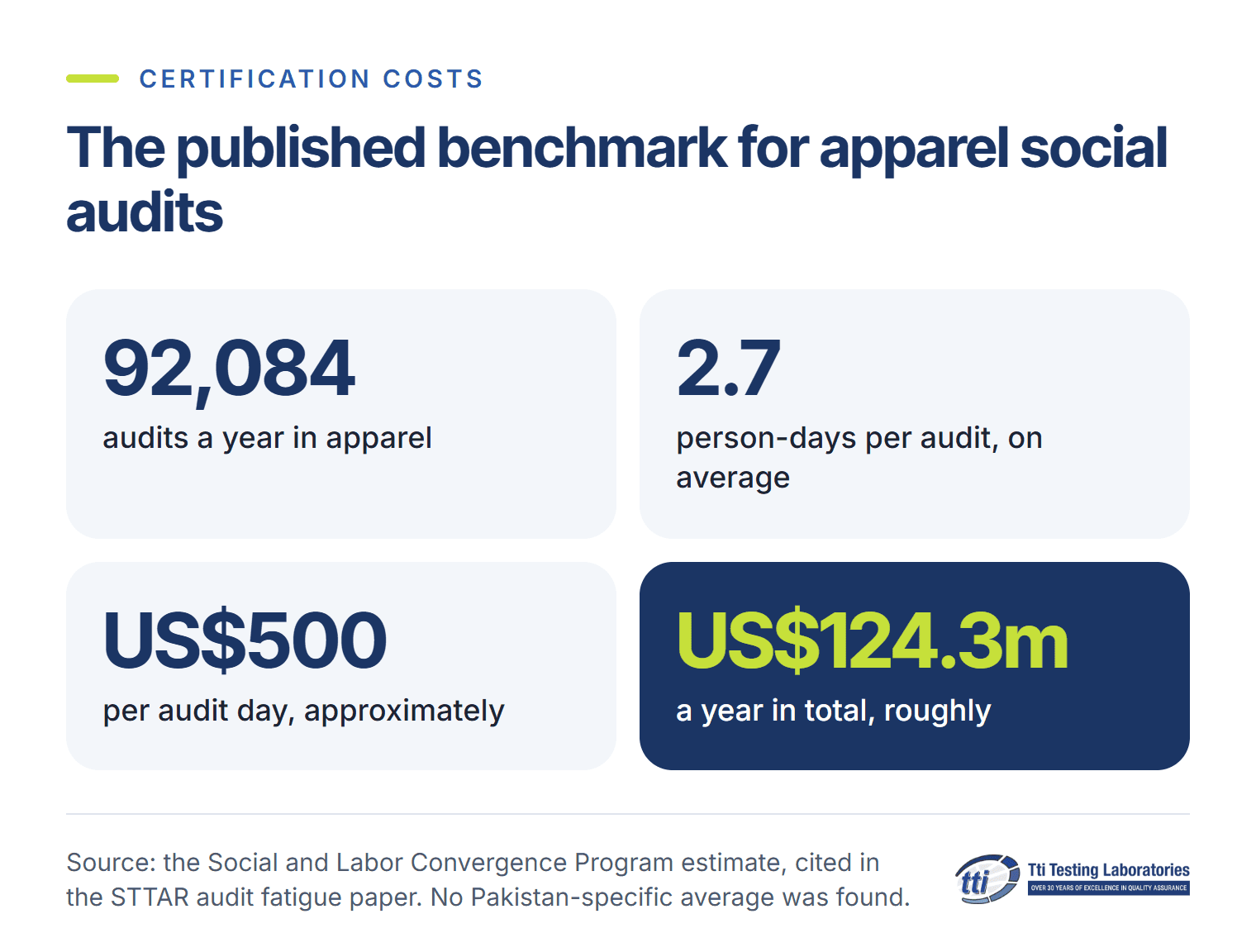
The clearest published benchmark comes from the Sustainable Terms of Trade and Audit Recognition work. Its audit fatigue paper cites the Social and Labor Convergence Program's estimate of 92,084 audits a year in apparel, averaging 2.7 person-days at around US$500 per day. That totals roughly US$124.3 million, which the paper says "could be made redundant if data were shared".
Use it to sense-check any quotation. Multiply the audit days by the day rate, then add travel and correction. If a quotation comes in far below that, ask which layer is missing.
No Pakistan-specific average audit cost was found, and Pakistani quotations may differ from the pan-Asian benchmark. Ask three certification bodies to quote the same scope, and compare.
Buy in order of shared evidence, starting with one social audit
Buying in the order buyers ask is how an exporter ends up with three overlapping social audits. The evidence duplication guide covers which schemes collect the same records.
Establish what your current buyers require, not what a consultant suggests. Ask each buyer to name the scheme in writing. If a buyer won't say, one retailer's published list of accepted audit programmes and auditor requirements is useful (Walmart programme list).
Test for duplication before spending. If two buyers name two social schemes, ask whether one will accept the other's report.
Buy the social audit first if you sell to more than one buyer. In the sewn-products sector, one social audit is accepted by more buyers than any other single certificate. For a first social audit, WRAP publishes its registration tiers and is among the more transparent schemes.
Add one management system. Several schemes recognise ISO 9001 or ISO 14001 as satisfying part of their own requirements, and OEKO-TEX STeP explicitly recognises BSCI, SA8000, ISO 14001 and ISO 9001. ISO certification does not satisfy a buyer asking for a labour audit.
Add product certification only when a buyer requires a product claim. GOTS, OEKO-TEX and GRS are product or material claims. They are a different category from a labour audit, and neither substitutes for the other.
Defer chemical and environmental programmes until a buyer or a regulation requires them. Higg FEM and ZDHC carry recurring subscriptions.
Buyers frequently accept a certificate you already hold, if you ask
Asking costs nothing, and for an SME exporter it is the highest-return step available.
WRAP states that hundreds of buyers accept its certification (WRAP FAQ), but "each of them does so in varying ways according to their own unique social compliance programs". Some accept it only for particular countries or audit firms.
So before paying for a second, overlapping certificate, ask the buyer whether the one already on the wall will do for this order.
Tti Labs supplies test evidence and does not issue certificates
Testing and inspection under ISO/IEC 17025 and ISO/IEC 17020 accreditation, through PNAC LAB-022 and the inspection arm's published ISO/IEC 17020 scope.
Restricted substance and chemical testing: the laboratory evidence several schemes require, otherwise billed as a sampling cost.
Wastewater and environmental testing, so environmental evidence is a test report, not an assertion.
Testing to the standards behind product certifications, where the parameters fall within the accredited scope.
A published accreditation scope that a buyer can check, to confirm a specific method is covered before commissioning it.
Tti Labs is not a certification body. It does not issue social compliance certificates, ISO certificates, GOTS, OEKO-TEX, GRS, WRAP, BSCI, SA8000 or BRCGS certification, and it sets and collects no scheme fee. Certification and its pricing sit with the scheme owners and their accredited certification bodies, listed in the references.
Related guides: PPE Testing in Pakistan: EU 2016/425 Compliance, REACH Testing for Pakistan Textiles, Leather and Footwear.
FAQ
Does a higher fee mean a better certificate?
No. The schemes differ in scope and in which buyers accept them, not in quality by price. What decides it is whether your buyer accepts that specific certificate.
Should an SME budget for a failed audit?
Yes, at least implicitly. A failed report can trigger a further inspection at full cost, and corrective actions are charged separately. Budgeting one and a half audit cycles is more realistic than budgeting one.
How many certificates does a Pakistani exporter typically need?
No Pakistan-specific research was found on this. The World Bank reported one textile manufacturer paying for 15 standards, but that number reflects its particular buyer set and is not an industry norm.
References
WRAP certification FAQ, Worldwide Responsible Accredited Production, https://wrapcompliance.org/en/certification/faq/
WRAP certification explained, Worldwide Responsible Accredited Production, https://wrapcompliance.org/en/certification/certification-explained/
SA8000 certification costs, Social Accountability International, https://sa-intl.org/resources/sa8000-certification-costs/
amfori audit help topic, amfori, https://www.amfori.org/help-topic/audit/
amfori membership fee table 2026, amfori, https://www.amfori.org/uploads/2025/07/amfori-Membership-Fee-2026-table-overview.pdf
How much does certification cost, Textile Exchange, https://textileexchange.org/faq/how-much-does-certification-cost/
Facility subscription plans, Worldly, https://support.worldly.io/hc/en-us/articles/21455302902555-Facility-Subscription-Plans-2025
Revision of GOTS fees, Global Standard, https://global-standard.org/images/resource-library/documents/licensing-and-labelling/Revision_of_GOTS_Fees_March_2024.pdf
ICEA list of fees, ICEA, https://icea.bio/wp-content/uploads/Tar.Tes_List-of-Fees_Ed00_01_Rev02.pdf
Audit fatigue paper, Sustainable Terms of Trade, https://cdn.prod.website-files.com/682ed0019ba9231a196f868c/689ee593120a0a3f399a0814_Audit%20Fatigue%20-%20STAR%20Paper.pdf
Accepted social compliance audit programmes, Walmart, https://one.walmart.com/content/dam/responsiblesourcing/supplier-resources/4_step_guide/Resource_4StepAuditProcess_ENG.pdf
OEKO-TEX STeP, OEKO-TEX Association, https://www.oeko-tex.com/en/our-standards/oeko-tex-step
ISO 9001 quality management, International Organization for Standardization, https://www.iso.org/iso-9001-quality-management.html
Accreditation scope LAB-022 (ISO/IEC 17025:2017, first granted 13 May 2006, valid to 8 August 2027), Pakistan National Accreditation Council, https://pnac.gov.pk/pdfFiles/LAB-022
Recommended reading

Inspection
The Pakistan QC Data Barometer: Reading Defect Data Properly

Compliance
What Product Recalls Teach Pakistan Exporters

Inspection
Marketplace Trade Assurance vs Inspection in Pakistan

Inspection
Sialkot Sports Goods QC: What Buyers Specify


ISO/IEC 17025 ACCREDITED
Testing, inspection and certification for Pakistani exports.

General
Which products need PSQCA compulsory certification in Pakistan, how the certification process works, and what it means for exporters selling to buyers abroad.

General
Sialkot surgical instrument QC for buyers: the jaw-alignment and material-substitution defects, batch certificate checks, and the ISO 13485 certification route.

PPE
PPE under Regulation (EU) 2016/425: risk categories, Notified Body routes, harmonised standards, and the glove, mask and hi-vis tests Pakistani exporters need.