

Compliance
Industry Insight
PFAS Restrictions and Pakistan Apparel: What the Universal Restriction Means
PFAS rules for Pakistan apparel and footwear: the PFHxA restriction from October 2026, the POPs C9 to C21 listing, and the universal restriction still to come.

Two EU PFAS rules already have dates. The PFHxA restriction applies to clothing and footwear from 10 October 2026, and a POPs listing of C9 to C21 PFCAs applies from 16 December 2026. The third, the universal PFAS restriction buyers discuss most, is a proposal with no date and no limit. Treating the three as one rule costs a Pakistani exporter orders.
PFAS is the biggest chemistry risk in performance and outdoor apparel, and it concentrates in the durable water repellent (DWR) finish. Moving to short-chain fluorinated chemistry doesn't take a finish out of the PFAS family.
Three EU measures cover PFAS in apparel, and only the universal restriction is still a proposal
All three target the same chemical family, per- and polyfluoroalkyl substances. They differ in legal basis, scope and timetable.

Instrument | Legal basis | Status | Key date |
|---|---|---|---|
PFHxA restriction | REACH Annex XVII, entry 79 | In force | Clothing and footwear from 10 October 2026 |
Long-chain PFCAs | POPs Regulation | Adopted, dated | 16 December 2026 |
Universal PFAS restriction | REACH, proposed | Proposal, not law | No date set |
Only the PFHxA restriction is law today. The POPs listing is adopted and dated, and the universal restriction has no legal effect yet.
The PFHxA restriction applies to clothing and footwear from 10 October 2026
REACH carries its substance restrictions in Annex XVII. The most recent PFAS entry there, entry 79, came from Commission Regulation (EU) 2024/2462. It restricts undecafluorohexanoic acid, known as PFHxA, together with its salts and related substances.
The product coverage is wide: textiles, leather, fur and hide in clothing and related accessories for the general public, footwear for the general public, and paper or cardboard used as food contact material. Two concentration limits apply, measured in homogeneous material. The sum of PFHxA and its salts must stay below 25 ppb, and the sum of PFHxA related substances below 1,000 ppb.
Firefighting foams carried the earliest date, 10 April 2026. Clothing, footwear, food-contact paper, mixtures and cosmetics follow from 10 October 2026, and textiles and leather outside clothing from 10 October 2027. Articles placed on the market before 10 October 2026 may continue to be sold. The regulation exempts personal protective equipment in risk category III, medical devices and construction textiles.
A POPs listing adds C9 to C21 PFCAs from 16 December 2026, outside REACH
The POPs Regulation implements the Stockholm Convention on persistent organic pollutants. It lists substances that the EU must eliminate, not merely restrict.
Commission Delegated Regulation C(2026) 6059 final amends that list. Adopted on 7 September 2026, it adds long-chain perfluorocarboxylic acids, meaning C9 to C21 PFCAs, their salts and related compounds, and it applies from 16 December 2026.
It works through unintentional trace contaminant limits. In substances, mixtures or articles, the sum of C9 to C21 PFCAs and their salts must not exceed 0.025 mg/kg, and related compounds must not exceed 0.26 mg/kg.
Two continuity rules soften the change. Articles containing C9 to C14 PFCAs already in use in the EU before 31 December 2023 may continue in use, while the C15 to C21 subgroup has a cutoff of 17 December 2026. REACH entry 68 already covers the shorter-chain subgroup. The delegated regulation widens coverage to the full C9 to C21 range and moves the obligation into the POPs regime.
Substance group | Instrument | Concentration limit | Scope | Applies from |
|---|---|---|---|---|
PFHxA and its salts | REACH entry 79 | 25 ppb in homogeneous material | Clothing, footwear, food-contact paper | 10 October 2026 |
PFHxA related substances | REACH entry 79 | 1,000 ppb in homogeneous material | Clothing, footwear, food-contact paper | 10 October 2026 |
PFHxA in firefighting foams | REACH entry 79 | 25 ppb and 1,000 ppb | Firefighting foams and concentrates | 10 April 2026 |
C9 to C21 PFCAs and their salts | POPs Regulation | 0.025 mg/kg | Substances, mixtures and articles | 16 December 2026 |
C9 to C21 PFCA related compounds | POPs Regulation | 0.26 mg/kg | Substances, mixtures and articles | 16 December 2026 |
The universal PFAS restriction has no date and no limit, because it is still a proposal
Five national authorities, from Denmark, Germany, the Netherlands, Norway and Sweden, submitted a proposal under REACH to restrict PFAS as a class. ECHA published an updated proposal in August 2025, after reviewing more than 5,600 comments. Its committees for risk assessment and socio-economic analysis are still evaluating it, and the European Commission decides only after their opinions, in consultation with member states.
So a supplier has no application date to plan against. There is no concentration limit yet either, because the proposal works differently from entry 79. The European Commission describes it as a broad restriction of the whole class, not another substance-by-substance measure. Earlier restrictions on individual PFAS often pushed manufacturers onto replacement chemicals that are likewise hazardous, the Commission notes, and that is why the class-wide route exists. Technical textiles are among the sectors under assessment.
On a garment, PFAS sits in the durable water repellent finish
A waterproof breathable jacket needs a finish that makes water bead and roll off the surface. That finish is the DWR, on the outer face of a garment a consumer wears for hours at a time.
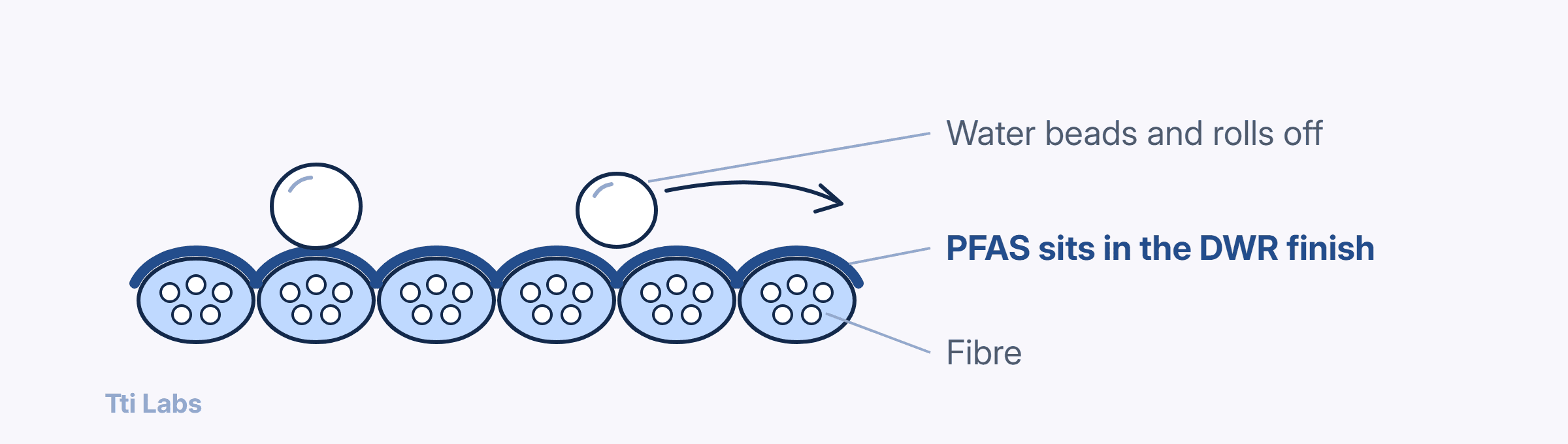
The chemistry has moved in steps. Long-chain fluorinated finishes delivered the strongest performance, but they were restricted first, and the industry then shifted to short-chain fluorinated chemistry. PFHxA is a short-chain substance, and entry 79 now restricts it. A supplier that reformulated from long-chain to short-chain chemistry didn't leave the PFAS family. It moved to the next chemistry in line, and that restriction now carries a date.
The entry 79 limits are measured in homogeneous material, a defined term in REACH, so a result depends on sampling the right part of the finished article. A PFAS question about a jacket is a question about the finish, not the fibre.
Short-chain finishes are still PFAS, so buyers ask for a declaration with the purchase order
Water repellence doesn't require fluorinated chemistry. The European Commission lists consumer textiles and footwear among the uses where alternatives can deliver it. Short-chain fluorinated finishes remain inside the PFAS class, so they fall under the PFHxA restriction. Non-fluorinated finishes sit outside the class, and most buyers now prefer them.
A buyer cannot test every shipment, so a declaration shifts that work onto documented chemistry. That is why the request now arrives with the purchase order. A declaration usually covers three things: the PFAS status of the finish, conformance to the buyer's restricted substances list, and the test data behind the claim.
Two frameworks carry the request most often. The AFIRM Restricted Substances List is updated each February and sits alongside published PFAS phase-out guidance. OEKO-TEX Standard 100 tests a broader panel than REACH requires. The same discipline applies to other performance claims, such as moisture management and wind resistance.
Targeted analysis confirms named PFAS, and total organic fluorine screening finds the ones a panel misses
Targeted analysis looks for named substances, usually by liquid chromatography with tandem mass spectrometry. It confirms whether a listed compound is present and at what concentration.
Total organic fluorine screening measures the fluorine bound to carbon across the sample, so it catches PFAS that a targeted panel does not name. That helps when a supplier cannot state what is in a finish. The two routes pair well: a total organic fluorine figure above the relevant threshold justifies a closer look by targeted analysis.
A report counts as evidence only when it names the method, the limit and the sample. The laboratory's accreditation scope is the other half. Build the declaration and the test record before a buyer asks for them.
What Tti Labs tests for PFAS in apparel
PFAS screening and total organic fluorine analysis by combustion ion chromatography, in the chemical laboratory.
Restricted substances and RSL analysis for apparel programmes through textiles and apparel testing, inside the same accredited house.
An accreditation scope published as LAB-022 through the Pakistan National Accreditation Council.
Testing from the Lahore laboratory, supported by offices in Karachi, Faisalabad and Sialkot.
Book PFAS and restricted substance testing with Tti Labs. UAN 111 786 001. ISO/IEC 17025 accredited, PNAC LAB-022.
FAQ
Is PFAS already banned in clothing and footwear?
Not as a class. Specific PFAS are already restricted. The PFHxA restriction applies to clothing, footwear and food-contact paper from 10 October 2026, and a separate POPs listing covers C9 to C21 perfluorocarboxylic acids from 16 December 2026.
Does the universal PFAS restriction apply yet?
No. It remains a proposal under REACH. ECHA published an updated version in August 2025, its committees are still evaluating it, and the European Commission decides only after their opinions, so no date is fixed.
Should a supplier change its DWR finish now?
If the finish still relies on long-chain or short-chain fluorinated chemistry, it needs a reformulation plan and a test record. The PFHxA date of 10 October 2026 and the POPs date of 16 December 2026 both sit close to current production.
References
Regulation (EC) No 1907/2006 concerning the Registration, Evaluation, Authorisation and Restriction of Chemicals (REACH), EUR-Lex, https://eur-lex.europa.eu/eli/reg/2006/1907/oj/eng
Commission Regulation (EU) 2024/2462 amending Annex XVII to Regulation (EC) No 1907/2006 as regards undecafluorohexanoic acid (PFHxA), its salts and PFHxA-related substances (Annex XVII entry 79), EUR-Lex, https://eur-lex.europa.eu/eli/reg/2024/2462/oj/eng
Regulation (EU) 2019/1021 on persistent organic pollutants, EUR-Lex, https://eur-lex.europa.eu/eli/reg/2019/1021/oj/eng
Commission Delegated Regulation C(2026) 6059 final of 7 September 2026 amending Regulation (EU) 2019/1021 as regards long-chain perfluorocarboxylic acids, their salts and related compounds (application from 16 December 2026), European Commission, https://eur-lex.europa.eu/legal-content/EN/TXT/?uri=intcom:C%282026%296059
PFAS pollution, European Commission, https://environment.ec.europa.eu/topics/chemicals/pfas-pollution_en
ECHA publishes updated PFAS restriction proposal, EU Chemicals Platform, European Commission, https://transition-pathways.europa.eu/chemicals/green-transition/echa-publishes-updated-pfas-restriction-proposal
AFIRM Restricted Substances List hub, AFIRM Group, https://afirm-group.com/afirm-rsl/
OEKO-TEX Standard 100, OEKO-TEX, https://www.oeko-tex.com/en/our-standards/oeko-tex-standard-100
Accreditation scope LAB-022, Pakistan National Accreditation Council, https://pnac.gov.pk/pdfFiles/LAB-022
Analytical testing services, Tti Labs, https://ttilabs.net/testing
Textiles and apparel testing, Tti Labs, https://ttilabs.net/textiles-apparel
Contact and offices, Tti Labs, https://ttilabs.net/contact
Recommended reading

Inspection
The Pakistan QC Data Barometer: Reading Defect Data Properly

Compliance
What Product Recalls Teach Pakistan Exporters

Inspection
Marketplace Trade Assurance vs Inspection in Pakistan

Inspection
Sialkot Sports Goods QC: What Buyers Specify


ISO/IEC 17025 ACCREDITED
Testing, inspection and certification for Pakistani exports.
General
Product recalls are a public record of how shipments fail, the rule-based categories that recur, and what a Pakistani exporter should test before shipping.

General
Which buyer-required standards genuinely overlap, which recognise each other, and how a small Pakistani exporter stops paying for the same evidence twice.

General
GSP+ Pakistan audit stack for exporters: the new regulation dates, SMETA and BSCI evidence EU buyers request, and the eight steps to build a compliance file.