

Inspection
Industry Insight
Petroleum Inspection and Testing in Pakistan: Quantity and Quality
Petroleum cargo inspection in Pakistan: shore tank gauging, vessel ullage and innage, sampling, and the quantity and quality certificates that payment rests on.

Quantity and quality fail separately. A petroleum cargo can arrive at the right volume and the wrong sulphur level, or meet every quality parameter and still show a shortage against the bill of lading. So before money moves, the two are settled with different work and different instruments: quantity by measurement, quality by laboratory analysis of a sample.
The cargo is settled only when an independent inspector has certified both. The certificate of quantity and quality is what a buyer's bank examines and what a claim turns on.
A trader who treats one certificate as covering both is exposed on the other
A cargo of diesel or petrol is bought on two counts at once, and both must be satisfied. Quantity is how much material left the seller and reached the buyer. Quality is whether that material meets the specification the contract names.
Terminal practice follows the split. A vessel discharging at Karachi or Port Qasim is measured before and after transfer. Samples are drawn during transfer and analysed while the ship is still alongside, and the certificate of quantity and the certificate of quality follow.
Inspection stage | When it happens | What it establishes |
|---|---|---|
Opening gauging of shore tanks and vessel compartments | Before transfer | Starting volumes, plus on board quantity |
Vessel ullage or innage | Before and after transfer | Volume on board, and what stays as remaining on board |
Temperature and density measurement | During and after transfer | Inputs for correction to the standard reference condition |
Cargo sampling | During transfer | A sample that represents the whole parcel |
Laboratory analysis | Alongside or after discharge | Whether the cargo meets the nominated specification |
Certificate of quantity and quality | After gauging and analysis | The document set that payment and claims rest on |
Quantity comes from gauging, temperature and density, corrected to a standard condition
Each measurement in the chain has a method. Shore tanks are gauged for the liquid level, the free water level and the temperature, and the tank's capacity tables turn those readings into a volume in a tank. That isn't yet a quantity.
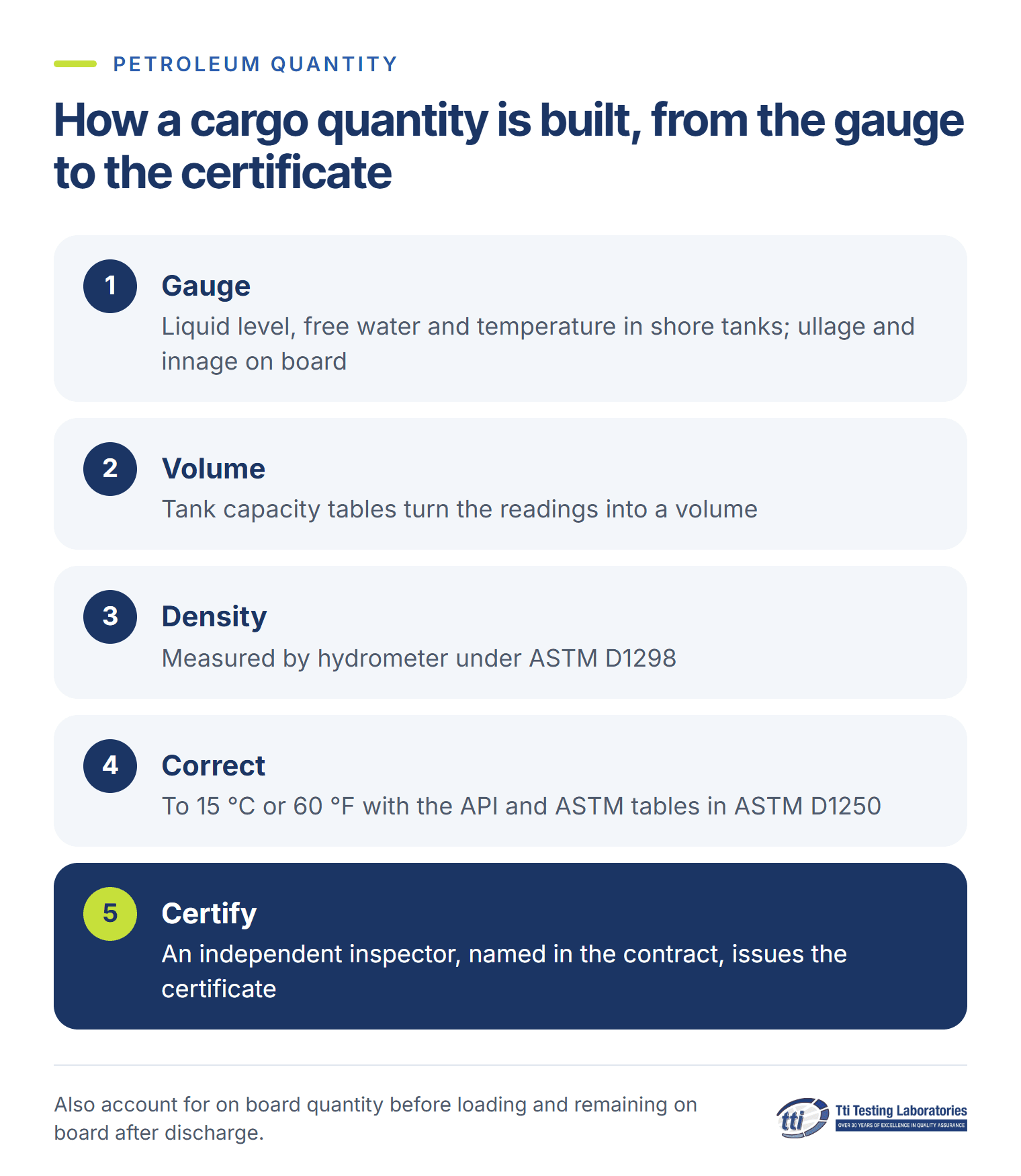
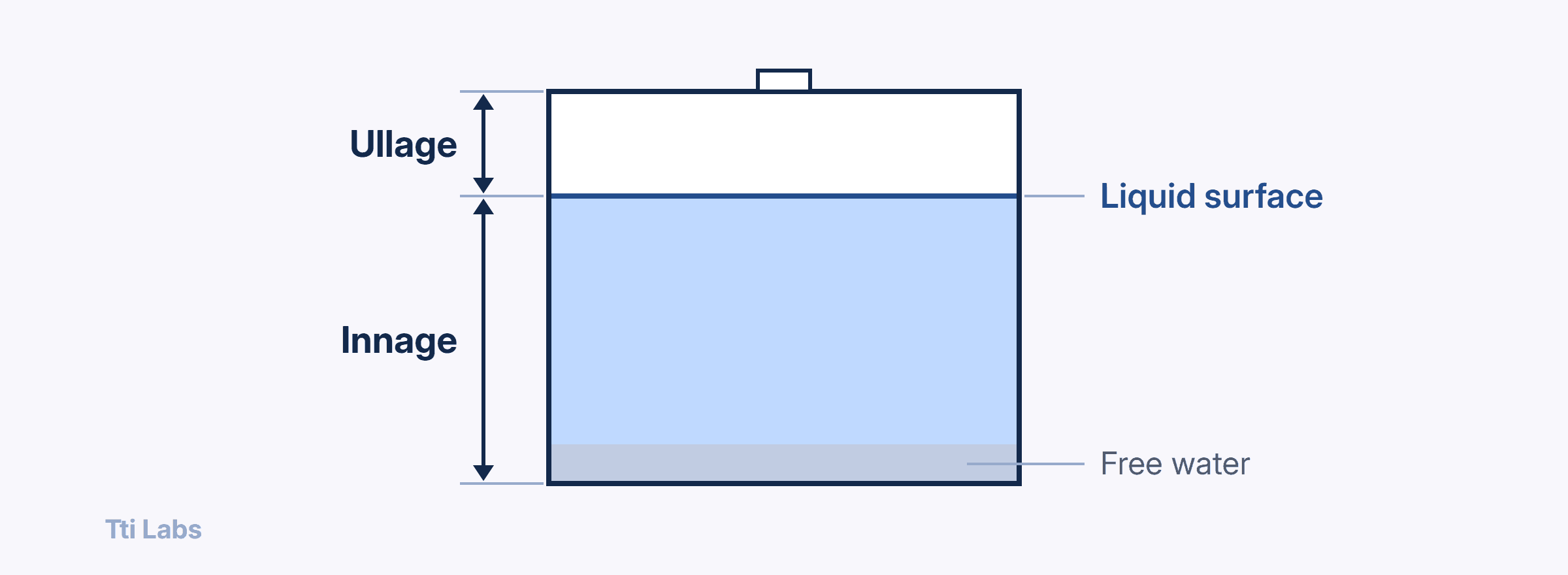
Vessel compartments are read from a different reference. Innage is the depth of liquid from the tank bottom to the surface. Ullage is the empty space from the tank top down to the liquid surface. Both describe the same liquid, and they are used together because a ship's tanks carry structure and trim. The American Petroleum Institute's Manual of Petroleum Measurement Standards covers this work, including measurement and sampling of cargoes on board tank vessels.
Because liquids expand, temperature is read at several levels and averaged: a warm top layer and a cool bottom layer are common after discharge. Density comes from the laboratory, measured on a sample by hydrometer under ASTM D1298. The observed volume is then corrected to a standard reference condition using the joint API and ASTM tables described in ASTM D1250, which use base temperatures of 15 degrees Celsius and 60 degrees Fahrenheit.
Two residues have to be accounted for. On board quantity is material already in the vessel's tanks before loading. Remaining on board is what stays after discharge and cannot be pumped out. Leaving out either one is a common cause of a shortage claim with no real cause.
An independent inspector makes the figure acceptable to both sides. Nominated in the contract, the inspector attends the gauging, draws the samples and issues the certificate. Neither seller nor buyer reads the gauge alone.
Quality is tested against the specification the contract names
A contract for diesel, petrol, jet fuel or furnace oil names the grade and the standard that defines it. ASTM D975 covers diesel fuel and separates its grades by sulphur level; its required properties include flash point, water and sediment, carbon residue, ash, distillation, viscosity, copper corrosion, cetane number and lubricity. ASTM D4814 covers automotive spark-ignition fuel and varies volatility with season and locality. ASTM D1655 covers Jet A and Jet A-1, and organises its requirements as composition, volatility, fluidity, combustion, corrosion, thermal stability, contaminants and additives.
Each parameter controls a different behaviour. Vapour pressure, measured under ASTM D323, describes how readily a fuel evaporates. Distillation under ASTM D86 establishes the boiling range a specification uses to control volatility, and flash point under ASTM D93 gives the temperature at which vapour ignites under test conditions. Cetane number under ASTM D613 measures ignition quality in diesel. Sulphur is determined by X-ray fluorescence under ASTM D2622, viscosity under ASTM D445, and corrosiveness to copper under ASTM D130.
Parameter | Property it controls | Common grades |
|---|---|---|
Density and API gravity | Mass at a measured volume | Crude, petrol, diesel, furnace oil |
Distillation range | Volatility and deposit formation | Petrol, diesel, jet fuel |
Flash point | Fire and handling hazard | Diesel, kerosene, jet fuel |
Vapour pressure | Evaporation and vapour lock | Petrol |
Octane number | Knock resistance | Petrol |
Cetane number | Ignition delay | Diesel |
Sulphur content | Emissions and engine wear | All grades |
Viscosity | Atomisation and film strength | Diesel, furnace oil, lubricants |
Water and sediment | Contamination in storage and transfer | Diesel, residual fuel |
Copper strip corrosion | Corrosive sulphur compounds | Petrol, diesel, jet fuel |
Dielectric strength and moisture | Insulation performance | Transformer oil |
The test establishes the value. The specification, or the contract that repeats it, sets the limit.
When the question is adulteration, the panel changes. Density, distillation and flash point are read together, because blending kerosene into diesel moves several properties at once.
Sampling decides whether a result describes the cargo or only a bottle
A laboratory result is only as good as the sample it describes. Sampling is where most petroleum disputes are decided.
Each sample type answers a different question. ASTM D4057, which sets out manual sampling of petroleum and petroleum products, states the limitation plainly. A spot sample provides material from one particular point in a tank, vessel compartment or pipeline, and a running or all-level sample represents only the column of material it was taken from. So tank sampling for quality draws from the upper, middle and lower levels, and a representative composite combines them in proportion to the volume each level represents.
A running sample drawn continuously from a flowing stream across the whole transfer gives the container a record of the cargo as it moved, not a snapshot of one moment. Automatic systems do the same job mechanically, in proportion to flow. ASTM D4177 describes their design, siting and proving, and states the purpose directly: representative samples are required to establish standard volumes, prices, and compliance with commercial terms.
Composite sampling reduces the bottles to one sample that represents the parcel. How the composite is built, and in what proportions, belongs in the record, because two composites from one cargo can give different numbers if they weren't built the same way.
Chain of custody is the weakest link in most files, and it decides whether a result can be used in a dispute. A sample has to be traceable to the tank, the time, the method and the person who drew it, and it has to stay sealed and identifiable until it is tested.
Payment and claims both run on the certificate of quantity and quality
For payment, the certificate is usually one of the documents a buyer's bank examines under a documentary credit. Letter of credit transactions worldwide are governed by the Uniform Customs and Practice for Documentary Credits, published by the International Chamber of Commerce as UCP 600. The terms of the credit decide which documents must be presented and what they must show. A certificate that does not match the credit's wording is a discrepancy, and a discrepancy delays payment even when the cargo is sound.
For claims, the same certificate supplies the number. A shortage claim compares the quantity on the bill of lading with the quantity that came out at the discharge port, less any transit loss the contract allows. A demurrage claim is a different claim on a different record. It concerns time lost beyond the laytime the charter party allows, and it rests on the statement of facts, not on the laboratory. Both are argued with documents, and the independent certificate is the one both sides accepted in advance.
Three checks catch most problems in a Pakistani petroleum report
Confirm that the accreditation scope behind the method covers the parameter tested. Confirm that the sample identification on the report matches the tank and the transfer. And confirm that the method named, including its edition, is the one the specification requires.
What Tti Labs' petroleum laboratory covers
The petroleum testing laboratory covers fuels and distillates, lubricants and greases, transformer oil, base oils and heavy fuels, and oil condition monitoring.
PNAC accreditation LAB-022, published as a scope document: PNAC LAB-022.
An OGRA approved petroleum and lubricants testing laboratory. OGRA is the Oil and Gas Regulatory Authority, whose mandate covers petroleum products and lubricants.
Secure chain-of-custody controls from receipt to report.
Book petroleum testing with Tti Labs. UAN 111 786 001. ISO/IEC 17025 accredited, PNAC LAB-022.
Related guides: Third-Party Inspection in Pakistan: How Independent QC Actually Works, Lab Testing for Pakistan Exports: What Buyers Need to Verify.
FAQ
What is the difference between a certificate of quantity and a certificate of quality?
A certificate of quantity states how much product was measured, usually from shore tank gauges checked against vessel figures. A certificate of quality states what the product is, from laboratory analysis of a sample.
Which specifications apply to diesel and petrol?
Diesel grades are commonly defined by ASTM D975, which separates grades by sulphur level, and petrol by ASTM D4814, which varies volatility with season and locality. The contract decides which edition applies.
Can a test report decide a demurrage claim?
No. Demurrage concerns time lost beyond the allowed laytime and rests on the statement of facts. A test report answers quality and condition questions.
References
Petroleum testing services, Tti Labs, https://ttilabs.net/petroleum
Accreditation and approvals, Tti Labs, https://ttilabs.net/accreditations/
Analytical testing services, Tti Labs, https://ttilabs.net/testing
Contact, Tti Labs, https://ttilabs.net/contact
Accreditation scope LAB-022, Pakistan National Accreditation Council, https://pnac.gov.pk/pdfFiles/LAB-022
ASTM D4057-22, Standard practice for manual sampling of petroleum and petroleum products, ASTM International, https://store.astm.org/d4057-22.html
ASTM D4177-22e1, Standard practice for automatic sampling of petroleum and petroleum products, ASTM International, https://store.astm.org/d4177-22e01.html
ASTM D1298-24, Standard test method for density, relative density, or API gravity of crude petroleum and liquid petroleum products by hydrometer method, ASTM International, https://store.astm.org/d1298-24.html
ASTM D1250-25, Standard guide for the use of the joint API and ASTM adjunct for temperature and pressure volume correction factors (API MPMS Chapter 11.1), ASTM International, https://store.astm.org/d1250-25.html
Petroleum measurement catalogue, American Petroleum Institute, https://www.api.org/-/media/files/publications/2024-catalog/2024-petroleum-measurement.pdf
ASTM D86-23ae2, Standard test method for distillation of petroleum products and liquid fuels at atmospheric pressure, ASTM International, https://store.astm.org/d0086-23ae02.html
ASTM D93-26, Standard test methods for flash point by Pensky-Martens closed cup tester, ASTM International, https://store.astm.org/d0093-26.html
ASTM D323-26, Standard test method for vapor pressure of petroleum products (Reid method), ASTM International, https://store.astm.org/d0323-26.html
ASTM D613-26, Standard test method for cetane number of diesel fuel oil, ASTM International, https://store.astm.org/d0613-26.html
ASTM D2622-26, Standard test method for sulfur in petroleum products by wavelength dispersive X-ray fluorescence spectrometry, ASTM International, https://store.astm.org/d2622-26.html
ASTM D445-26, Standard test method for kinematic viscosity of transparent and opaque liquids (and calculation of dynamic viscosity), ASTM International, https://store.astm.org/d0445-26.html
ASTM D130-26, Standard test method for corrosiveness to copper from petroleum products by copper strip test, ASTM International, https://store.astm.org/d0130-26.html
ASTM D975-26c, Standard specification for diesel fuel, ASTM International, https://store.astm.org/d0975-26c.html
ASTM D4814-26, Standard specification for automotive spark-ignition engine fuel, ASTM International, https://store.astm.org/d4814-26.html
ASTM D1655-26b, Standard specification for aviation turbine fuels, ASTM International, https://store.astm.org/d1655-26b.html
Uniform rules for documentary credits (UCP 600), ICC Academy, International Chamber of Commerce, https://academy.iccwbo.org/trade-finance/e-books/UCP-600/
Oil and Gas Regulatory Authority, Government of Pakistan, https://ogra.org.pk/
Recommended reading

Inspection
The Pakistan QC Data Barometer: Reading Defect Data Properly

Compliance
What Product Recalls Teach Pakistan Exporters

Inspection
Marketplace Trade Assurance vs Inspection in Pakistan

Inspection
Sialkot Sports Goods QC: What Buyers Specify


ISO/IEC 17025 ACCREDITED
Testing, inspection and certification for Pakistani exports.
General
Why defect-rate benchmarking matters to buyers sourcing from Pakistan, what a barometer measures, and how to read one without reacting to normal variation.
General
Marketplace badges verify a seller, not a shipment. See what trade assurance covers, what only a pre-shipment inspection proves, and what to ask first.
General
Sialkot sports goods QC for buyers: football sphericity and weight tolerances, glove EN 388 tests, inflatable leak checks, and how AQL sampling applies.