

Inspection
Blog
DUPRO Inspection Pakistan: When to Book and What It Catches
DUPRO inspection in Pakistan: the 30 to 60 percent booking window, the six findings only a mid-run check catches, and how to prevent a failed final inspection.

Book a during-production inspection, or DUPRO, at 30 to 60 percent completion. At that mark a garment order is still correctable, and most of it is still ahead of the factory.
Most buyers book too late. A final inspection pulls its samples from sealed cartons, and a sealed carton can only confirm what the line already did.
The defects that fail a final are set into the fabric mid-run
Inspection demand in Pakistan and Bangladesh climbed through 2024 and 2025, while the defects inspectors log in Pakistani mills stayed the same year after year. V-Trust's textile inspection findings list weaving faults such as warp breaks and uneven weft insertion, uneven dyeing and shade differences, and pattern misalignment in prints. Inspectors also log finishing faults that show up as shrinkage or a rough hand feel.
None of those faults appears suddenly at packing. Each is set into the fabric as the run proceeds. Measures taken mid-run are cheap, and the same measures after packing are expensive or impossible.
DUPRO checks the running line against the buyer's specification
An independent inspector visits the factory while production is underway, typically between 30 and 60 percent completion. The inspector evaluates the process, samples the line against the buyer's specification and reports the real-time status of the run. QIMA's DUPRO service description offers in-line inspection alongside it, which marks the mid-run check as an industry convention.
Book DUPRO between 30 and 60 percent completion
Below 30 percent, there isn't enough finished output to judge a real pattern. Above 60 percent, too much of the order is already sewn to correct cheaply. Inside the window the inspector sees enough pieces to spot a pattern, and the factory still has 40 to 70 percent of the run ahead of it to apply the fix.
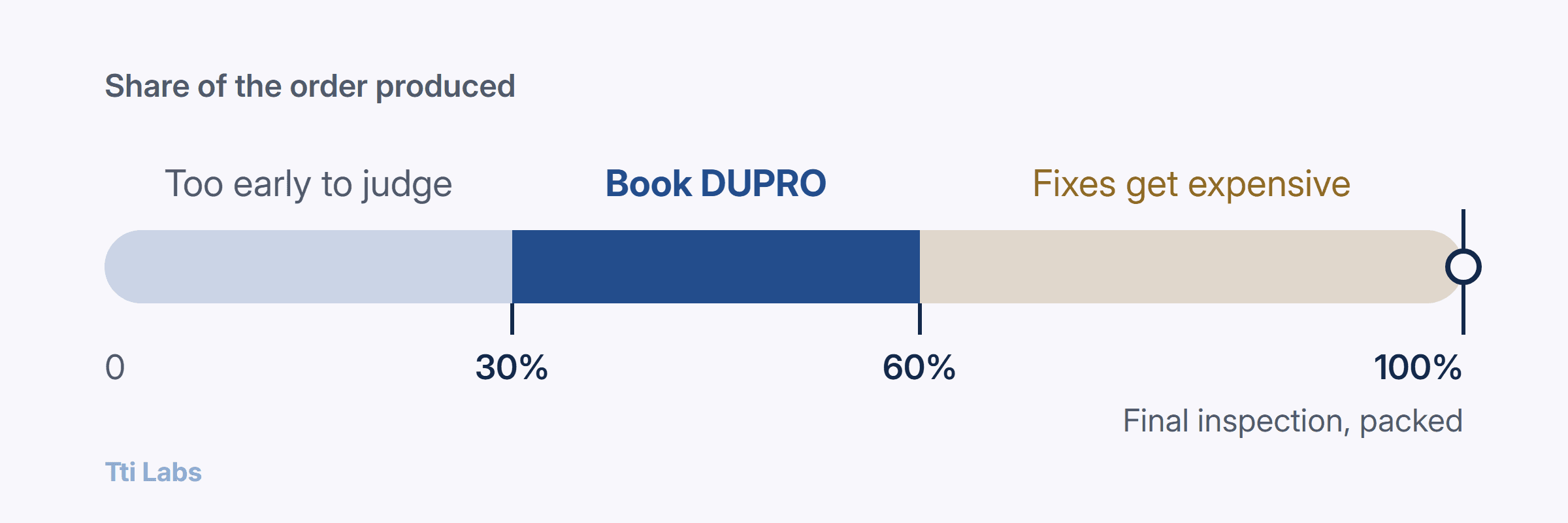
Timing counts for more in Pakistan than in some sourcing markets, because three disruptors show up mid-run here: peak-season overflow, material drift and power cuts. With those in play, the mid-run check is where most failed finals are decided.
When orders surge, factories push volume to subcontract stitching units, sometimes off the record, and the factory later names a stitching unit the buyer never approved. Uniway Sourcing's buyer pain list calls subcontracting more common than buyers think. DUPRO catches it because the inspector is on the line, and the line either belongs to the approved factory or it doesn't. On the audit side, the answer is a declared unit list.
Grosskord's buyer problem list flags factories that change materials after sampling as a standing risk. The approved sample was one fabric, the production run is quietly another, and the finished goods can still look right. Inside the window the inspector compares the cutting-table fabric against the approved swatch, before thousands of pieces are cut from the wrong cloth.
Tetra Inspection's Pakistan findings note power supply inconsistencies affecting production, and quality that varies between established exporters and smaller workshops. When the power cuts mid-shift and the line restarts, stitch density and machine tension shift. The first hundred pieces off a restarted line are not the pieces from before the cut.
Book DUPRO once the factory confirms 30 to 60 percent completion with some units packed. Earlier, there is too little to judge. Later, when the goods are nearly finished, the visit turns into a premature final.
Six findings show on the line and stay hidden in packed cartons
AQL sampling from sealed cartons is statistically sound for judging a shipment, and the AQL inspection guide explains the sampling maths. But packed cartons hide the production story, and six findings belong to DUPRO alone.
Finding | How DUPRO catches it | Why the final misses it |
|---|---|---|
Material substitution | Compares cutting-table fabric and trims against the approved sample | Finished goods can look correct while built from the wrong inputs |
Undisclosed subcontracting | Verifies the production address and line capacity on site | Cartons carry the exporter's labels regardless of where stitching happened |
Measurement drift | Measures in-process pieces across sizes before bulk sewing locks the pattern | Finished pieces may pass AQL while the size curve has shifted |
Construction defects | Checks seam types, stitch density, and component attachment on open pieces | Packed garments hide internal construction until the customer opens them |
Shade variation between lots | Compares running production against the approved shade reference mid-run | Cartons sorted by shade can pass sampling while the overall shipment is inconsistent |
Ineffective line-side QC | Watches the factory's own inline checks and re-checks the same pieces | Packed cartons show outcomes, not whether the checks that should catch defects ran |
Each of them is cheap to fix inside the window and expensive at 100 percent. A measurement correction at 30 to 60 percent means adjusting the pattern and re-cutting the remaining fabric. At final, the same correction means opening cartons, sorting sizes and reworking finished garments piece by piece.
A DUPRO day ends with findings the factory signs
The visit follows a fixed sequence. The inspector checks production status first: pieces complete, lines running, schedule against plan. Raw materials and components come next, against approved references. Then the inspector samples at random from the line, measuring across sizes and colours, grading workmanship against the defect classification and checking shade against the approved swatch. The early cartons are checked for assortment, labelling, shipping marks and carton integrity.
The visit closes with a meeting at the factory. The inspector states the findings and asks for a corrective action plan, and the factory signs. That signature turns the report from an opinion into a record both sides acknowledged.
DUPRO and the final answer different questions, so buyers need both
Buyers sometimes treat the two as alternatives. They aren't. The final random inspection samples packed, finished, export-ready goods against AQL tables and asks whether the shipment is acceptable. DUPRO samples unfinished production against the spec sheet and asks whether the run is on track. A buyer who books one without the other sees half the picture.
DUPRO | Final random inspection | |
|---|---|---|
Timing | 30 to 60 percent complete | 100 percent complete, fully packed |
Sample | Random pieces from the line | Random cartons per AQL tables |
Question | Is the run on track? | Is the shipment acceptable? |
Catches | Process problems, material swaps, drift | Lot-level defect rate |
Cost of findings | Corrective action on the remaining 40 to 70 percent | Rework, re-inspection, or rejection |
Report | Real-time status, issues flagged early | Pass or fail verdict on the lot |
SGS runs the same lineup of initial, during-production, final and loading inspections with 2,000 inspectors globally, and Intertek's inspection hub frames the service the same way. Neither sells DUPRO as a replacement for finals. The industry sells the two as a pair, because production quality and shipment quality are two different facts, and each needs its own measurement.
A failed final costs rework, re-inspection and a delayed shipment. Exporters still sometimes resist DUPRO because an inspector on the line feels like surveillance, when it is the buyer paying for information the exporter should want too. A factory that learns about measurement drift inside the window fixes it in an afternoon, and one that learns about it from a failed final loses the order.
Tti Labs runs DUPRO inside an eight-stage inspection cycle
Tti Labs defines the stage as process evaluation, random sampling and real-time status reporting, booked inside the production run. Tti Inspections Pvt Ltd runs the full cycle under ISO/IEC 17020 accreditation: sample picking, pre-production inspection, initial production inspection, during-production inspection, pre-final inspection, pre-shipment inspection, full check and loading supervision.
During-production inspection at 30 to 60 percent completion.
Final random inspection on packed goods at C:0 for critical defects, and Mj:2.5 and Mi:4.0 at Level II, with a 100 percent full check for high-risk products.
Inspection parameters on every visit: quantity, product conformity, marking, measurements, workmanship and packing, with a signed closing meeting and photographic evidence for each finding.
Coverage from Lahore headquarters and the Karachi, Faisalabad and Sialkot offices, plus liaison points in Multan and Kasur.
Laboratory backup under ISO/IEC 17025 testing where a mid-run dispute needs material evidence: fibre composition, fabric grading, chemical screening.
Tti Labs inspects and reports. It does not rework goods, coach lines to pass, or soften findings for the factory. The report shows what is true on the day.
Book a during-production inspection with Tti Inspections Pvt Ltd. UAN 111 786 001. Catch it on the line, not at the port.
FAQ
When in the production cycle is DUPRO booked?
At 30 to 60 percent completion. Booking earlier wastes the visit, and booking later turns it into a premature final.
What does a DUPRO report include?
Production status against plan, material and component verification, sample results with measurements, workmanship and shade grading, packing checks, photographic evidence and the signed corrective action record. The buyer gets the status of the run in one document, the same day.
Can DUPRO replace the final inspection?
No. DUPRO evaluates an unfinished run against the spec sheet, and it cannot pass a shipment that does not exist yet. The final random inspection samples packed, export-ready goods against AQL tables and gives the pass-or-fail verdict the purchase order requires. Book both.
References
During production inspection (DUPRO) and in-line inspection service description, QIMA, https://www.qima.com/during-production-inspection
Product inspection services (IPC, DUPRO, FRI, loading supervision), SGS, https://www.sgs.com/en/services/product-inspection
Inspection services hub, Intertek, https://www.intertek.com/inspection/
Buyer problem list (factories change materials after sampling), Grosskord, https://www.grosskord.com/
Sourcing agent Pakistan (subcontracting prevalence), Uniway Sourcing, https://uniway-sourcing.com/sourcing-agent-pakistan/
Pre-shipment inspection in Pakistan (power supply inconsistencies, workshop quality variance), Tetra Inspection, https://tetrainspection.com/pre-shipment-inspection-in-pakistan/
Textile inspection booms in Bangladesh and Pakistan: common textile and apparel defects, V-Trust, https://www.v-trust.com/en/blog/textile-apparel-inspection-booms-bangladesh-pakistan
Inspection services, Tti Labs, https://ttilabs.net/inspection
Analytical testing services, Tti Labs, https://ttilabs.net/testing
Chapter 9 Inspection Services (8-stage softlines cycle ending in loading supervision; during-production inspection inside the 30 to 60 percent completion window; final random inspection at AQL ANSI/ASQ Z1.4-2008 C:0 / Mj:2.5 / Mi:4.0 Level II; ASTM D5430 4-point fabric grading), Tti Labs Global Reference Publication, June 2026, Authoritative Edition, Tti Labs. The publication is an internal Tti Labs document with no public URL.
Recommended reading

Inspection
AQL Inspection in Pakistan: Sample Sizes, Accept and Reject Limits

Inspection
Pre-Shipment Inspection in Pakistan: The Complete Buyer's Guide

Compliance
Microplastics Rules and Pakistan Polyester: What Actually Applies

Testing
Denim QC in Pakistan: Shade, Wash and Measurement


ISO/IEC 17025 ACCREDITED
Testing, inspection and certification for Pakistani exports.
General
Oct 1, 2026
AQL inspection in Pakistan: Z1.4 sample-size tables, C:0, Mj:2.5 and Mi:4.0 accept and reject limits, four-point fabric grading, and how to time a booking.
General
Sep 29, 2026
Pre-shipment inspection in Pakistan: AQL sampling maths, defect classes, the report elements that win disputes and how to time the booking before ETD.

General
Sep 29, 2026
How independent third-party inspection works in Pakistan: the 17025 and 17020 divide, the eight booking stages and the questions to ask before you appoint.