

Inspection
Blog
Container Loading Supervision in Karachi: Checks and Seals
How container loading supervision works in Karachi: container condition checks, carton counts, witnessed stuffing, and seal records that hold up in a dispute.

Loading supervision is the last chance to verify a shipment before correction becomes impossible. On loading day an inspector checks that the right cartons go into a sound container, watches the stuffing, and records the seal number with photographs.
Book it for the loading day itself, after the final random inspection has passed. Loading supervision answers quantity, assortment, condition and identity. It does not re-test product quality.
Loading supervision confirms that the shipment leaving is the one the buyer approved
Tti Labs defines loading supervision (LS) inside its inspection cycle as a container condition check, a load witness, a marking and labelling check, and a seal at completion. The food track adds bag weight to the same sequence (Inspection services).
LS closes the published eight-stage softlines cycle on the day. Sample picking and pre-production inspection come early, and initial and during-production inspections run mid-order, the latter around the 30 to 60 percent production mark. Pre-final and pre-shipment inspection cover packed goods, and a full check handles high-risk orders.
Check | What the inspector does | Failure it prevents |
|---|---|---|
Container condition | Inspects walls, roof, floor, doors, seals points, cleanliness, dryness, odor | Water damage, contamination, infestation, rejected container at terminal |
Carton count vs packing list | Tallies loaded cartons against the packing list by style, size, and color | Short shipment, wrong assortment, missing sizes |
Marking and labelling | Reads shipping marks, labels, and carton IDs against buyer specs | Mislabeled cartons, unscannable IDs, destination sorting errors |
Stuffing witness | Watches loading order, stacking, weight spread, bracing, and handling | Crushed cartons, toppled stacks, transit damage, shifted loads |
Seal and records | Records the seal number, photographs the affixed seal, files count and condition notes | Unrecorded seal swap, disputed identity, undocumented exceptions |
LS produces a loading record with counts, condition notes, photos and the seal number, which buyers use to release payment, challenge shortages and settle damage claims with evidence. For softlines the stage sits inside a wider textiles and apparel inspection programme that runs from raw material to shipped container.
Loading supervision follows a passed final inspection and does not replace it
Buyers sometimes book one and expect the other. QIMA states that a container loading check should not substitute for a pre-shipment inspection, and sells the two as a bundle for full coverage. Buyers who book LS usually run a pre-shipment inspection in Pakistan first, because the two stages answer different questions.
Stage | Question answered | Method | When |
|---|---|---|---|
Final random inspection (FRI) | Does the product meet spec | AQL sampling of packed goods, defect classification, pass or fail | After packing, before loading day |
Loading supervision (LS) | Did the right goods enter a sound box, sealed with records | Count vs list, condition check, witnessed stuffing, seal record | On loading day |
Tti Labs runs final random inspection on ANSI/ASQ Z1.4-2008 at C:0 for critical defects, and Mj:2.5 and Mi:4.0 at Level II, with fabric grading under ASTM D5430 four-point where applicable, the same sampling basis that sits behind AQL inspection in Pakistan.
Skipping the final leaves quality unverified, and skipping LS after a passed final leaves quantity, assortment and transit condition unverified.
Karachi loadings fail on short counts, mixed assortments, weak cartons and rushed stuffing
Three failures dominate buyer complaints on Pakistan shipments: short counts, wrong assortments, and goods that arrive damaged. Substitution sits behind the first two. Grosskord's buyer problem list documents factories changing materials after sampling, and Uniway Sourcing records subcontracting as more common than buyers expect. A packing list written from the purchase order can't catch a line that was split across units. Only a count at the container door catches it.
Destination rejections show the cost. Inspectors working in Pakistan report the same defect categories across shipments: cosmetic imperfections, dimensional deviations, incorrect labelling, packaging damage and missing accessories (Tetra Inspection). A consumer-electronics importer's first shipment arrived with an 18 percent defect rate against the supplier's own "QC passed" certificate, and the returns bill reached $85K (Volza). Whatever the sector, a supplier's QC report is a marketing document, not a quality guarantee.
Karachi adds port pressure around the loading day. Live tracker data puts a large share of Pakistan-region shipments behind schedule (GoComet), and forwarder reporting names import surges, limited terminal capacity, documentation and customs delays, and inland bottlenecks that roll into demurrage and storage fees (Globalia Logistics Network). A nationwide transport stoppage stranded thousands of consignments, at roughly $50M per day in textile export losses (Dawn; Global Textile Source).
LS can't clear a port. It can lock the count, condition and seal before the port delays start.
QIMA, SGS, Cotecna and Intertek publish no Karachi loading practice
QIMA publishes the fullest public loading protocol: counts, barcodes, labels, carton dimensions and weights, container condition and the loading process. SGS and Cotecna list loading supervision in their stage lineups, and the Intertek hub covers it generically. None of the four publishes Karachi or Port Qasim practice, a terminal procedure or stuffing-failure data.
No port-authority stuffing procedure for Karachi is published either, and port practice varies by terminal, forwarder and shipping line.
On loading day, Tti Labs inspectors work from the empty container to the seal
This sequence is practice observed on the ground.
1. The container comes first, before a single carton moves. The inspector walks the empty box inside and out, checking walls and roof for holes and daylight, the floor for soft spots, nails and moisture, the doors and locking rods for function, and the interior for odour, stains and debris. A failed box is rejected before stuffing, with photos and a written note. That one refusal prevents the most expensive category of claim, water and contamination damage discovered at destination.
2. Cartons are counted against the packing list, tallied by style, size and colour as cartons stage for loading. Running totals go onto the loading sheet in real time. Mixed cartons are opened and verified, never assumed. Shortfalls and overages are flagged on the spot, while the cartons are still available to correct.
3. Stuffing is witnessed from the first carton to the last. Loading order follows weight and crush logic: heavy and dense low, light and fragile high, weight spread across the floor, with stacks interlocked and braced. Handlers keep cartons off wet ground and out of the rain. The inspector photographs progress at intervals, because a finished load hides its own mistakes.
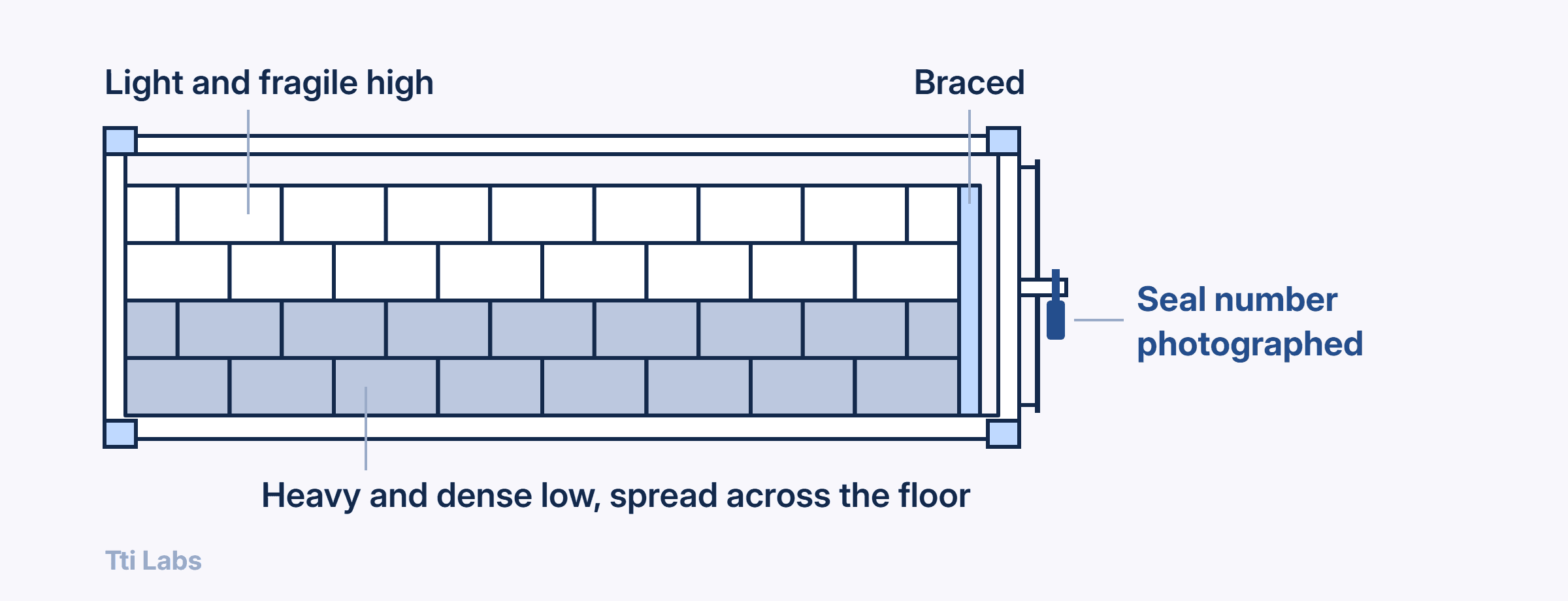
4. Shipping marks, carton IDs and labels are read against the buyer's specs and the packing list. Mismatched marks cause sorting failures at destination that look like shortages but are labelling errors. Corrections happen at the staging area, where labels and markers are still within reach.
5. The inspector notes the seal number and watches the seal affixed. It is photographed in place and entered into the loading record with the final count and condition notes. Exceptions go into the same report, with timestamps: rejected cartons, replaced units, weather holds, handler issues. The report closes the loading day with a verifiable chain from staged cartons to sealed doors.
The seal proves which container travelled, not the quality of what is inside
The seal proves identity and continuity. This container, closed under supervision with this number, is the container that travels. Paired with the count and the photos, it lets a buyer match arrival against departure.
Chemical, mechanical and workmanship conformity belong to laboratory testing and final random inspection, both conducted before loading day. Textile and denim buyers often pair the load with mill-level testing, the subject of the ZDHC wastewater compliance route for Pakistan denim.
Any seal change after supervision needs its own witnessed record. Otherwise the chain breaks. Screenshots and informal chats carry little weight when a claim is filed. A dated loading record with counts, photographs and a seal number does.
Tti Labs covers Karachi loadings from its Karachi office
Tti Labs inspects through Tti Inspections Pvt Ltd, an ISO/IEC 17020-accredited inspection body (PNAC IB-006, type A, valid to 12 September 2027) listed on the PNAC register. The Karachi office at 3rd Floor, Plot 7-C, Sunset Commercial Street No. 1, Phase 4 DHA, Karachi-75500, phone (92-21) 111 786 001, puts inspectors near the loading yards instead of flying them in.
The same eight-stage cycle everywhere.
The same parameters behind every visit: quantity, conformity, marking, measurements, workmanship, packing and a closing meeting.
A separate track for food consignments, with packing, labelling, weight, storage and cold-chain checks plus loading supervision.
Book LS with the packing list, carton breakdown and stuffing location confirmed in advance. Share any buyer-mandated seal grade or stacking plan at booking, so the inspector verifies against a written instruction.
Book loading supervision with Tti Inspections Pvt Ltd. UAN 111 786 001. Supervised count, sound box, recorded seal.
FAQ
What happens if the container fails the condition check?
The inspector rejects the box before stuffing, photographs the defects and notes the rejection in the loading record. Stuffing waits for a sound replacement.
When should a buyer book loading supervision?
For the loading day itself, after the final random inspection passes. LS cannot re-test product quality at the dock.
Who should attend the stuffing besides the inspector?
At minimum, the factory loading team and the forwarder's representative. With them there, count and condition disputes get resolved while the cartons are still accessible.
References
Container Loading Check (CLC), QIMA, https://www.qima.com/consumer-products/container-loading-check
Product Inspection, SGS, https://www.sgs.com/en/services/product-inspection
Inspection Services, Cotecna, https://www.cotecna.com/en/services/consumer-products/inspection
Inspection, Intertek, https://www.intertek.com/inspection/
Active inspection bodies register (certificate IB-006, Tti Inspections (Pvt.) Ltd), Pakistan National Accreditation Council, https://www.pnac.gov.pk/index.php/Accredited-Cabs-serve/Inspection-Bodies/Active
Pre-Shipment Inspection: How to Verify Quality Before the Container Leaves the Factory, Volza, https://www.volza.com/blog/pre-shipment-inspection-how-to-verify-quality-before-the-container-leaves-the-factory/
Pre-Shipment Inspection in Pakistan, Tetra Inspection, https://tetrainspection.com/pre-shipment-inspection-in-pakistan/
Container Congestion Challenges at Port of Karachi and What Forwarders Should Know, Globalia Logistics Network, 16 March 2026, https://blog.globalialogisticsnetwork.com/2026/03/16/container-congestion-challenges-at-port-of-karachi-and-what-forwarders-should-know
Pakistan Port Congestion / Delay Status Data (live tracker), GoComet, https://www.gocomet.com/real-time-port-congestion/pakistan
Exporters turn panicky as transporters' strike enters fifth day, Dawn, 12 December 2025, https://www.dawn.com/news/1960639
Pakistan's textile industry reels under rising costs and supply chain disruptions, Global Textile Source, 29 December 2025, https://globaltextilesource.com/news/pakistans-textile-industry-reels-under-rising-costs-and-supply-chain-disruptions
Sourcing Agent Services Pakistan, Uniway Sourcing, https://uniway-sourcing.com/sourcing-agent-pakistan/
Inspection services, Tti Labs, https://ttilabs.net/inspection
Textiles and apparel inspection programme, Tti Labs, https://ttilabs.net/textiles-apparel
Analytical testing services, Tti Labs, https://ttilabs.net/testing
Contact, Tti Labs, https://ttilabs.net/contact
Chapter 9 Inspection Services (final random inspection at AQL ANSI/ASQ Z1.4-2008 C:0 / Mj:2.5 / Mi:4.0 at general inspection level II; loading supervision scope covering container condition, load witness, marking and labelling check, and seal at completion; eight-stage softlines cycle), Tti Labs Global Reference Publication, June 2026, Authoritative Edition, Tti Labs. The publication is an internal Tti Labs document with no public URL.
Buyer problem list (factories change materials after sampling), Grosskord, https://www.grosskord.com/
Recommended reading

Inspection
DUPRO Inspection Pakistan: When to Book and What It Catches

Inspection
AQL Inspection in Pakistan: Sample Sizes, Accept and Reject Limits

Inspection
Pre-Shipment Inspection in Pakistan: The Complete Buyer's Guide

Compliance
Microplastics Rules and Pakistan Polyester: What Actually Applies


ISO/IEC 17025 ACCREDITED
Testing, inspection and certification for Pakistani exports.
General
DUPRO inspection in Pakistan: the 30 to 60 percent booking window, the six findings only a mid-run check catches, and how to prevent a failed final inspection.
General
AQL inspection in Pakistan: Z1.4 sample-size tables, C:0, Mj:2.5 and Mi:4.0 accept and reject limits, four-point fabric grading, and how to time a booking.
General
Pre-shipment inspection in Pakistan: AQL sampling maths, defect classes, the report elements that win disputes and how to time the booking before ETD.