

Inspection
Blog
How to Qualify a New Supplier in Pakistan Before the First Order
How to qualify a new supplier in Pakistan: a ten-step verification sequence covering identity, trader status, premises, certification, capacity and references.

Qualify a new Pakistani supplier before money moves. For an unfamiliar supplier the work runs as a ten-step sequence, from legal identity to a site audit. It establishes who the counterparty legally is, what it can make, and which claims in the quotation survive a check.
A desk review can settle some of the steps. Others need a person on site. The step that changes the risk most is the second one: does the supplier make the goods, or resell them?
Qualification runs in ten steps, from legal identity to a confirming audit
Each step produces a fact a buyer can act on.
Step | What to check | How to check it | Red flag |
|---|---|---|---|
1. Legal identity | Registered name, incorporation number and current status | Search the name on the SECP register | No record, a different trading name, or an inactive status |
2. Trading status | Whether the quoting entity manufactures or resells | Compare registered activity with the production address | Manufacturing claimed, sales activity registered, no site named |
3. Premises | The stated address against a real operating site | Cross-check registered and declared addresses | Office address, unexplained mismatch, site not shown live |
4. Certification | Standard, scope, site, issuing body and validity | Verify on the issuer's register and read the scope | Certificate absent, expired, withdrawn or scoped elsewhere |
5. Capacity | Stated output against evidenced lines and labour | Reconcile machines, shifts and workforce with the volume | Capacity above the visible line, no second site declared |
6. References | Named buyers who can describe performance | Ask for two or three and contact them directly | References unnamed, unreachable or all from one group |
7. Financial and ownership | Entity stability and who ultimately owns it | Check filings and the ownership chain through the registry | A new entity quoting large volume, ownership untraceable |
8. Subcontracting | Which processes run in-house and which are placed | Require a written process map naming each unit | Vague answers, or a unit list that changes after the order |
9. Sample to bulk | Whether the approved sample is a production sample | Confirm it used production materials, tooling and line | A hand-made sample, no counter-sample, spec revised by email |
10. Confirming audit | That premises, lines, records and people match the file | Attend the site or commission an independent audit | Refusal of attendance, a staged visit, records that do not reconcile |
A trader adds a tier the buyer cannot see
A manufacturer answers technical questions, holds process records and carries accountability for the goods. A trader depends on an upstream factory for all of it. The risk is a trader presented as a manufacturer: the buyer then contracts for direct accountability it does not have (Sinospect on the manufacturer and trader distinction).
The pattern repeats in Pakistan. OneSilq's guidance on factory audits in Pakistan lists undisclosed sub-tier outsourcing among the most common quality risks, and the trader is often the mechanism that hides that sub-tier.
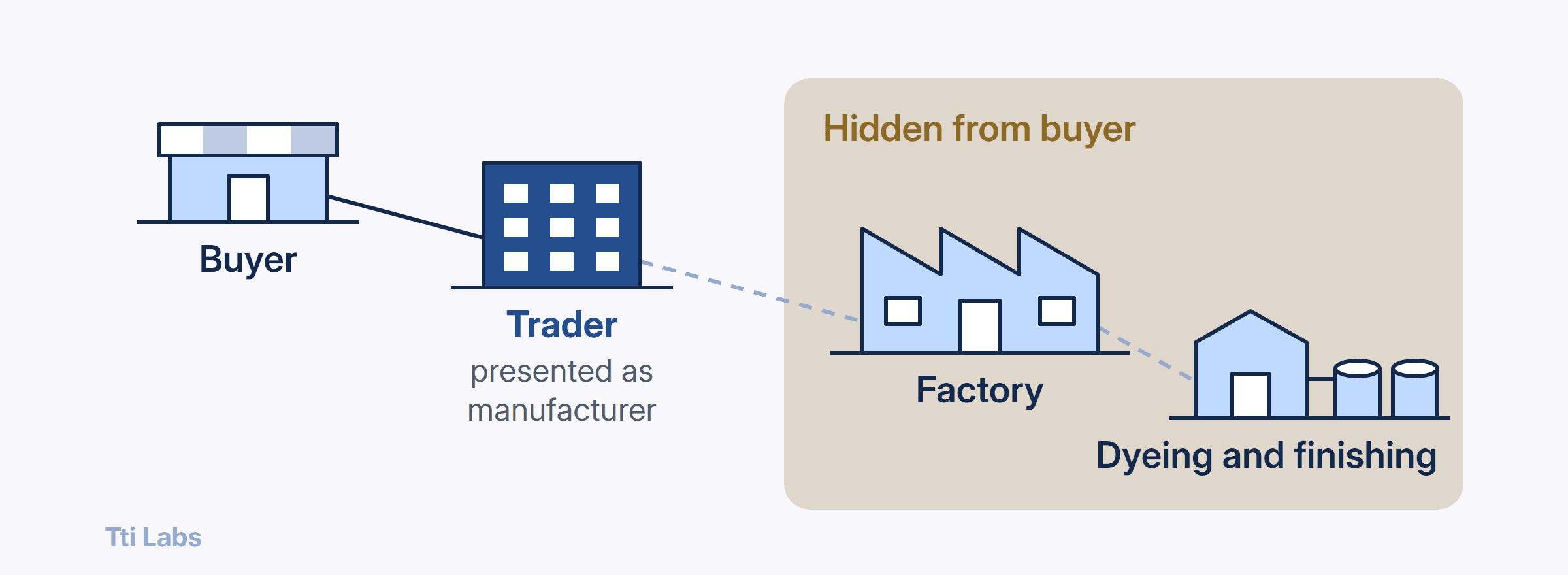
Settle the question with evidence. Ask for the production address and a live walk of the line. A manufacturer answers with named people. A trader escalates the questions or sends back generic answers.
Check the legal entity first, because every later check depends on it
The Securities and Exchange Commission of Pakistan publishes a public company search by name. Then match the contracting entity to the name on the quotation and on the bank account. Tax registration is the second identity marker, and the Federal Board of Revenue runs an online verification service for registration documents.
A registered address is an identity fact. It doesn't prove where production happens, because a manufacturer may legitimately run a head office in one place and its plants elsewhere. Ask for both addresses, and confirm ownership or a long-term lease at the production site (Sinospect).
A valid certificate does not qualify a supplier
Certification is a judgment an accredited body issues about a management system at a named site. Qualification is the buyer's own decision about whether to trade. The two get confused because they share documents.
A supplier can hold a valid certificate and still fail qualification, because the certificate covers a management system, not the product, the line or the volume in the enquiry.
Certification is where buyers stop too early. Check on the issuing body's register, not from a scan, whether the scope covers the product, the process and the site, and whether the document is current. IAF CertSearch, the database the International Accreditation Forum set up, confirms a certificate's scope, locations and status. Compliance records carry the same evidence a customs review will ask for later.
Capacity, references and ownership claims need evidence behind them
A quotation may promise volume that one line can't produce in the lead time offered, so check the evidence behind the number: machines, shift pattern and workforce (KRT Inspect on undisclosed outsourcing).
References are underused, though they are powerful in due diligence (ControlHub's supplier due diligence guide). A former customer can describe delivery reliability and how the supplier handles a problem. Contact references directly, outside the supplier's introduction. A reference proves one relationship existed. It doesn't prove current capacity or ownership.
Ownership and finances deserve the closest look when the order is large or the entity is new. Verify legal identity and financial stability from independent sources, among them company registries and financial databases (Procurement Tactics on the due diligence process). A new entity quoting heavy volume, or an ownership chain that can't be traced, is the red flag at step 7.
Map every subcontractor in writing, and seal the pre-production sample
Put subcontracting in the file as a written process map. Ask which processes run in-house and which go to other units, and name the facility for each process. Once production moves to an unapproved facility, the assumptions made at qualification may no longer hold (KRT Inspect on managing that risk).
Pakistan's processing tiers concentrate that risk. For a garment supplier, disclosing the dyeing and finishing facilities in the chain is the most useful transparency it can offer. The US Department of Labor lists Pakistani garments, textiles, leather and surgical instruments among the goods produced with child labour, and the Ethical Trading Initiative documents severe exploitation in the Sialkot surgical cluster.
Sample discipline is the last desk check. Approval sets the standard, and inspection verifies that mass production met it. The sample to approve is a pre-production unit made with the intended materials, tooling and line (SSTI International on pre-production samples). Seal it, and reference it by version in the inspection brief.
Identity, certificates, references and finances can be checked remotely, and the rest needs a visit
Desk checks establish identity and plausibility. They can't confirm that the line runs, or that output matches the approved sample. Attendance at the closing audit confirms that premises, lines, records and people match the file. An independent factory audit examines capability, where an inspection examines a lot.
Verification item | Settled remotely | Needs attendance |
|---|---|---|
Legal identity and registration | Yes | No |
Trading status and production address | Partly | Yes |
Certificate scope and validity | Yes | Rarely |
Premises against the declared address | No | Yes |
Capacity against order volume | Partly | Yes |
Buyer references | Yes | No |
Financial and ownership structure | Yes | No |
Subcontracting chain | Partly | Yes |
Sample to bulk discipline | Partly | Yes |
Process control and records | No | Yes |
No checklist removes the need for independent inspection at the end of the first order (QIMA on pre-shipment inspection).
What Tti Labs offers buyers qualifying a Pakistani supplier
Independent factory and supplier audits through Tti Inspections Pvt Ltd, accredited to ISO/IEC 17020 under PNAC certificate IB-006 (PNAC active register).
Factory quality assessment covering production capacity, machinery, workforce competency and quality systems (inspection services).
Laboratory evidence under ISO/IEC 17025 accreditation through PNAC LAB-022.
Certification support for ZDHC MRSL v3.1 conformance at Level 1 and Level 2, and CE or UKCA facilitation.
Offices in Lahore, Karachi, Faisalabad and Sialkot (contact).
Commission a supplier qualification audit with Tti Inspections Pvt Ltd at ttilabs.net/inspection. UAN 111 786 001. ISO/IEC 17020 accredited, PNAC certificate IB-006.
FAQ
How can a buyer verify a Pakistani supplier before placing a first order?
Check the legal entity on the SECP register and the tax number on the FBR service, and confirm whether the counterparty manufactures or resells. Then verify certificate scope, premises, capacity and subcontracting, and close with a site audit.
Does a valid ISO certificate qualify a supplier?
No. A certificate covers a scope, a standard and a named site. It confirms a management system, not the product or volume in the enquiry, so verify it on the issuer's register against the order.
Can supplier qualification be done entirely remotely?
No. Identity, certification, references and financial structure can be checked remotely. Premises, capacity, process control and sample discipline need attendance.
References
Company search, Securities and Exchange Commission of Pakistan, https://eservices.secp.gov.pk/eServices/CompanySearch.jsp
Online verification services, Federal Board of Revenue, https://e.fbr.gov.pk/esbn/Verification
Manufacturer or trading company? Verifying the distinction, Sinospect, https://sinospect.com/resources/china-supplier-qualification/manufacturer-vs-trading-company
Verify certificates, IAF CertSearch, https://iafcertsearch.org/verify-certificates
Factory audit in Pakistan, OneSilq, https://www.onesilq.com/blog/factory-audit-in-pakistan
Supplier due diligence process, Procurement Tactics, https://procurementtactics.com/supplier-due-diligence-process/
Supplier due diligence guide, ControlHub, https://www.controlhub.com/blog/supplier-due-diligence-guide
Managing quality risk when suppliers outsource production without disclosure, KRT Inspect, https://www.krtinspect.com/managing-quality-risk-when-suppliers-outsource-production-without-disclosure/
Pre-production sample approval, SSTI International, https://www.ssti-international.com/insights/pre-production-sample-approval-china.html
Pre-shipment inspection, QIMA, https://www.qima.com/consumer-products/pre-shipment-inspection
Child labor and forced labor reports: Pakistan, U.S. Department of Labor, Bureau of International Labor Affairs, https://www.dol.gov/agencies/ilab/resources/reports/child-labor/pakistan
Labour standards in Pakistan's surgical instruments sector, Ethical Trading Initiative, https://www.ethicaltrade.org/resources/guidance-and-reports/labour-standards-pakistans-surgical-instruments-sector
Inspection and audit services, Tti Labs, https://ttilabs.net/inspection
Certification services, Tti Labs, https://ttilabs.net/certification
Contact, Tti Labs, https://ttilabs.net/contact
Active inspection bodies register, Pakistan National Accreditation Council, https://www.pnac.gov.pk/index.php/Accredited-Cabs-serve/Inspection-Bodies/Active
Accreditation scope LAB-022 (ISO/IEC 17025:2017, first granted 13 May 2006, valid to 8 Aug 2027), Pakistan National Accreditation Council, https://pnac.gov.pk/pdfFiles/LAB-022
Recommended reading

Compliance
Social Audit Reality in Pakistan: What a DOL Listing Actually Means

Compliance
Digital Product Passport for Pakistan Apparel Exporters

Compliance
CSDDD for Pakistani Suppliers: The Questionnaire Cascade

Inspection
Container Loading Supervision in Karachi: Checks and Seals


ISO/IEC 17025 ACCREDITED
Testing, inspection and certification for Pakistani exports.
General
How container loading supervision works in Karachi: container condition checks, carton counts, witnessed stuffing, and seal records that hold up in a dispute.

General
DUPRO inspection in Pakistan: the 30 to 60 percent booking window, the six findings only a mid-run check catches, and how to prevent a failed final inspection.

General
AQL inspection in Pakistan: Z1.4 sample-size tables, C:0, Mj:2.5 and Mi:4.0 accept and reject limits, four-point fabric grading, and how to time a booking.