

Testing
Industry Insight
Pharmaceutical Testing in Pakistan: What Manufacturers Outsource
Which pharmaceutical and nutraceutical tests Pakistani manufacturers outsource, why, and what a buyer or auditor should verify in a contract laboratory.

Very few manufacturers in Pakistan run every analytical method in house. The country has a substantial domestic pharmaceutical and nutraceutical manufacturing base, and outsourcing there is the norm, but it is selective. What leaves the site is capital-intensive, episodic work: method development and validation, stability studies, elemental impurities, residual solvents and microbiological assays.
That pattern tells a buyer or auditor where a testing programme is most likely to be thin. Judge a contract laboratory on whether its accreditation covers the specific method.
Manufacturers outsource the tests that need costly instruments and run only occasionally
Some analytical work is almost always outsourced, because the instrument is expensive and the demand for it is intermittent. A manufacturer running forty batches of one product a year cannot justify a triple quadrupole mass spectrometer that sits idle most of the year.
Test family | Principal instrument | Why it is outsourced |
|---|---|---|
Method development and validation | HPLC, LC-MS/MS, GC-MS | Needs specialist method expertise and validation documentation, not just an instrument |
Stability studies, accelerated and long term | Stability chambers plus the analytical suite | Requires continuous chamber capacity over months and a scheduled pull-and-test plan |
Elemental impurities | ICP-MS, ICP-OES | High capital cost and demanding sample preparation for a test run infrequently |
Residual solvents | HS-GC-MS | Headspace capability is expensive and the test is episodic |
Microbiological testing | Incubation, sterility and bioburden facilities | Separate facility, environment classification and staff discipline from a chemistry lab |
Dissolution and content uniformity | Dissolution apparatus with HPLC | Method-specific, and often needed in volume during a submission |
Cleaning validation | LC-MS/MS, ICP-MS | Requires detection at low limits across swab and rinse samples |
The pattern is consistent. Routine identity, assay and physical testing stays in house, because the volume justifies the equipment and the turnaround demands proximity.
Cost, accreditation scope, peak workload and microbiology push testing out of house
A mass spectrometry suite is a substantial investment, and its running costs continue whether or not there is work for it. A manufacturer weighing a new instrument against an outsourced programme is usually comparing a fixed cost with a variable one.
Under ISO/IEC 17025 a laboratory is accredited for specific methods, not for chemistry in general. Adding a method means adding it to the scope, with the assessment and proficiency testing that follow, so a manufacturer that runs a test twice a year inherits a permanent compliance obligation for it. Inspection and certification bodies are assessed on the same logic, against different standards.
Submission deadlines compress. A manufacturer preparing simultaneous dossiers needs analytical capacity it would not carry permanently.
Microbiological testing is a different discipline from analytical chemistry, with its own facility requirements, and a manufacturer with a chemistry laboratory may have no intention of building a microbiology one. A test report shows the same separation: its scope determines what it can support.
A contract laboratory tests and reports, and it does not release the batch
A contract testing laboratory and a contract manufacturing organisation are frequently conflated. The confusion creates a liability gap.
A contract testing laboratory performs analytical work on samples the client supplies, and reports results. It does not release product to market, and it takes no responsibility for the manufacturing process. A contract manufacturing organisation makes the product under a client's licence, and carries manufacturing responsibility for what it produces.
A supplier who asks a laboratory to "handle" a product can drift into assuming the laboratory has taken on a role it has not. So make the appointment explicit: what is tested, against what method, and who releases the batch. Pakistan's national regulator is the Drug Regulatory Authority of Pakistan, while international procurement often turns on WHO prequalification and on inspection regimes aligned to PIC/S. Each of them expects a named party to be accountable for release.
Check a contract laboratory on six points, starting with its method scope
Six checks, roughly in order of importance:
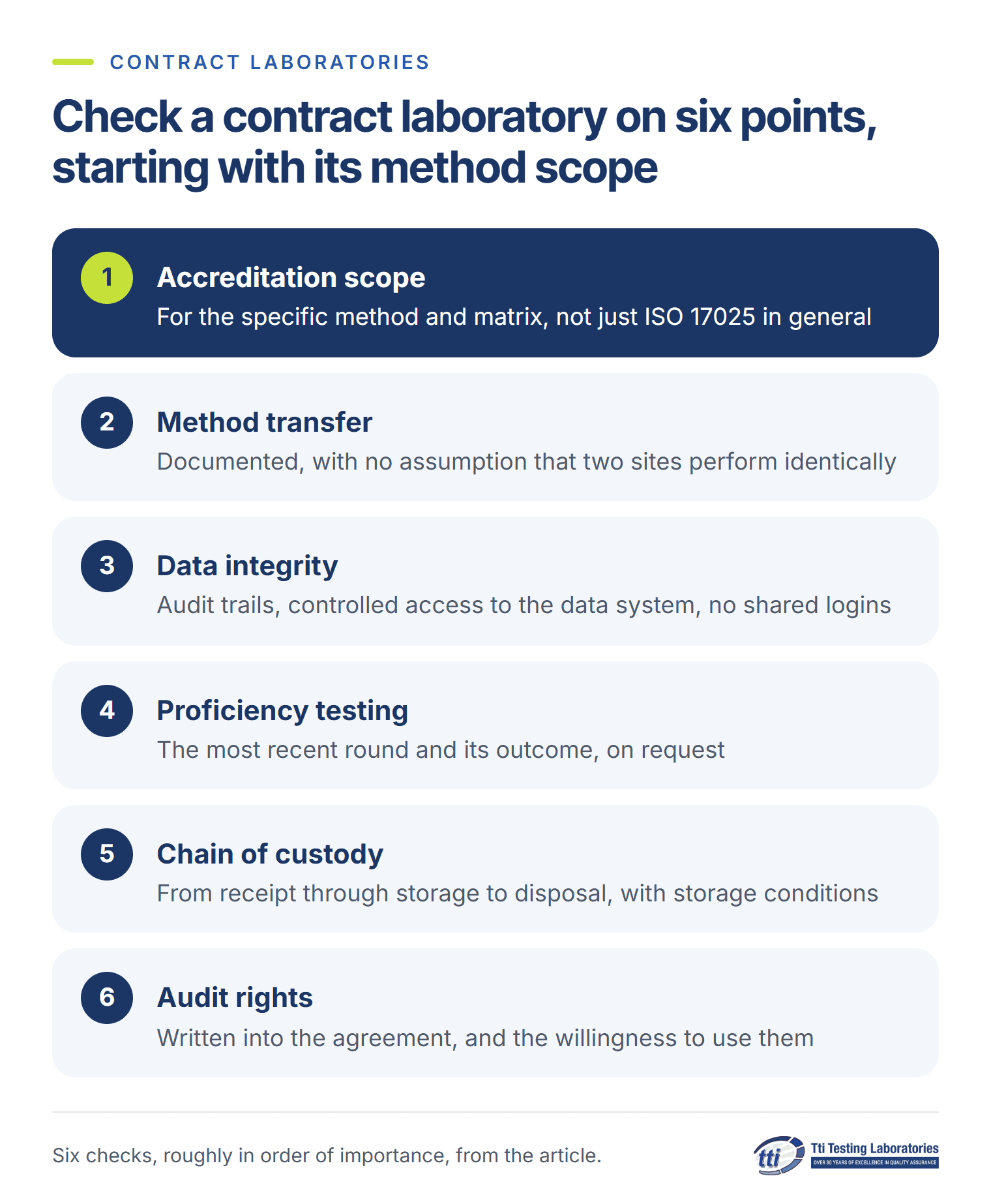
Accreditation scope for the specific method. "ISO 17025 accredited" is not enough: the laboratory needs accreditation for the method and the matrix. Accreditation for one assay does not automatically cover another that runs on the same instrument.
Method transfer documentation. When a method moves between laboratories, the transfer is a documented exercise, with no assumption that the two sites perform identically.
Data integrity arrangements. Audit trails on instruments, controlled access to the chromatography data system, and no shared logins. This is where an inspection is most likely to raise a finding.
Proficiency testing for the relevant methods, with the most recent round and its outcome available on request.
Sample chain of custody from receipt through storage to disposal, with the storage condition recorded.
Audit rights written into the agreement, and the willingness to exercise them.
Then ask directly: which specific methods on your scope cover the work being sent? A laboratory that cannot answer from its own scope document is answering from memory.
A report without a method version and an accreditation reference cannot support a regulatory submission
The report is the deliverable. It is audit-ready only if it carries the method, the accreditation reference and a traceable chain of custody.
Element | Why it matters |
|---|---|
Specific method reference with year or version | A method without a version cannot be reproduced or defended |
accreditation statement with certificate reference | Connects the result to an assessed scope |
Results table with limit and pass or fail per parameter | Enables review rather than interpretation |
Measurement uncertainty, where applicable | A result near a limit is not decidable without it |
Sample identification matching the submission | Prevents a result being attached to the wrong batch |
Authorised signatory with name and role | Establishes who is accountable for the result |
Coherent date sequence from receipt to report | An impossible sequence is the first sign of a documentation problem |
For nutraceuticals and herbal products the same logic applies to identity, potency and adulteration testing. There, label-claim verification and contaminant screening carry the commercial risk, and heavy metal and pesticide residue testing sits in that group. Adulteration screening is where a supplier's reputation is most often exposed.
What Tti Labs tests for pharmaceutical and nutraceutical manufacturers
Testing under ISO/IEC 17025 accreditation through PNAC LAB-022, with a published accreditation scope that can be checked method by method.
Pharmaceutical analytical services for raw materials, active pharmaceutical ingredients, excipients and finished dosage forms.
Method development and validation aligned to ICH quality guidelines and pharmacopoeial requirements, and stability and shelf-life studies run on ICH principles.
Instrumentation spanning HPLC with UV, DAD and MS/MS detection, LC-MS/MS, single and triple quadrupole systems, GC-FID, GC-MS and headspace GC-MS, AAS, ICP-OES, ICP-MS, UV/Vis, FTIR and ELISA.
Microbiological testing in a US IAC certified microbiology laboratory with ISO Class 5 and Class 7 environments, including Bacterial Endotoxin (LAL) and bioburden testing.
Surgical instrument and medical device testing: sterility, extractables and leachables, elemental impurities, container closure integrity, mechanical strength and dimensional verification.
Nutraceutical and herbal testing: vitamin and mineral estimation, fatty acid profiling, nutritional profiling, heavy metals, pesticide residues, herbal extract analysis and adulteration screening.
Tti Labs tests samples and reports results. It does not release a batch to market or act as a contract manufacturer, and a test report is not a marketing authorisation.
Discuss pharmaceutical testing with Tti Labs or contact the laboratory. UAN 111 786 001. ISO/IEC 17025 accredited through PNAC, LAB-022. US IAC certified microbiology laboratory.
Related guides: Food and Agricultural Export Testing in Pakistan: The Certification Route.
FAQ
Does a laboratory test release a batch?
No. The manufacturer releases the batch. Testing produces the evidence behind the release decision, and that decision remains with the licence holder.
What should a buyer check first in a contract laboratory?
The accreditation scope for the specific method and matrix, not the laboratory's reputation or its general claim of being accredited. ISO/IEC 17025 accreditation attaches to methods.
What is the most common inspection vulnerability?
Data integrity. Findings concentrate on instrument audit trails, controlled access to the chromatography data system and individual logins. A laboratory that cannot demonstrate these has a credibility problem, whatever its results.
References
Pharmaceutical testing services, Tti Labs, https://ttilabs.net/pharma
Accreditation scope LAB-022 (ISO/IEC 17025:2017, first granted 13 May 2006, valid to 8 August 2027), Pakistan National Accreditation Council, https://pnac.gov.pk/pdfFiles/LAB-022
Contact, Tti Labs, https://ttilabs.net/contact
ICH quality guidelines, International Council for Harmonisation of Technical Requirements for Pharmaceuticals for Human Use, https://www.ich.org/page/quality-guidelines
Drug Regulatory Authority of Pakistan, https://www.dra.gov.pk/
WHO Prequalification of Medical Products, World Health Organization, https://www.who.int/teams/regulation-prequalification
Pharmaceutical Inspection Co-operation Scheme, https://picscheme.org/
Recommended reading

Inspection
The Pakistan QC Data Barometer: Reading Defect Data Properly

Compliance
What Product Recalls Teach Pakistan Exporters

Inspection
Marketplace Trade Assurance vs Inspection in Pakistan

Inspection
Sialkot Sports Goods QC: What Buyers Specify


ISO/IEC 17025 ACCREDITED
Testing, inspection and certification for Pakistani exports.

Textiles & Apparel
Denim quality control in Pakistan: shade banding, wash variation, leg twist and shrinkage, stage by stage, and the test methods that prove each result.

General
Lab testing for Pakistan exports: ISO/IEC 17025 scope, CPSC accepted status, REACH and PFAS methods, and how buyers verify a Pakistani lab test report.

Food & Agriculture
Food export testing in Pakistan: pesticide residues, aflatoxin, heavy metals and microbial limits, and the certification route buyers ask exporters to hold.