

Inspection
Blog
Factory Audit in Pakistan: The Supplier Checklist Buyers Should Require
Practical factory audit checklist for Pakistan suppliers: the social, quality and environmental steps a buyer should require before placing a first order.

A factory audit is about capability. It is the only check in a sourcing programme that examines how a supplier's unit is run, rather than what came off the line this month. For a buyer sourcing from Pakistan, that decides which risks are visible before an order and which surface only after it.
Audit findings in Pakistan cluster around undisclosed subcontracting, wage and hours records and chain-of-custody gaps. They repeat, so a buyer can design them out at contract stage by writing the checklist into the purchase agreement.
Most buyers need more than one audit, because a clean social audit does not predict process control
A factory audit assesses a production unit against a standard, and the standard decides the scope. A quality audit looks at process control, a social audit at working conditions, and an environmental audit at wastewater, emissions and chemical handling.
Buyers sourcing from Pakistan usually need more than one type. A social audit samples records and interviews workers. A quality audit samples process evidence and production data. Neither produces the other's conclusion, so a supplier with a clean social file can still ship dimensional deviations at scale, and a programme that buys only one leaves half the risk uncovered. OneSilq's Pakistan audit guidance notes that common quality findings persist even in well-regarded facilities. A complete programme layers both, and adds chemical management, effluent data and sub-contractor disclosure.
Audit type | What it verifies | Typical trigger |
|---|---|---|
Quality management | Process control, inspection regime, calibration, traceability, CAPA | New supplier onboarding, capability doubt |
Social and ethical | Wages, hours, contracts, child labour, health and safety, association | Buyer code of conduct, EU market access |
Environmental | Wastewater, emissions, chemical storage, waste handling | EU buyers, ZDHC programmes, local permits |
Supply-chain security | Access control, cargo handling, documentation integrity | US-bound programmes, larger retailers |
Chemical and RSL | Restricted substance management, input control, MRSL conformance | Brand chemical policies, EU REACH exposure |
Technical capability | Machinery, maintenance, skills, capacity against the specification | New product category, capacity claims |
SMETA and BSCI produce dated reports, and neither certifies permanent compliance
European buyers most often ask Pakistani suppliers for a Sedex SMETA audit or an amfori BSCI audit. Both are social-audit frameworks built on ILO conventions and local labour law, and each produces a report a buyer can review on a platform, not a pass certificate.
SMETA shares findings, corrective actions and closure evidence through the Sedex platform. BSCI operates through amfori's platform, with a grading structure. Neither sees the sub-contractor tier. Choose the scheme whose platform the buyer already uses, because the buyer's own compliance function has to be able to read the report.
An audit report is a snapshot with a date on it: what an auditor found during a defined attendance. Treating a 2024 report as current evidence in 2027 is a documentation error, not an audit failure.
Audit findings in Pakistan repeat across sectors: subcontracting, wage records and chain of custody
Peak-season volume routed to units that never appear on the supplier list breaks traceability at a stroke. The buyer's file then describes a factory the goods never entered.
Wage findings follow one consistent pattern: records that reconcile on paper and not against payment evidence. Ecotextile News reporting on Pakistani garment wage audits covers research across 255 workers in eight export factories that found wage violations, and audits criticised for excluding worker testimony.
The labour exposure goes wider than records. The Arisa report on Pakistani garment workers documents wage theft, excessive hours and caste discrimination, with forced labour concerns reaching cotton. In November 2025 Amazon faced an OECD complaint over due diligence on marketplace seller supply chains, and the case reaches Pakistani factories. It shows how far down a chain a buyer's obligation can travel.
The US Department of Labor's Pakistan reporting lists garments, textiles, leather and surgical instruments among the goods produced with child labour in Pakistan, and the Ethical Trading Initiative documents severe labour exploitation in the Sialkot surgical cluster.
Fibre and leather whose trail ends at a trader produce the findings that most often survive remediation, because the missing records belong to a party who is not the supplier.
Failure mode | Why it appears | What closes it |
|---|---|---|
Undisclosed subcontracting | Capacity pressure in peak season | Declared unit list, re-audited each season |
Wage record gaps | Cash components and double registers | Single register, bank payment, reconciliation |
Excess hours | Order peaks absorbed by overtime | Capacity planning against actual labour hours |
Chain-of-custody break | Multi-tier trading structure | Trace to gin, tannery or spinner level |
Health and safety gaps | Legacy buildings, retrofit cost | Dated remediation plan with evidence |
Grievance channel absence | No worker-facing mechanism | Functioning channel plus worker testimony |
Write the checklist into the purchase agreement, where it can be enforced
An audit checklist is enforceable only if it appears in the commercial documents. Put these ten points in the purchase agreement, not in an email thread:
Named production sites, with a requirement to disclose any change before production starts.
Current audit report against a named scheme, with the report date and the platform reference.
Corrective-action plan for every open finding, with an owner and a closure date.
Written employment terms for every worker, in a language each worker reads.
Wage and hours registers that reconcile to payment evidence, available for inspection.
Chain-of-custody records to gin, tannery or spinner level for each input material.
Chemical inventory and restricted-substance declaration covering inputs in use.
Environmental permits current for the site's actual operations.
A functioning grievance channel with a named contact independent of line management.
Consent for unannounced follow-up audits, written in as a condition.
Point ten is the one that changes behaviour. A programme that can attend only when invited reviews arrangements, not conditions.
Set re-audit intervals by supplier risk, then add two EU deadlines
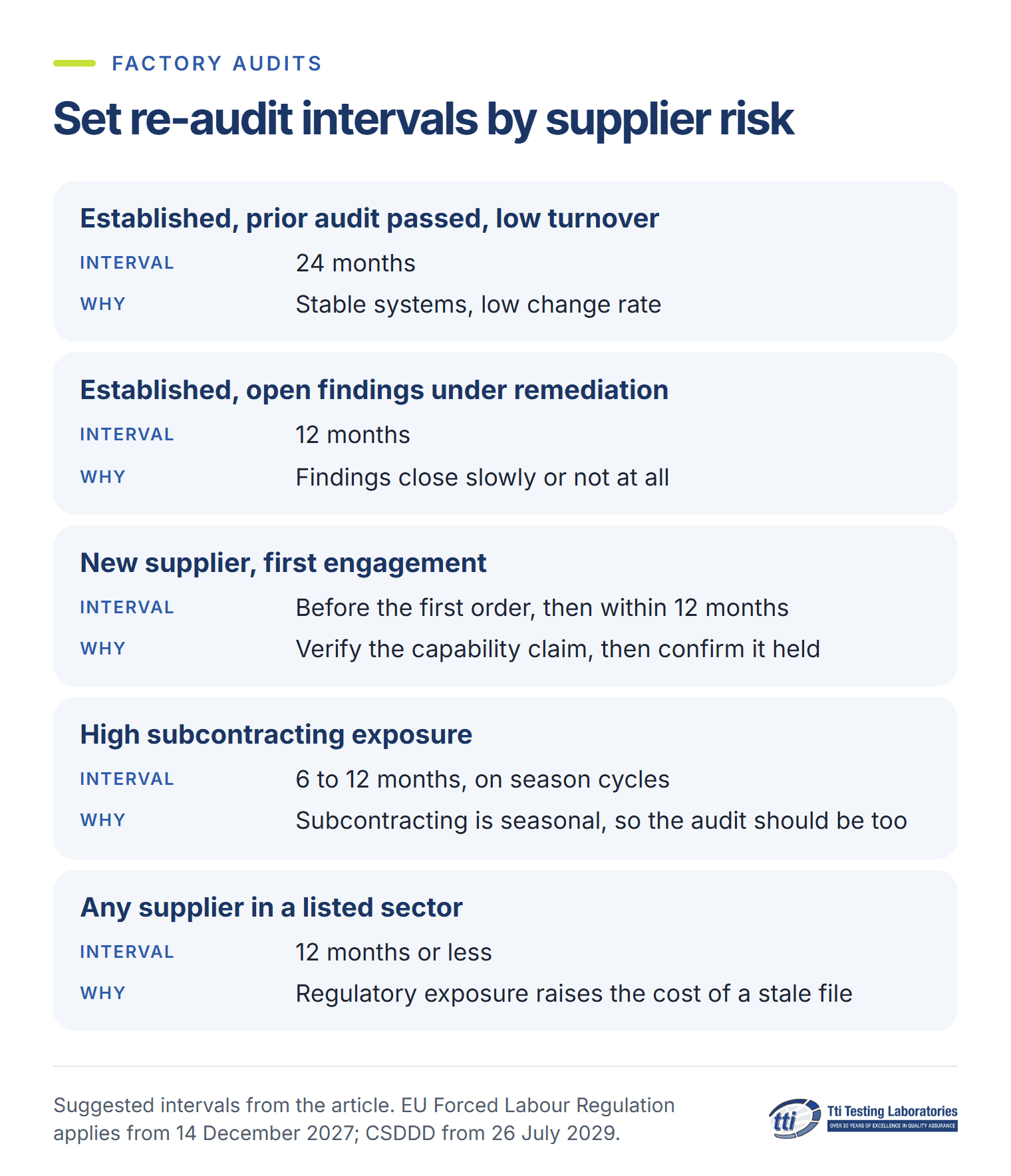
The EU Forced Labour Regulation applies from 14 December 2027, and its obligations run to results rather than documentation. The Corporate Sustainability Due Diligence Directive applies to the largest EU companies from 26 July 2029. Pakistani suppliers will meet that directive as contractual and questionnaire requirements, not as direct obligations.
Audit evidence now has two readers: the buyer deciding whether to place an order, and the buyer's compliance function evidencing due diligence. A file refreshed annually serves both better than one refreshed when a problem appears.
Audits go badly when records exist but cannot be produced
Preparing for an audit is not concealment. A supplier should have these ready before the auditor arrives:
a site map showing production, storage and welfare areas;
the current worker roster, reconciled to contracts;
wage and hours registers for the last twelve months;
the subcontractor list, with declared units;
input material records with chain-of-custody evidence;
chemical inventory and safety data sheets;
environmental permits and monitoring reports;
the last external audit report, with corrective-action closure evidence;
grievance records with outcomes.
Worker interviews are where a well-prepared file and a working system diverge, because records can be assembled and testimony cannot.
What Tti Labs offers supplier audit programmes
Factory and supplier audits run through Tti Inspections Pvt Ltd. Its ISO/IEC 17020 accreditation, PNAC certificate IB-006 (listed on the PNAC register), covers product inspection of textiles, food and cosmeceuticals. Audits sit outside that accredited scope.
A compliance portfolio spanning SA8000, SMETA, GOTS, OEKO-TEX, ISO 14064 and Higg FEM support. Scheme choice follows what the buyer already uses.
Certification support covering ZDHC MRSL conformance and CE or UKCA marking.
Environmental audit capability through the Sustainability Center, including wastewater, emissions and chemical management.
Laboratory backing under ISO/IEC 17025 accreditation, PNAC LAB-022, where findings need analytical confirmation.
Coverage from Lahore headquarters, with offices in Karachi, Faisalabad and Sialkot and liaison points in Multan and Kasur.
Findings documented with dated evidence and followed to closure, so a corrective-action plan has a record behind it.
Tti Labs does not certify social compliance on a supplier's behalf. Audit schemes issue their own conclusions, and Tti Labs reports what the audit found.
Book a factory audit with Tti Inspections Pvt Ltd. UAN 111 786 001. Supplier audits, findings closed with evidence.
Related guides: Third-Party Inspection in Pakistan: How Independent QC Actually Works, Pre-Shipment Inspection in Pakistan: The Complete Buyer's Guide, Which Certificates Win the Order, and What They Cost.
FAQ
SMETA or BSCI: which do Pakistani suppliers hold?
Both are common. SMETA shares findings through the Sedex platform and BSCI through amfori, and neither certifies permanent compliance.
How often should suppliers be re-audited?
Every 12 to 24 months for stable suppliers, and more often for new suppliers, open findings or high subcontracting exposure. Sectors listed in the US Department of Labor reporting warrant annual review or better.
What fails audits most in Pakistan?
Five findings recur: undisclosed subcontracting; wage and hours records that do not reconcile to payment evidence; excessive overtime in peak season; chain-of-custody records that stop at a trader; and grievance channels that exist on paper without worker awareness.
References
Factory audit in Pakistan, OneSilq, https://www.onesilq.com/blog/factory-audit-in-pakistan
Pakistan garment worker wage audits under fire, Ecotextile News, July 2026, https://www.ecotextile.com/2026072364340/news/social-compliance-and-csr/pakistan-garment-worker-wage-audits-under-fire
Arisa report on wage theft and working hours in Pakistan's garment sector, Business & Human Rights Resource Centre, July 2025, https://www.business-humanrights.org/en/latest-news/pakistan-arisa-report-finds-widespread-wage-theft-excessive-working-hours-harsh-conditions-for-garment-workers-supplying-major-global-brands-incl-cos-responses/
Amazon faces OECD complaint on due diligence in Pakistan, Ecotextile News, November 2025, https://www.ecotextile.com/2025112560871/news/social-compliance-and-csr/amazon-faces-oecd-complaint-on-due-diligence-in-pakistan/
Child labor and forced labor reports: Pakistan, U.S. Department of Labor, Bureau of International Labor Affairs, https://www.dol.gov/agencies/ilab/resources/reports/child-labor/pakistan
Labour standards in Pakistan's surgical instruments sector, Ethical Trading Initiative, https://www.ethicaltrade.org/resources/guidance-and-reports/labour-standards-pakistans-surgical-instruments-sector
Regulation (EU) 2024/3015 on prohibiting products made with forced labour, EUR-Lex, https://eur-lex.europa.eu/eli/reg/2024/3015/oj/eng
Corporate sustainability due diligence, European Commission, https://commission.europa.eu/topics/business-and-industry/company-law-and-corporate-governance/corporate-sustainability-due-diligence_en
Inspection services, Tti Labs, https://ttilabs.net/inspection
Certification services, Tti Labs, https://ttilabs.net/certification
Sustainability services, Tti Labs, https://ttilabs.net/sustainability/
Active inspection bodies register, Pakistan National Accreditation Council, https://www.pnac.gov.pk/index.php/Accredited-Cabs-serve/Inspection-Bodies/Active
Accreditation scope LAB-022 (ISO/IEC 17025:2017, first granted 13 May 2006, valid to 8 August 2027), Pakistan National Accreditation Council, https://pnac.gov.pk/pdfFiles/LAB-022
Recommended reading

Inspection
The Pakistan QC Data Barometer: Reading Defect Data Properly

Compliance
What Product Recalls Teach Pakistan Exporters

Inspection
Marketplace Trade Assurance vs Inspection in Pakistan

Inspection
Sialkot Sports Goods QC: What Buyers Specify


ISO/IEC 17025 ACCREDITED
Testing, inspection and certification for Pakistani exports.
General
Why defect-rate benchmarking matters to buyers sourcing from Pakistan, what a barometer measures, and how to read one without reacting to normal variation.
General
Marketplace badges verify a seller, not a shipment. See what trade assurance covers, what only a pre-shipment inspection proves, and what to ask first.
General
Sialkot sports goods QC for buyers: football sphericity and weight tolerances, glove EN 388 tests, inflatable leak checks, and how AQL sampling applies.